
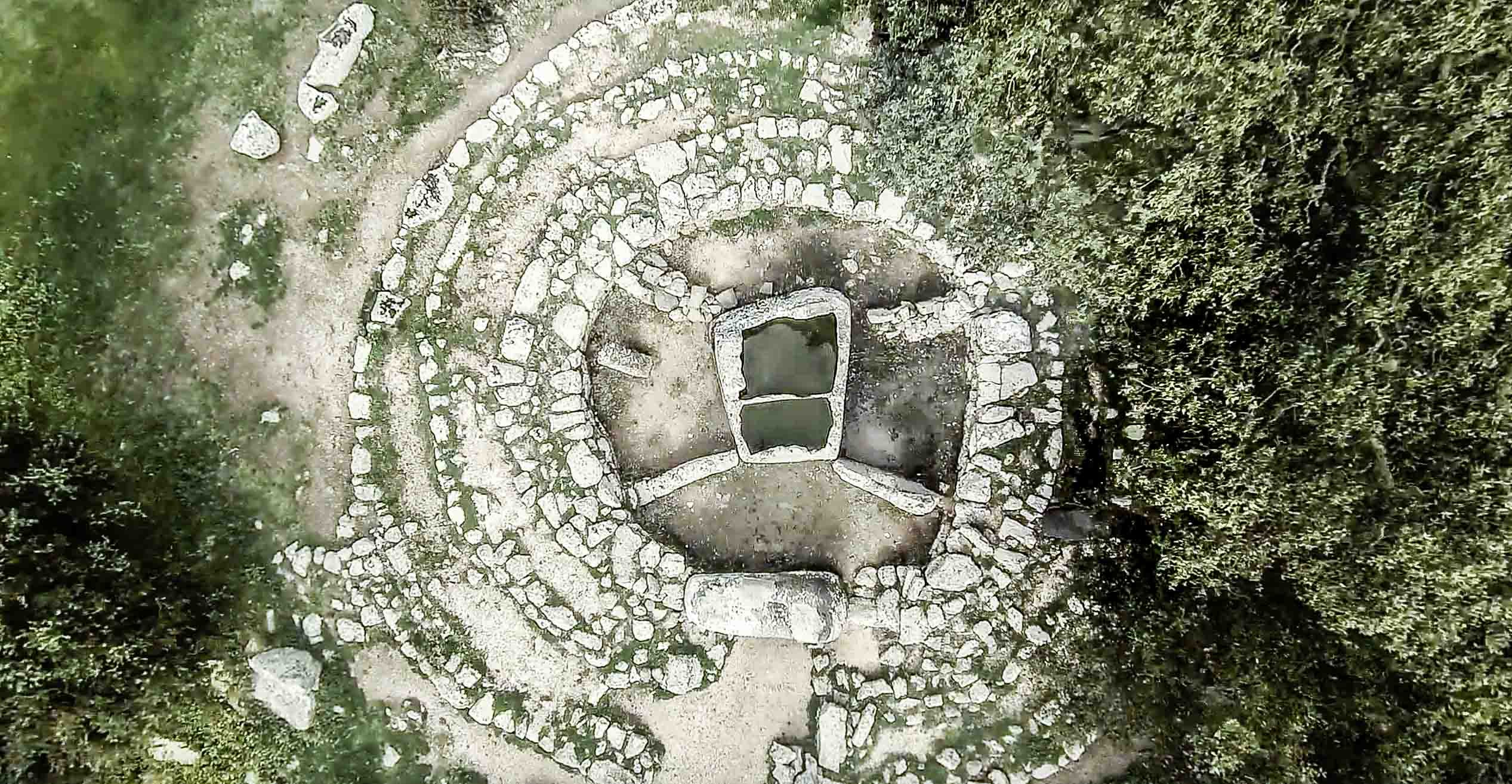
The solstice sun rises and aligns perfectly with a row of stones driven into the earth, casting long shadows over the dry grass. We are at Pranu Mutteddu, a plateau surrounded by ancient cork oak trees that guards one of Europe’s most enigmatic megalithic complexes. Often hastily labeled the "Sardinian Stonehenge," this Late Neolithic site (c. 3200-2800 BC) is actually something profoundly different. It is not a circular observatory, but a vast ceremonial necropolis where the dead rested in the shadow of over sixty menhirs (standing stones) aligned along precise astronomical axes.
Discovery Among the Cork Oaks
Until the early 1980s, the monoliths of Pranu Muttedu lay mostly knocked down or partially buried, hidden by the vegetation of the Gerrei, a rugged, hilly region in the island's southeast. It was the archaeologist Enrico Atzeni who grasped the true scale of the site, launching systematic excavation campaigns in 1980.
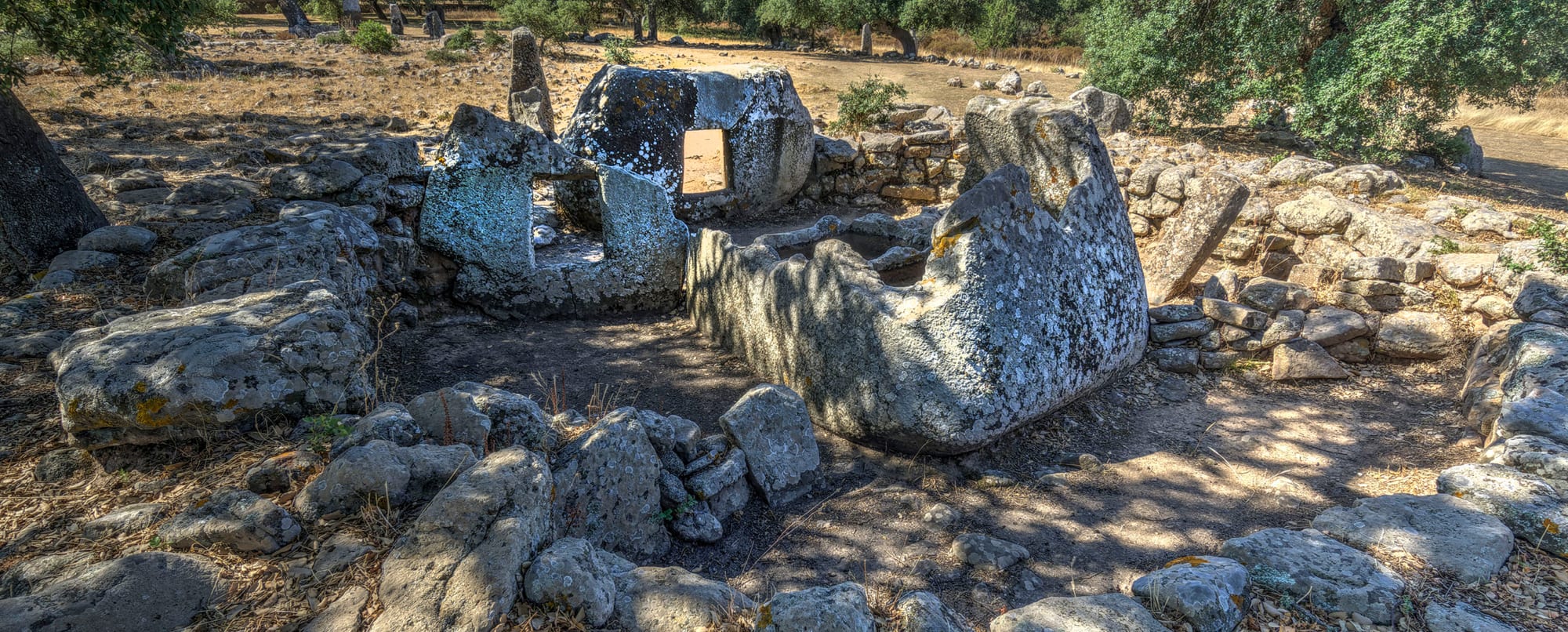
What emerged beneath the layers of soil was a funerary sanctuary covering roughly 200,000 square meters. Archaeologists found more than just stones thrust into the ground; they uncovered a rigorous spatial organization featuring monumental tombs surrounded by complex alignments of standing stones, known locally as perdas fittas.
The Menhirs: Time Carved in Stone
The hallmark of the site is its exceptional concentration of menhirs, the highest ever recorded in Sardinia. There are about sixty of them, carved mostly from local sandstone. Their arrangement is far from random:
- Straight Alignments: The primary rows run from east to west, mirroring the sun's apparent daily path.
- Shapes and Meanings: The monoliths often feature an ogival (pointed arch) shape and smoothed surfaces. Scholars debate their exact function: some suggest they represent deified ancestors guarding the burials (phallic/masculine symbolism), while others believe they marked complex astronomical cycles tied to agricultural seasons.
- The Main Cluster: The most dramatic alignment consists of twenty menhirs arranged in pairs or short rows directly associated with the monumental Tomb II.
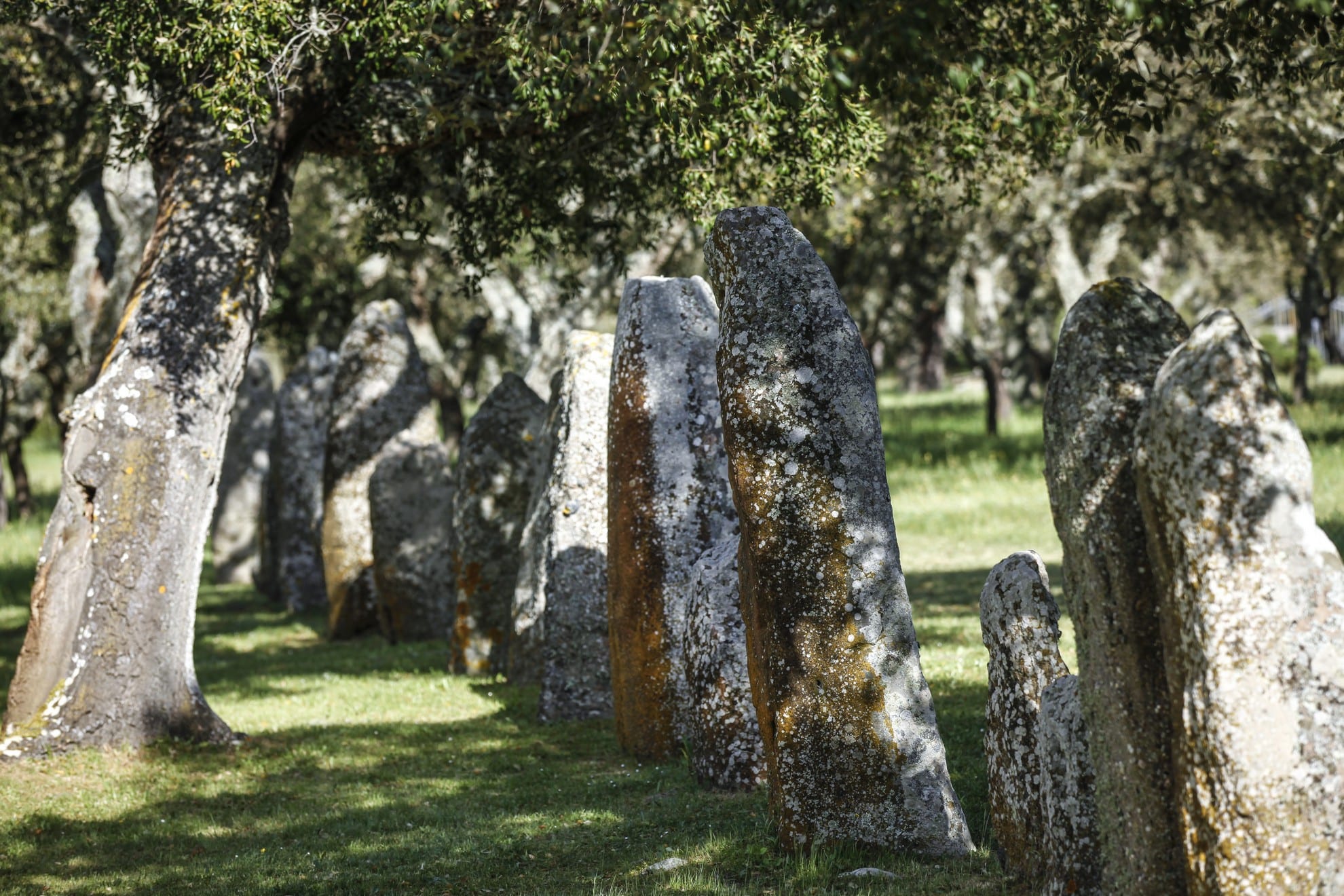 The menhir rows oriented along the east-west axis, illuminated by morning light.
Funerary Architecture: The Circular Tombs
Unlike the rock-cut domus de janas typical of the rest of the island during this period, the deceased here were buried in structures built above ground.
Tomb II, excavated by Atzeni, showcases the precise technical skill of the Ozieri culture builders. It consists of three concentric rings of stones forming a drum-like base, inside of which a burial chamber was constructed, originally topped with a corbelled dome. The entrance is marked by a pierced stone slab—a symbolic threshold between the world of the living and the dead. The wall thickness at the base demonstrates a significant engineering effort designed to endure for millennia.
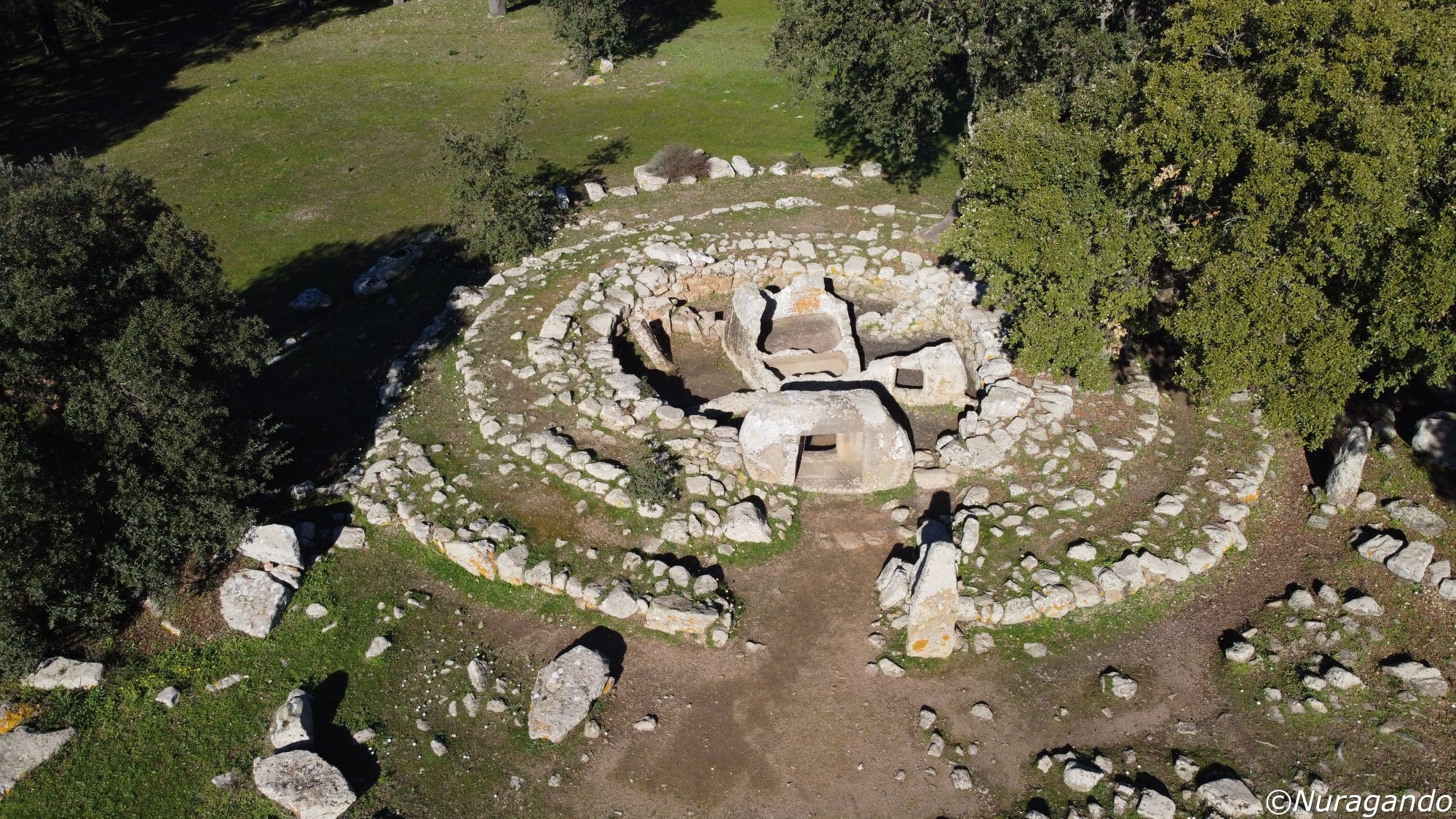 Tomb II featuring concentric stone rings and the pierced entrance slab.
How to Visit the Archaeological Park
Today, Pranu Muttedu is a well-maintained park. The walking path winds beneath the dense shade of the cork oaks, making it a pleasant visit even during the hot summer months. The site is located about two kilometers from the village of Goni, reachable in less than an hour's drive from Cagliari. Artifacts recovered during excavations, including finely decorated pottery and a small flint dagger, are housed partly in the small local museum and partly in the National Archaeological Museum in Cagliari.