Picture yourself standing on the shores of southern Sardinia on a crisp spring morning in the mid-8th century BC. On the horizon, square sails filled with the southern wind begin to appear. These are robust, round-hulled ships called gauloi, their wooden prows carved with horse heads. Aboard, you won't find heavily armed soldiers bent on territorial conquest. Instead, the crew consists of sun-beaten sailors, merchants speaking an incomprehensible Semitic tongue, and cargo holds packed with unexampled pottery, fine wine, and olive oil. These are the Phoenicians, arriving from the prosperous city-states of the Levant, in modern-day Lebanon.
For over two millennia, the arrival of the Phoenicians in Sardinia was framed through the lens of ancient mythology, often painted as a sudden, brutal colonization. Modern archaeology, however, has unveiled a reality that is far more nuanced and infinitely more fascinating: a long, gradual process that began with sporadic exploratory voyages in the 9th century BC and solidified a century later. But why embark on a perilous 2,500-kilometer journey across the Mediterranean just to anchor in Sardinia? The answer lies not in a single motive, but in a perfect storm of political pressure in the Middle East, a massive demand for metals, and the unforgiving geometry of ancient maritime routes.
The Shadow of the Assyrian Empire and the Hunger for Silver
To understand the motivations driving these Levantine sailors to Sardinian shores, we must look thousands of kilometers eastward. During the 9th century BC, the wealthy coastal cities of Tyre, Sidon, and Byblos found themselves crushed under the weight of an immensely powerful neighbor: the Assyrian Empire. The Assyrian kings, continuously funding massive military campaigns, demanded colossal tributes in silver, gold, and other precious metals. The Phoenician cities, undeniably rich but militarily weak and lacking vast agricultural hinterlands, saved themselves from annihilation by essentially becoming the maritime logistics agency of the empire. They had to source metals to pay their tribute, forcing them to sail farther and farther west.
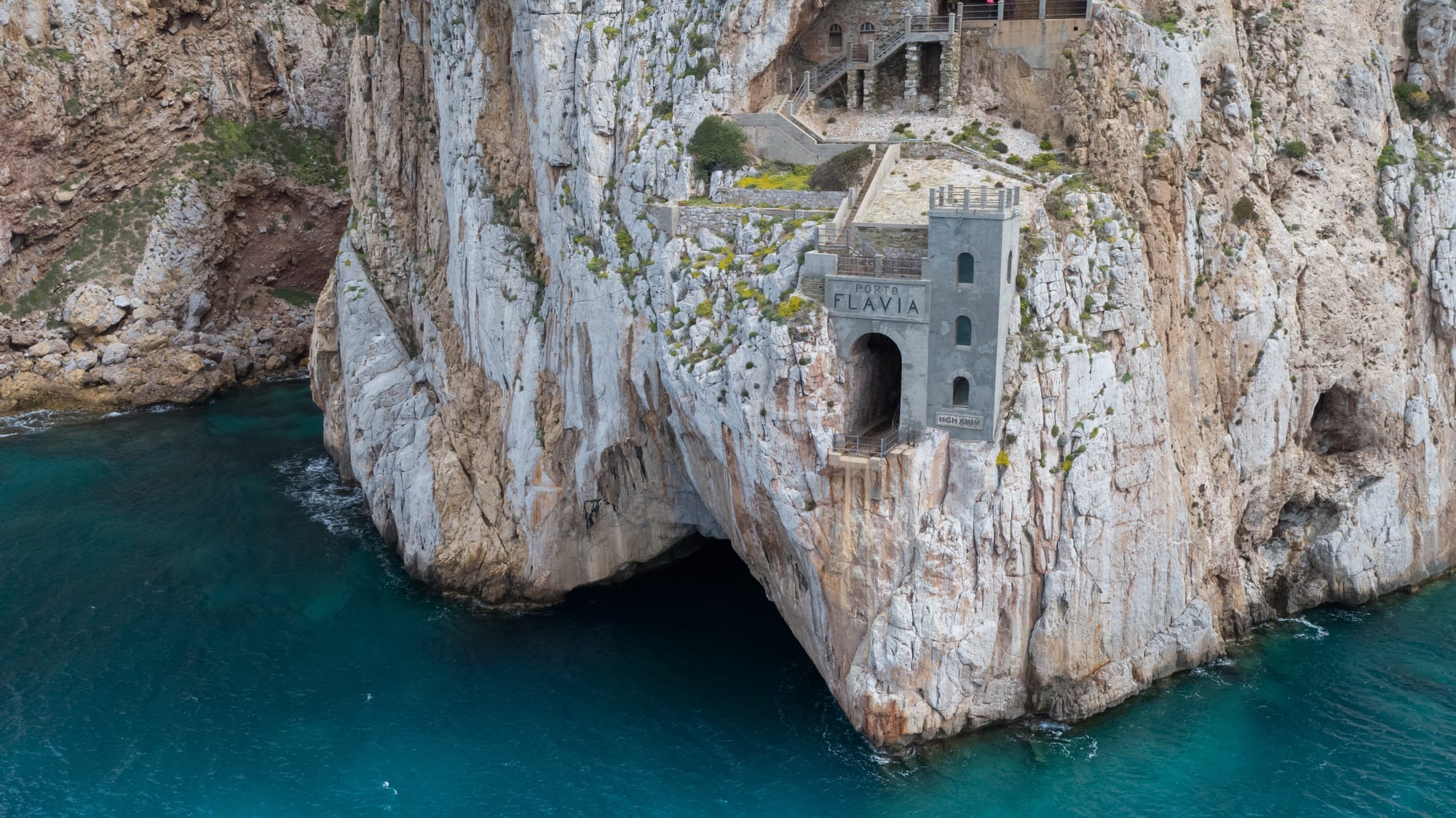
From this perspective, Sardinia was an open treasure chest in the middle of the sea. The mountains of the Sulcis-Iglesiente district, in the island’s southwest, held massive deposits of lead, iron, copper, and crucially, silver (extracted from silver-bearing galena ore). The indigenous Nuragic people—the builders of the thousands of stone towers scattered across the island—had been master metallurgists for centuries. However, their vast Bronze Age trade networks had partially collapsed around 1200 BC.
The Phoenicians didn't arrive to violently seize these mines; they lacked both the manpower and the logistical desire to fight mountain wars. They came to trade. Luxury oriental goods—fabrics dyed with the wildly expensive Tyrian purple, glass beads, fine jewelry, and superior agricultural products—were bartered for rough metal ingots brought down from the mountains by the Nuragic locals. Modern isotopic analysis of lead and silver artifacts found in the Levant confirms that a significant portion of these metals circulating in the Middle East during the 9th and 8th centuries BC originated directly from Sardinia and the Iberian Peninsula.
A Sea Without Highways: The Route to Iberia
As valuable as Sardinian metal was, the ultimate prize lay even further west: the legendary kingdom of Tartessos in southern Spain (modern Andalusia), heavily mythologized for its staggering wealth in native silver and tin. Yet, ancient navigation was fundamentally different from today. Long, open-water crossings were avoided at all costs. Phoenician vessels were technological marvels of their time, but they relied entirely on dominant winds and currents, remaining highly vulnerable to sudden Mediterranean squalls. Captains sailed almost exclusively in the summer, coasting or making calculated jumps between safe harbors, rarely losing sight of land for more than a few days.
On the map of ancient navigation, Sardinia served as a natural aircraft carrier positioned perfectly midway. Any merchant wishing to reach Spain from Cyprus, Carthage, or Sicily inevitably had to face the Mistral winds sweeping down from southern France. The southern and western coasts of Sardinia offered a providential, life-saving refuge.
The Logistics of the Emporia
The earliest landfalls were not established cities. They were temporary waystations, known as emporia, where crews could haul their ships onto sandy beaches for repairs, restock crucial freshwater supplies, and wait for favorable wind shifts. Vessels would arrive in spring, riding the currents along North Africa, anchor in Sardinia, and then make the leap toward the Balearic Islands (Ibiza became another major Phoenician hub) and finally onward to Gibraltar and the Atlantic Ocean.
It is no coincidence that the first permanent settlements in Sardinia all sprang up in the southwestern quadrant—the precise coastal strip that faced the maritime routes to Spain and sat adjacent to the metal-rich mountains.
Sulki and the Strategy of the "Islands within the Island"
Levantine explorers did not pick settlement locations at random. They looked for very specific geographical features: coastal promontories offering two adjacent bays (ensuring at least one sheltered harbor regardless of wind direction), easy access to inland trade routes, and natural defensibility.
The city of Sulki (modern-day Sant'Antioco) is the textbook example of this strategy. Founded around 770 BC, it is widely considered the oldest urban settlement in Sardinia. It was built on an island—the Island of Sant'Antioco—separated from the Sardinian mainland by a narrow, shallow sandy isthmus. This location was tactically flawless: it commanded the gulf, provided a safe anchorage, and if attacked from the mainland, the inhabitants could simply retreat to their island, effectively cutting off land access.
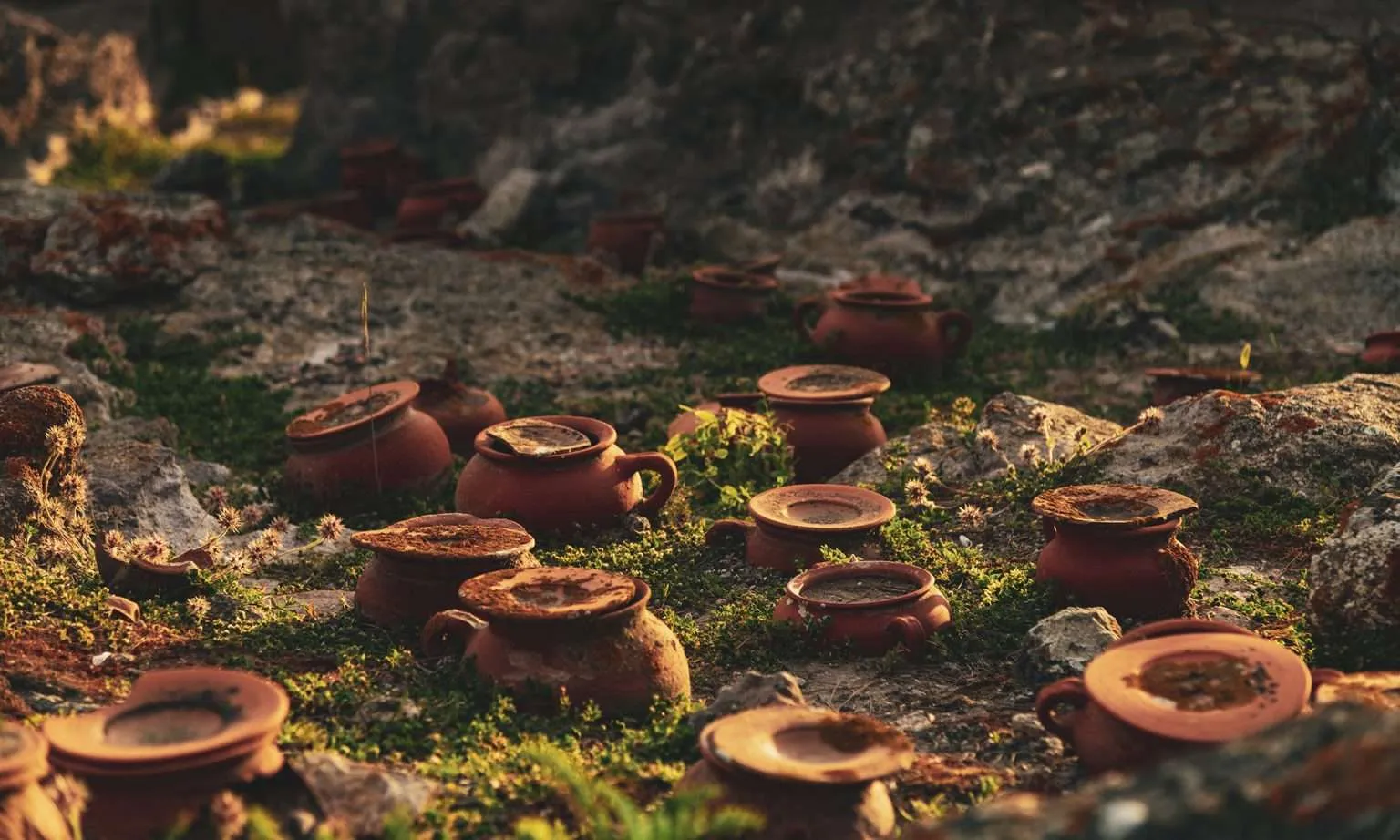 The ruins of the tophet of Sulki an open-air cemetery housing thousands of clay urns.
Archaeologists excavating Sulki have uncovered one of the most massive tophets in the Mediterranean, second in size only to the one in Carthage. Long victimized by Greek and Roman propaganda that painted it as a site of horrific human sacrifice, modern scholarship views the tophet primarily as a sacred burial ground for stillborn infants and children who died in early infancy. Their ashes were interred in urns, often accompanied by the burned remains of small animals (like lambs) offered to the gods Baal Hammon and Tanit as a sign of devotion or plea for grace. The sheer scale of this area at Sulkiproves that within a few decades, a simple trading post had rapidly evolved into a populous, demographically vibrant city.
Tharros, located further north along the western coast, replicated this logic. Founded on the narrow Sinis peninsula, it offered anchorages in either the "Dead Sea" (the calm inner gulf) or the "Live Sea" (the exterior, exposed to the Mistral), depending on the weather. Tharros acted as a vital hinge between the Spanish transit routes and the Nuragic agricultural heartlands of the Campidano plain.
The Mystery of the Nora Stone: Sardinia's First Name
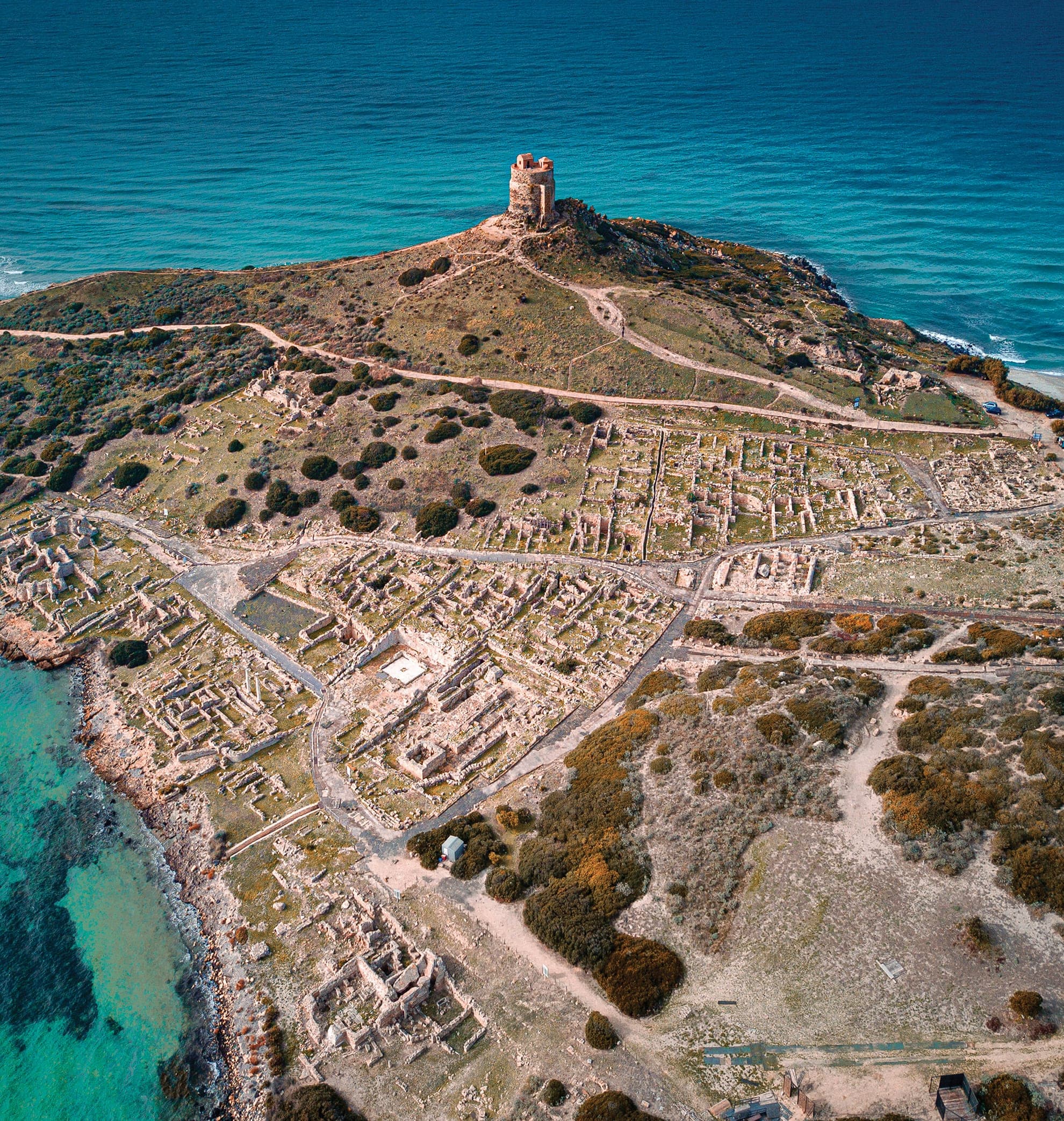
Moving to the southern coast, near the modern capital of Cagliari, we find Nora. Situated on a scenic promontory currently dominated by a 16th-century Spanish watchtower, Nora is famous not just for its later Roman mosaics, but for a staggering accidental discovery made in 1773. A local farmer, dismantling a dry stone wall, uncovered a block of reddish sandstone slightly over a meter tall and 60 centimeters wide, carved with eight lines of ancient Phoenician script.
This stone, now known as the Nora Stone and displayed at the National Archaeological Museum in Cagliari, is the most important epigraphic document in the western Mediterranean. Dated by scholars to between 830 and 730 BC (decades before the legendary founding of Rome), it contains a groundbreaking inscription. In the third line, one can clearly read a sequence of letters (ancient Phoenician, like Hebrew, did not write vowels): B-Š-R-D-N.
Leading Semitic epigraphy scholars, including Frank Moore Cross, agree on the translation: be-shardan, meaning "in Sardinia". This marks the first time in human history that the name of the island was written down in a surviving document.
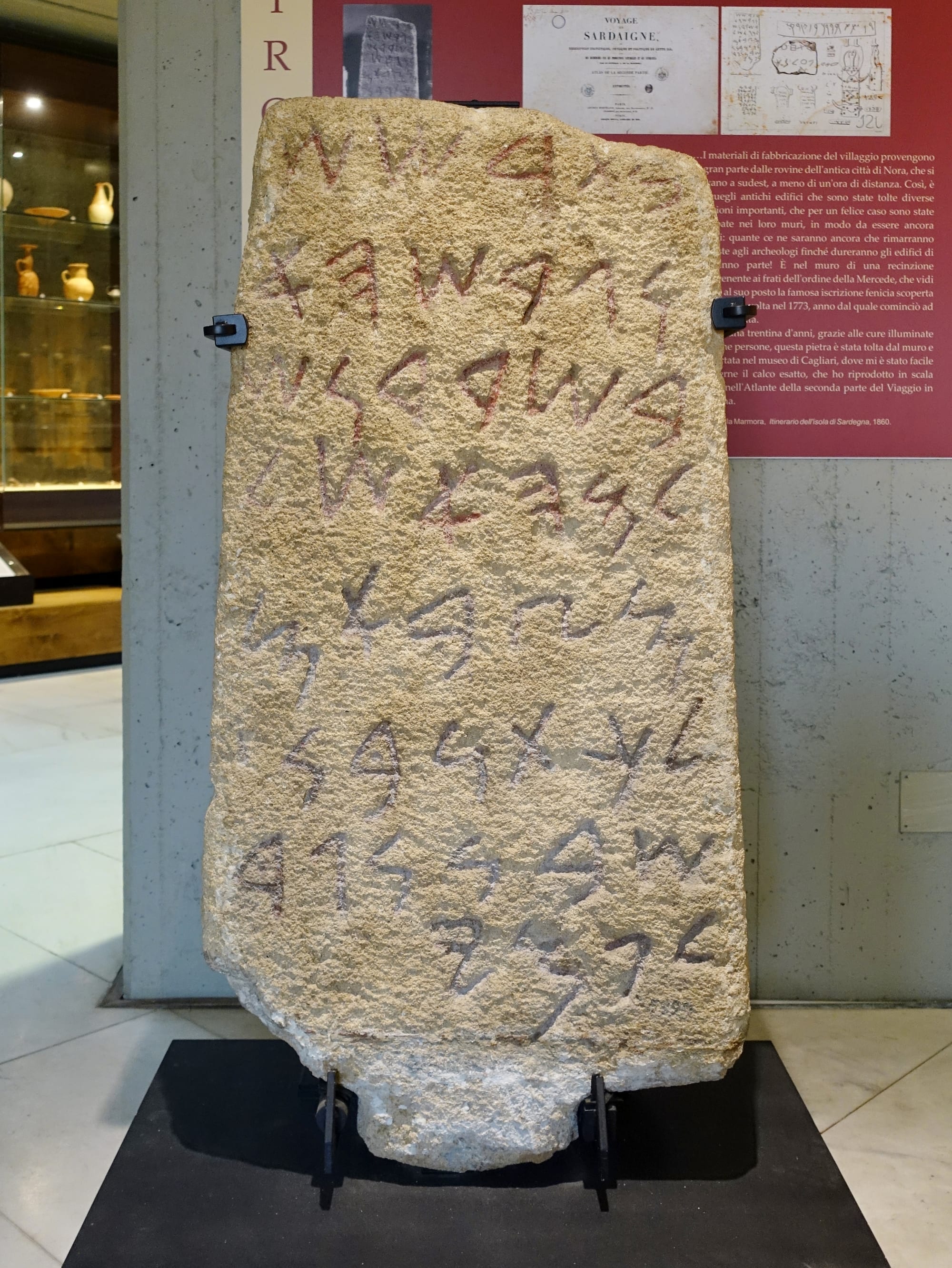 The Nora Stone, measuring 105 centimeters in height, dates back to 830–730 BC. It showcases the linear Phoenician alphabet, the ancestor of all Western alphabets.
The rest of the text remains fiercely debated. The top portion of the stele is missing, and the archaic vocabulary defies easy translation. Some experts interpret the text as a votive inscription left by a general named Pumay, giving thanks to a deity for protecting him after a naval expedition to Tarshish (likely Tartessos in Spain). Others read it as the dedication of an altar honoring safe passage through a storm. Regardless of the philological debate, the stone establishes a hard fact: by the late 8th century BC, Sardinia was not an uncharted wilderness, but a structured hub equipped with sanctuaries and officials, fully integrated into the world's first true maritime network.
Beyond the Coast: Monte Sirai and Coexistence with the Nuragics
One of the most captivating questions archaeologists ask is: how did the indigenous builders of the stone towers react to the arrival of Middle Eastern merchants? Past theories assumed brutal warfare, picturing Phoenicians barricaded on the coasts and fierce Nuragic tribes confined to the mountains. The excavation data of the last fifty years tells a vastly different story—one of prolonged cultural osmosis and peaceful coexistence.
It is crucial to remember that by the time the Phoenicians arrived, the Nuragic civilization had already moved past its peak tower-building phase (the great stone towers hadn't been built for centuries), but their social and territorial organization remained highly complex. The two populations actually needed each other. The Levantines possessed the ships, the alphabet (a revolutionary technology for keeping trade records), and a monopoly on oriental luxury goods. The Sardinians controlled the inland territory, the mountain passes, mass agriculture, and the mining operations.
The site of Monte Sirai, located just a few kilometers inland from Sulki perfectly illustrates this integration. Founded around 750 BC on a volcanic plateau overlooking the plain, it was not a purely Phoenician outpost, but a hybrid settlement. Excavations here have revealed houses built using Phoenician techniques (regular floor plans, use of mudbrick) but filled with everyday Nuragic pottery. Nuragic women married Phoenician men and vice versa, creating a new, blended Sardinian-Phoenician identity within a few generations. Local Nuragic sanctuaries were frequently repurposed and updated, with local deities partially assimilated into Levantine figures like Astarte and Melqart. It was a subtle, peaceful conquest driven by economics and the allure of a "modern" lifestyle, rather than by swords.
The End of an Era: The Arrival of Carthage and the Shift to War
This delicate balance shattered violently in the 6th century BC. Around 540 BC, as Greek pressure expanded across the western seas and political turmoil rocked the mother city of Tyre, the western Phoenician cities called upon their most powerful North African sister for help: Carthage.
Up until this point, the western Phoenicians had been maritime traders and shipwrights, uninterested in the military occupation of vast inland territories. With the Carthaginians taking the stage, foreign policy changed drastically. The Carthaginians, led by the general Malchus (and later the Magonid dynasty), brought massive mercenary armies to Sardinia. Their goal was no longer just securing trade routes; they wanted to seize the fertile Campidano plain, the "granary" of the island, to feed the booming North African population.
The transition was bloody. The peaceful hybrid town of Monte Sirai was fortified and turned into an armed garrison. Numerous Nuragic settlements were destroyed or permanently abandoned. The coastal cities lost their partial independence, becoming heavily armed strongholds of a maritime empire that would rule the island with an iron fist for over three hundred years, until their fatal clash with the rising power of Rome. But that is a story for another chapter.
Where to See Phoenician Traces Today
To truly grasp the impact of this extraordinary historical era, seeing the sites in person is essential.
- The National Archaeological Museum in Cagliari is the mandatory starting point. Alongside the Nora Stone, it houses stunning Phoenician jewelry, Egyptian-style faience scarabs, glass bead necklaces, and their signature red-slip pottery.
- In Sant'Antioco (Sulki), the Ferruccio Barreca Archaeological Museum is attached to the vast tophet site. Here, you can walk among hundreds of original burial urns and votive steles, truly comprehending the material scale and demographics of the ancient city.
- The archaeological park of Nora, accessible via guided tours, allows you to walk along ancient streets. While the visible structures are largely from the later Roman Imperial period, exploring the coastline and the bays perfectly illustrates why 8th-century BC navigators chose to drop anchor at that very promontory.
Understanding the arrival of the Phoenicians means abandoning the idea of ancient Sardinia as an isolated, closed-off island. 2,800 years ago, these bays were bustling nodes in the greatest trade network of the ancient world.