It was a spring morning in 1857. Giovanni Columbu, a farmer from central Sardinia, was pushing his plow through the fields of Serra Ilixi, near the village of Nuragus. Suddenly, the plowshare struck something hard and heavy. It wasn't a rock. From the soil emerged massive, oxidized metal plates, weighing nearly thirty kilograms (about 66 pounds) each, with a bizarre shape: a rectangle with elongated corners, resembling a stretched ox hide.
Columbu couldn't have known it, but he had just unearthed the first copper "oxhide" ingots ever discovered in Sardinia. That strike of the plow was the spark that eventually shattered an old academic myth: the presumed isolation of the Nuragic people. Those copper plates proved that, three thousand years ago, the island was the hub of a massive trade network linking the Aegean, the Middle East, and continental Europe. A network built on the most precious resource of the Bronze Age: metals.
The Island of Metals: The Geology That Made History
To understand the role of prehistoric Sardinia, you first have to look beneath its surface. Geologically, the island is a fragment of a very ancient continent—the Sardinian-Corsican block—formed during the Paleozoic era, over five hundred million years ago. While the Italian peninsula and much of the Mediterranean basin are geologically young, made of limestones and recent sediments largely devoid of ores, Sardinia is a behemoth of granite and schist crisscrossed by deep hydrothermal veins.
These veins are the scars of ancient tectonic and volcanic activity, and they are literally saturated with minerals. In the southwest (the Iglesiente and Sulcis regions), galena (yielding lead and silver) and sphalerite are abundant. In the center of the island (Barbagia and Sarcidano), chalcopyrite and malachite outcrop, which are essential minerals for copper extraction.
This geological anomaly shaped Sardinia's destiny. During the Bronze Age (roughly 2200 to 900 BC), copper and tin were the equivalent of today's oil and silicon. Whoever controlled metals held the power, forging unstoppable weapons, armor, and agricultural tools. Massive civilizations like the Egyptians or the Mycenaeans had to import almost all their copper from Cyprus or the Arabian desert. Sardinia, on the other hand, had entire mountains of it. It didn't take long before the entire Mediterranean came knocking on its shores.
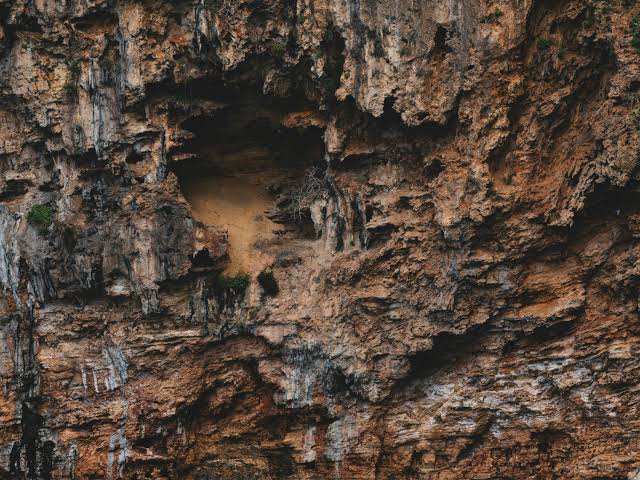 The rugged rock formations of the Sardinian hinterland guard metalliferous veins that have been exploited for over four thousand years.
Funtana Raminosa: Copper in the Heart of Barbagia
The absolute symbol of Sardinian prehistoric mining is Funtana Raminosa, in the territory of Gadoni. Nestled in a steep gorge carved by the Flumendosa river, this mine was exploited continuously from the Bronze Age until the late 20th century. The place name itself, "Coppery Spring," describes the waters that take on the green and blue hues of copper salts as they flow through the ore deposits.
But how do you carve through solid bedrock without steel or gunpowder? Nuragic miners used an ancient, exhausting technique: fire-setting. They piled wood against rock walls rich in malachite veins and set it ablaze. Once the rock became blistering hot, they threw buckets of freezing river water onto it. The brutal thermal shock fractured the boulder, creating micro-cracks.
Then the pickmen took over. They used massive stone mauls made of hard volcanic rock, like andesite or basalt, weighing between three and five kilograms, tied to wooden handles with leather straps. With these rudimentary but effective tools, they smashed the fractured rock and extracted the ore nodules. Hundreds of these stone hammers have been found in the oldest tunnels of Funtana Raminosa.
The work was grueling. The prehistoric galleries, often only wide enough for a crouching man, slavishly followed the ore veins. They didn't dig straight tunnels; they burrowed into the mountain's bowels in zig-zags, chasing the green color of malachite by the flickering light of oil lamps.
The Oxhide Ingot Route
Once extracted and smelted in primitive pit furnaces, the copper had to be transported and sold. Here is where Giovanni Columbu's discoveries at Serra Ilixi, and dozens of other similar ingots found across Sardinia, re-enter the story.
The oxhide ingot is a masterpiece of prehistoric logistical design. It always weighs around 27-30 kilograms. This isn't random: it corresponds to the "talent," the standard unit of measurement in the ancient Near East. The four elongated, leg-like corners are not artistic flourishes; they are ergonomic handles. A strong man could grab the ingot, hoist it onto his shoulders or back in a balanced way, and carry it from the port to the forge, or load it into a ship's hold.
For decades, archaeologists assumed that the ingots found in Sardinia had been produced by the Nuragics using copper from Funtana Raminosa for export. It seemed the most logical deduction. But in the 1990s, exact science disrupted Sardinian archaeology.
Researchers Zofia Stos-Gale and Noel Gale from Oxford University applied lead isotope analysis to the Sardinian ingots. Every ore deposit in the world has a unique isotopic "signature," like a fingerprint. The results were shocking: the oxhide ingots found in Sardinia were not made with Sardinian copper. Their copper came entirely from Cyprus, an island located almost three thousand kilometers away.
How can this paradox be explained? Why would a copper-rich island like Sardinia import dozens of tons of copper from Cyprus? The academic debate, led by scholars like Fulvia Lo Schiavo, paints a fascinating picture. Nuragic Sardinia wasn't just a mining colony; it was a metallurgical superpower. Its forges produced such an enormous quantity of weapons, tools, and bronze votive boats that domestic raw material wasn't enough. The Nuragics exported finished goods and local copper to Iberia and continental Europe, while simultaneously importing standardized raw Cypriot copper to feed their insatiable domestic industry. Underwater shipwrecks, like the one at Uluburun in Turkey, confirm these complex, circular maritime highways.
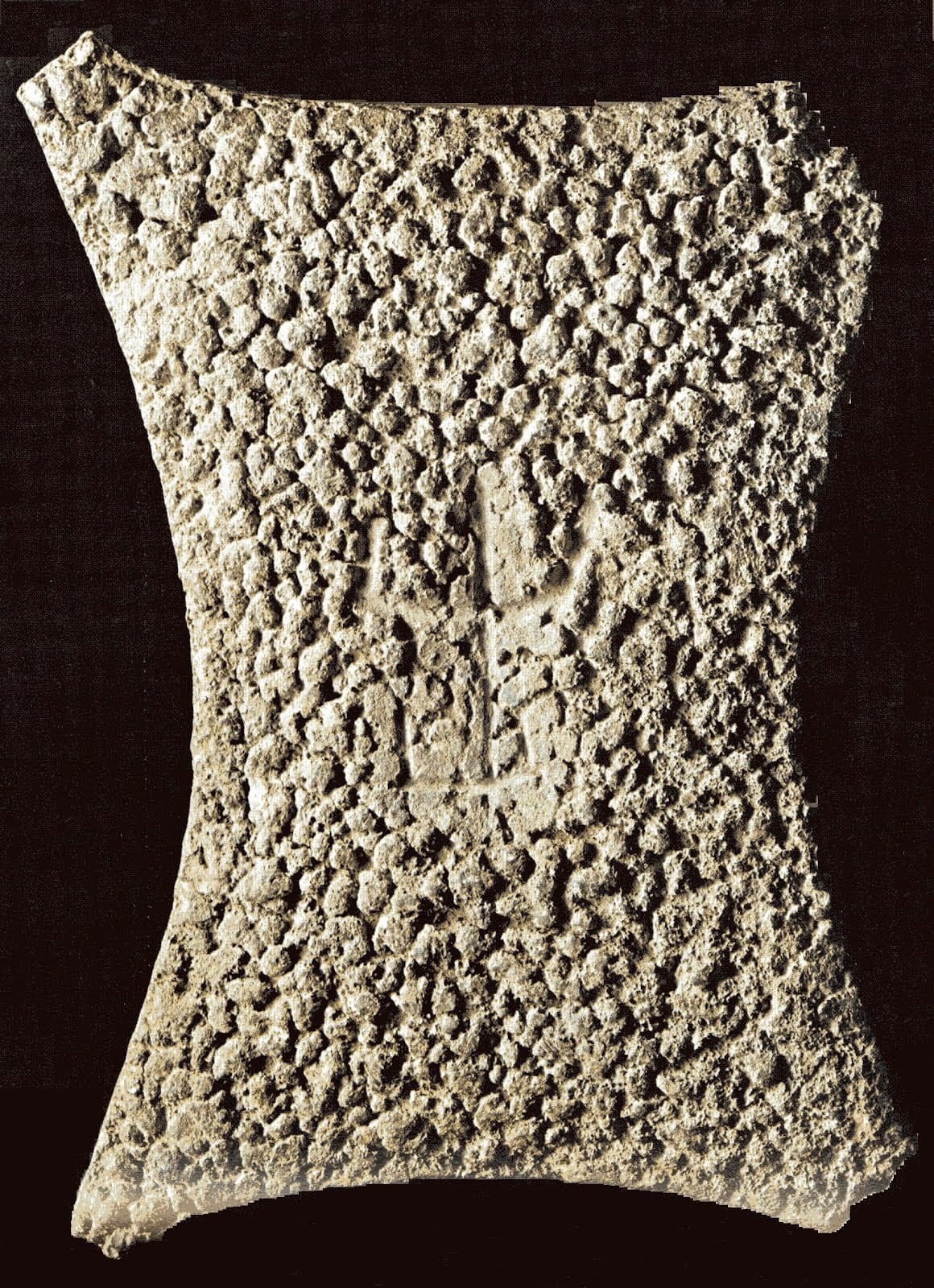 A typical copper "oxhide" ingot. The corners served as handles to facilitate carrying on shoulders or securing them on merchant ships.
Sa Sedda 'e Sos Carros and the Bronze Industry
Having copper (and tin, likely imported from the Iberian Peninsula or Cornwall) is not enough: you need the technology to transform it. The site of Sa Sedda 'e Sos Carros, in the harsh, white limestone heart of Oliena's Supramonte, is the perfect place to understand how the Nuragic bronze industry worked.
This wasn't just a village. It was a place where heavy industry merged with the sacred. The site is famous for its extraordinary sacred spring, a circular stone basin finely carved where water flowed through spouts shaped like mouflon (wild sheep) heads. But just a few meters from the worship site, archaeologists found something much less spiritual and far more practical: a massive metallurgical workshop.
The workshop was highly organized. Archaeologists found smelting furnaces, where temperatures had to exceed 1083 degrees Celsius (1981°F, the melting point of copper). To reach such heat, enormous amounts of charcoal and constant use of leather bellows were required; terracotta nozzles (tuyères) that protected the leather from the flames have been recovered.
Even more crucial are the casting molds made of steatite, a soft, heat-resistant stone into which the shapes of the objects were carved. Molten metal was poured in to produce daggers, axes, and spearheads. At Sa Sedda 'e Sos Carros, a massive "hoard" was discovered: a pit containing hundreds of kilos of bronze fragments, broken weapons, and casting slag. This wasn't trash. In the Bronze Age, metal was never thrown away: a broken axe was raw material to be melted down into a new dagger. These hoards were the bank vaults, the gold reserves of Nuragic communities.
Silver, Lead, and the Arrival of the Phoenicians
As the Bronze Age slipped into the Iron Age (around the 10th-9th century BC), the world changed. Bronze lost its military supremacy to iron, but Sardinia still had a geological ace up its sleeve: lead and, above all, the silver of the Iglesiente region.
In the Near East, the Assyrian Empire was imposing its brutal rule, demanding immense silver tributes from the cities on the Syro-Palestinian coast. These cities, inhabited by the Phoenicians, were full of artisans and sailors, but they had no mines. To pay the Assyrian tyrants, Phoenician navigators had to push westward, toward the only known sources of silver: Andalusia (Spain) and Sardinia.
Sardinian silver, however, is not found pure in nature. It is trapped inside argentiferous galena, mixed with massive amounts of lead. To extract it, a complex chemical process called cupellation is needed. Sardinian and Phoenician metallurgists smelted the galena in highly aerated furnaces. The lead oxidized rapidly, turning into litharge (a spongy crust), while the silver—a noble metal that doesn't oxidize—remained pure at the center of the crucible, like a gleaming teardrop.
The Phoenicians didn't arrive in Sardinia in the 9th century BC merely to found commercial ports like Sulky, Nora, or Tharros; they came to tap directly into this silver trade, forging alliances and trade agreements with the Nuragic aristocracies that controlled access to the inland mines.
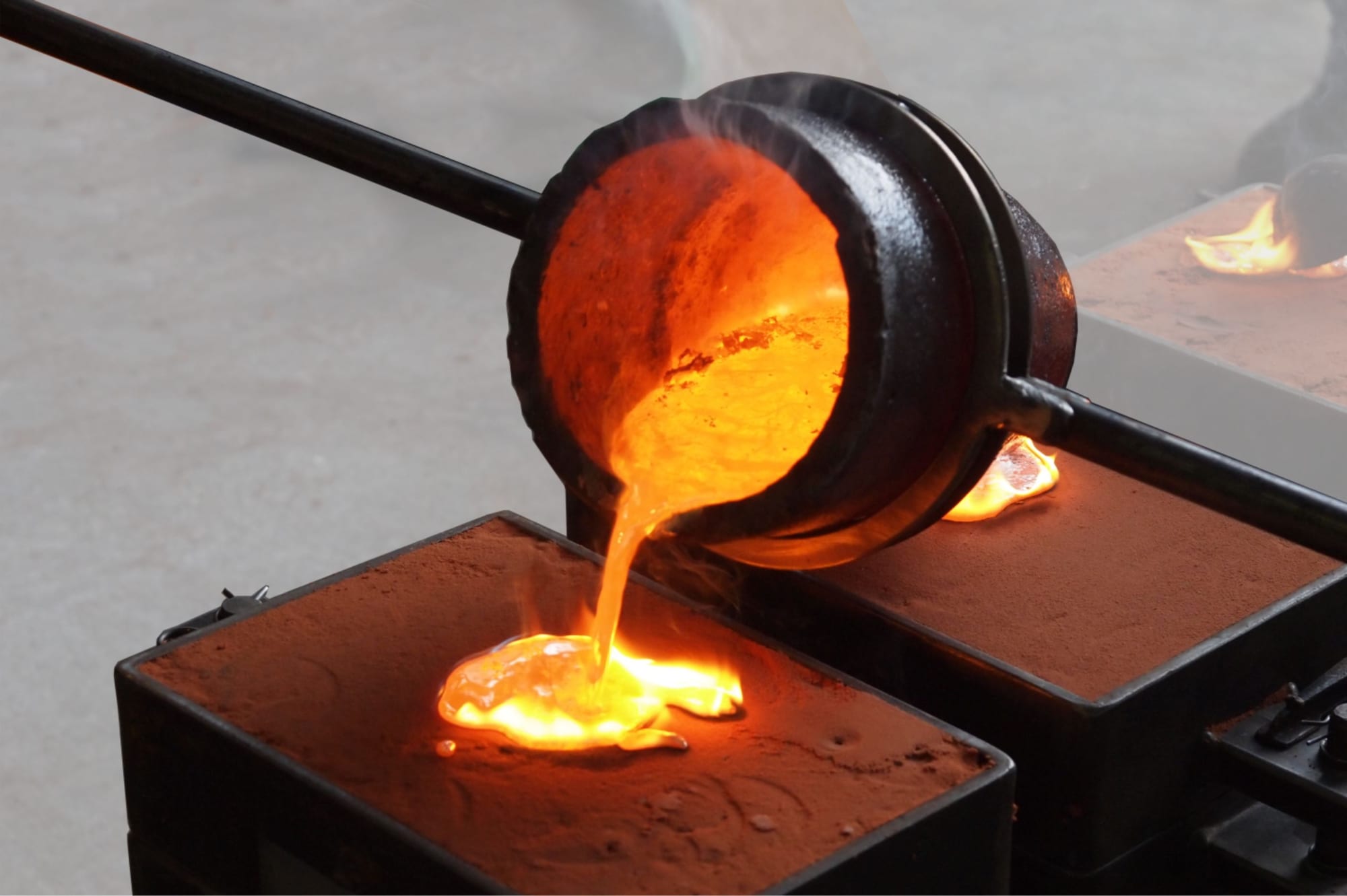 Pure silver emerges from oxidized lead during the ancient process of cupellation, a key technology in the 1st millennium BC.
5 Things to Know About Nuragic Metallurgy
- "Poisonous Bronze." Before discovering that perfect bronze is achieved by mixing copper with 10% tin, early Sardinian metallurgists used arsenical copper (copper mixed with arsenic). Producing it was extremely dangerous: arsenic fumes caused severe neuropathies. It is no coincidence that the Greek god of blacksmiths, Hephaestus, was lame, reflecting the occupational diseases of ancient smelters.
- Lead in Architecture. The Nuragics didn't just use metal for tools. At the Arrubiu Nuraghe in Orroli, archaeologists discovered that massive basalt blocks were held together by molten lead poured into special grooves—an extraordinarily advanced anti-seismic and structural consolidation technique.
- Lost-Wax Casting. The famous Nuragic "bronzetti"—votive statuettes a few inches tall and rich in detail—were produced using the lost-wax technique. The artisan sculpted the figure in beeswax, covered it with clay leaving two holes, baked the whole thing (melting and draining the wax), and poured molten bronze into the empty mold. Therefore, every bronzetto is a unique piece: the mold had to be broken to extract it.
- Nomadic Merchants. It is believed that many smelters were itinerant artisans. They traveled from village to village with their molds, bags of charcoal, and bellows, repairing old weapons and selling their technological know-how in exchange for food, livestock, and protection.
- The Forraxi Nioi Treasure. In Nuragus, one of the most massive hoards of antiquity was found: it weighed hundreds of pounds and contained dozens of weapons, ingot fragments, and even Cypriot daggers, proving that wealth in Sardinia was not tied to coins (which did not yet exist), but to the sheer weight of metal.
Where to See the Traces of This World
To witness the scale of this ancient trade network, the mandatory starting point is the National Archaeological Museum in Cagliari. Here, you will find not only the famous oxhide ingots of Serra Ilixi but also hundreds of casting molds, daggers, two-meter-long votive swords, and the largest collection of Nuragic bronzetti in the world.
For those who want to literally step into the bowels of the earth, you can visit the Funtana Raminosa mining area in Gadoni. Today, it is a geopark that allows you to explore the extraction galleries, feeling firsthand the darkness, the exhaustion, and the greatness of those who, over three thousand years ago, bent bare rock to build the Mediterranean Bronze Age.