On the northwestern coast of Sardinia, set against steep schist cliffs plunging into a deep cobalt sea, lies a place where the brutal power of heavy industry collided head-on with wild nature. This is Argentiera, the island's ultimate ghost town, a fascinating relic inhabited today by a stubborn handful of just 54 people.
Walking through the dusty, silent squares of this village today means treading on the memories of entire generations. Until September 1963, Argentiera wasn't a peaceful coastal retreat, but a colossal, deafening machine for wealth extraction. It was a classic company town where absolutely everything—the houses, the daily routines, and even the lungs of the workers—belonged to the mining corporation.
This is the story of a ruthless industrial cycle: the discovery of a vastly rich ore deposit, the epic engineering feats that drove tunnels 163 meters below sea level, the tragic human toll of silicosis, the severe environmental disaster left in its wake, and finally, a pioneering cultural renaissance that is currently transforming the industrial void into a cutting-edge, open-air liquid museum.
Silver Veins: The Geology of Argentiera
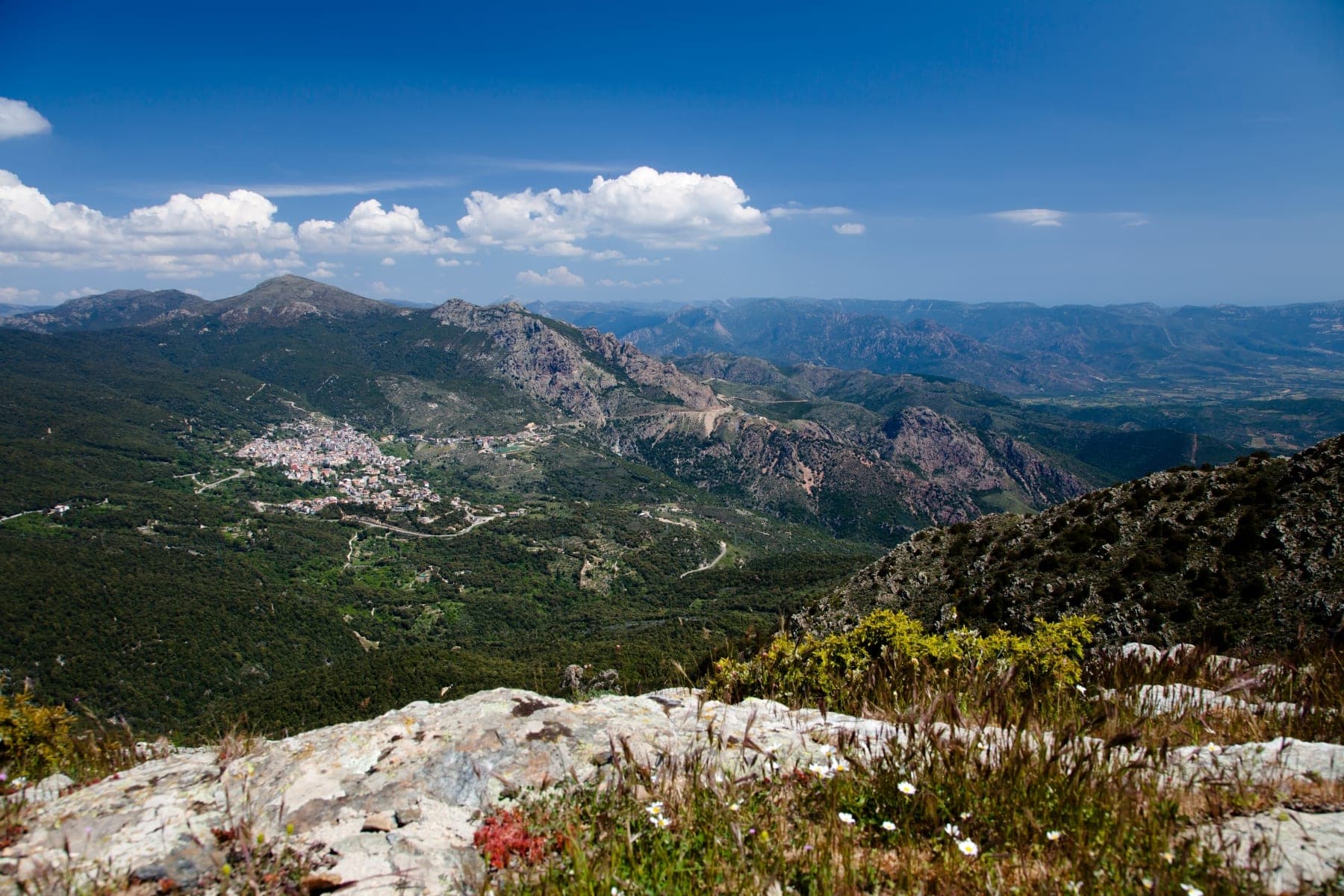
Argentiera’s industrial epic was actually written hundreds of millions of years ago. Structurally, the area—known as the Nurra—is a spectacular outcrop of the ancient Sardinian Paleozoic basement. The Variscan orogeny, a titanic continental collision, literally folded, fractured, and crushed these ancient rocks, creating the dramatic vertical cliffs that now drop into the Sea of Sardinia. Resting on this metamorphic foundation are more recent sedimentary formations, layered with quartz-rich sandstones.
But the true wealth, the treasure that attracted investors from across Europe, came from deep below. During the final stages of that ancient tectonic upheaval, hellishly hot hydrothermal fluids, saturated with dissolved metals, were forced upward by immense pressure through the faults in the bedrock. As these fluids cooled, they deposited their chemical payload, weaving a complex network of mineral veins.
The Argentiera deposit is irregular and unpredictable, dipping steeply toward the northwest and alternating between incredibly rich nodes and completely barren rock. The most coveted prize was argentiferous galena, a lead sulfide that hid microscopic inclusions of pure native silver within its crystal lattice. It was this silver that dictated the high market prices, justifying the staggering engineering costs required to extract the ore from solid rock.
Today, decades after the heavy machinery fell silent, the underground world is reacting to the human invasion with a fascinating mineralogical phenomenon. Rainwater filtering through the abandoned shafts becomes highly acidic upon contact with the remaining metal sulfides. This acidic water then corrodes the massive iron nails driven into the rock by 19th-century miners. Around these rusting nails, the subterranean ecosystem is metabolizing the industrial ruins, naturally crystallizing extremely rare secondary minerals like akaganeite and dypingite.
Descent into the Abyss: The Podestà Shaft and the Killing Dust
Although the Romans and Pisans had scratched the surface centuries earlier, true industrial-scale mining exploded here in 1867. Post-unification Sardinia quickly became a primary raw materials reservoir for French-Belgian and Piedmontese holding companies. Initially, the site was entirely isolated: in 1869, the illustrious Italian statesman and geologist Quintino Sella reached Argentiera from the city of Sassari only after a grueling seven-hour journey on horseback.
During this pioneering phase, miners dug horizontally into the hillsides, often relying on the archaic and dangerous fire-setting method—literally cracking the quartz with fire—which suffocated workers long before modern explosives became standard. The real industrial turning point occurred in 1890 under the Correboi Mining Company, which hired the first permanent doctor in 1893, and later peaked under the powerful French-Italian Pertusola corporation from 1929 until the mine's closure.
To chase the elusive mineral veins, the engineers had to defy the sea. The nerve center of the operation became the Pozzo Podestà (Podestà Shaft), a vertical conduit plunging 163 meters (534 feet) below sea level. Around this central axis lay a claustrophobic, three-dimensional labyrinth of tunnels, connected by the dreaded "fornelli"—extremely narrow vertical chutes where miners had to climb slippery wooden ladders, and down which the blasted rock was thrown. The crushing pressure of the mountain caused the wooden support beams to creak constantly, and lethal cave-ins were tragically common. In 1925, a young worker named Giovanni Salaris was crushed beyond recognition in the Podestà Shaft when a worn elevator cable snapped.
Yet, the most devastating enemy made no sound at all. To reach the silver-rich galena, miners had to drill through extremely hard quartz bedrock. The relentless use of dry pneumatic drills raised thick clouds of crystalline silica dust. When inhaled, these microscopic, razor-sharp quartz particles (under 10 micrometers in diameter) entered the lungs. The body’s immune macrophages attempted to engulf and destroy the crystals, but were killed instead. This cellular destruction triggered a terrifying chain reaction, slowly turning healthy, spongy lung tissue into a hardened mass of non-functional scar tissue. This was silicosis, an incurable, agonizing suffocation that corporate management coldly calculated as a silent, inevitable "cost of production."
Anatomy of a Company Town and the Wooden Washery
Argentiera is one of Italy's most perfectly preserved models of a company town: an entire urban settlement designed, built, and owned by the corporation, where the street layout brutally reflected the era's strict social hierarchies.
Down in the valley, wedged tightly beneath the industrial plants and right up against the beach, the poor workers' dwellings were packed together. These were stark, unadorned stone cubes, permanently enveloped by the deafening roar of the ore-crushing mills and constantly coated in the toxic dust kicked up by the conveyor belts. For the laboring families, there was no visual or acoustic escape; the boundary between private life and the alienating space of the factory did not exist.
Higher up on the hills, in panoramic positions safely distanced from the noise and grime, lived the engineers and managers. Built in the 1940s following Rationalist architectural principles, the managerial villas functioned as panoptic control towers overseeing the entire valley. In a surprising display of bioclimatic design, some of these buildings were nestled against specific rock ridges specifically to shield them from the corrosive, violent Mistral winds blowing off the sea, and they enjoyed running water and electricity decades before the workers' homes did.
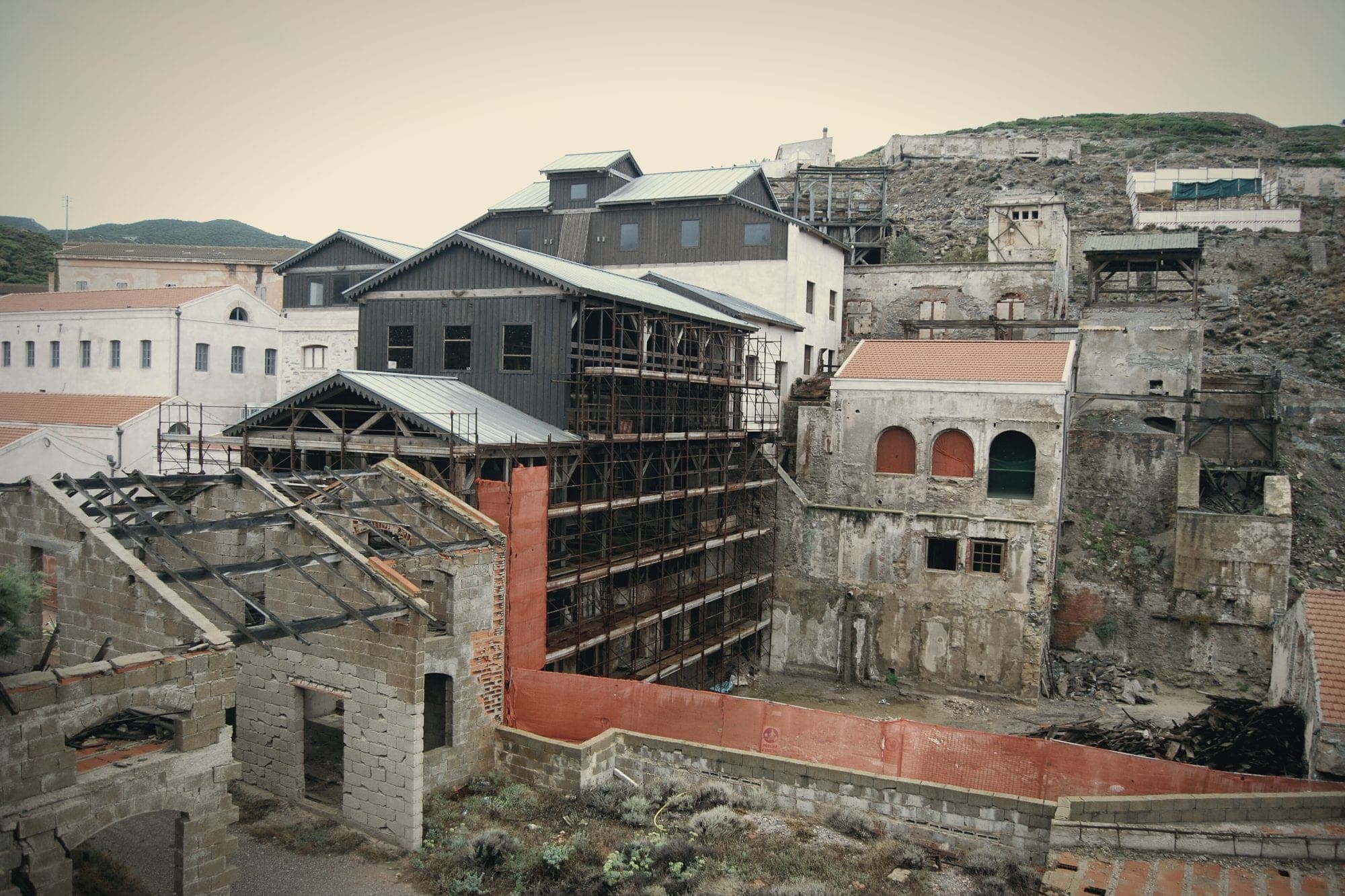
The architectural masterpiece that dominates the ghost town today is the immense skeleton of the laveria (the washing plant), built in 1930 to crush and chemically separate the ore. Unlike the heavy masonry washeries typical of southern Sardinia's historic mines, this towering structure was built almost entirely of pitch-pine, a highly resinous pine imported from the Americas. This wasn't an aesthetic choice. Sitting mere steps from the ocean, an iron frame would have rusted away in no time due to galvanic oxidation, aided by the caustic chemical reagents used in ore flotation. The pitch-pine guaranteed total resistance to salt and acid, while offering extraordinary flexibility to absorb and dissipate the violent vibrations of the heavy machinery. Terraced against the steep hillside, the washery elegantly used gravity to move the crushed rock from the upper vats down to sea level.
The Sorters and the Days of Revolt
Official history has long ignored a crucial segment of this industrial army: the women. While the men plunged into the underground darkness, the surface belonged to the cernitrici (the sorters). These were young girls, some just 10 or 12 years old, alongside mothers and widows, working under grueling conditions around the oscillating sorting screens.
Their task was precise and punishing: they had to manually smash the rough boulders and quickly pick out the valuable galena fragments from the sterile quartz. They worked 10-hour shifts, bent over outdoor tables, exposed to the blistering summer heat and the freezing, salt-laden winter winds, constantly breathing the chemical fumes from the adjacent washery. They earned a pittance compared to the men, usually working off the books without any accident insurance. Losing a finger under a heavy manual hammer was a common occurrence, and because they breathed the same quartz dust all day, many died of the same silicosis that killed their husbands underground.
This harsh class reality finally exploded after World War II. Inspired by the famous 70-day strike of the coal miners in southern Sardinia, the Argentiera workers took drastic action in January 1949 to fight against starvation wages and mass layoffs. Dozens of miners occupied the Podestà Shaft and the underground tunnels indefinitely, threatening to shut down the water pumps and flood the entire mine if the company called in the police.
On the surface, the women, local merchants, and elderly silicosis sufferers organized a formidable logistical network, lowering hot food down the shafts. Leading the protest was a young union leader and washery operator, Pietro Pittalis, who masterfully articulated the workers' technical and political demands. However, the corporation's power was overwhelming. Backed by state police, management isolated the protesters and starved them out. The surrender was bitter, and the retaliation was ruthless: mass political firings eliminated Pittalis and all the union leaders from the payroll, effectively decapitating the labor movement and establishing a regime of corporate terror.
Abandonment and the Long Poison
By the late 1950s and early 60s, the rich metallic veins began to thin out. Chasing the ore to ever-greater depths required immense water-pumping costs, which became financially unsustainable against the fierce competition of cheap African minerals. With no government bailout in sight, the Pertusola company abruptly closed the mine with a simple regional decree (No. 365, September 21, 1963). Argentiera was the first of Sardinia's great historic mines to fall.
The impact was immediate and brutal. Hundreds of families lost their income overnight and were forced into a mass exodus toward the petrochemical hub of Porto Torres or to mainland Europe. The company town emptied instantly: the cinema was abandoned, the schools closed, and the doors were bricked up.
But the poison stayed behind. Over seventy years of chemical processing had left a legacy of immense industrial sludge dumps (tailings), piled into massive artificial dunes that spilled directly onto the beautiful San Nicola beach. Left completely uncovered for fifty years, autumn rains and fierce winds washed enormous quantities of heavy metals (lead, cadmium, zinc) down to the shoreline, heavily contaminating the coastal groundwater.
It wasn't until 2019 that a historic ruling by the Regional Administrative Court (T.A.R. Sardegna) finally broke decades of bureaucratic paralysis, legally mandating an environmental cleanup. Because removing the toxic mountain was financially impossible, environmental engineers opted for encapsulation: the entire hillside of lethal mining waste was literally entombed beneath a colossal, terraced reinforced concrete sarcophagus. While heavily criticized for its visual impact on the wild landscape, the concrete shield successfully stopped the lethal chemical leaching, finally making the beach safe for the public once again.
The Augmented Renaissance: From Ruin to Liquid Museum
For decades, Argentiera was viewed solely as a public health hazard and a playground for urban explorers. Today, however, this frozen space is becoming one of the most advanced laboratories for grassroots urban regeneration in the Mediterranean.
Instead of trying to clumsily rebuild collapsed walls, the award-winning MAR (Miniera ARgentiera) project—led by the LandWorks association and the tech startup Bepart—has transformed the ruins into a "liquid museum" through Augmented Reality. By downloading a free app, visitors can point their smartphones at the gutted buildings, causing them to spring to life on screen. The decaying walls become a canvas for digital artworks, archival footage, and historical animations.
Among the most powerful installations is an artwork by Francesca Macciò, which explores the psychological split between the claustrophobic darkness of the mine and the blinding light of the Sardinian wind. Another moving piece is Casa d'altri (Someone Else's House) by Francesco Clerici, which brings the skeleton of a worker's house back to life by blending the ghostly recorded voices of historical miners with those of the town's few remaining inhabitants. Crucially, the work of Milena Tipaldo restores dignity to the exhausted women sorters, conceptually bridging the divided worlds of the surface and the underground. The genius of this approach is that the physical ruins remain archaeologically untouched: not a single brick is altered, as the technology simply overlays the space like a digital ghost.
Alongside digital art, Argentiera is being physically rebuilt through circular economy self-construction workshops. The "Scala", a large wooden ramp painted with organic textures by the renowned Sardinian artist Tellas, now elegantly connects the upper and lower village, serving as an open-air amphitheater for literary festivals. Under the OltreMAR manifesto, the former ghost town is establishing itself as a premier destination for winter eco-tourism, fully integrated into the prestigious UNESCO Sardinian Historic and Environmental Geomining Park.
Visiting Argentiera today is no longer just a walk through chaotic rubble, but a journey to witness the incredible resilience of both human memory and wild nature—as the heather, the broom shrubs, and the peregrine falcons slowly, inexorably heal the deep wounds inflicted by a century of furious industrial digging.
Cover photo: cisko66, CC BY 3.0, [Wikimedia Commons] (https://commons.wikimedia.org/wiki/File:Argentiera,_Miniera_-_panoramio.jpg)