On 22 April 1991 about eighty miners went down the Amsicora shaft, in south-west Sardinia, and did not come back up. They stayed underground for 27 days. They were not asking for a raise: they wanted the mine to stay open. When the agreement was signed in mid-May by the state energy company ENI, the Sardinian Region and the unions, it said the opposite of what they wanted: the permanent closure of Montevecchio.
It ended a story that had begun 143 years earlier, in 1848, when a king granted a businessman from Sassari the perpetual right to dig lead and zinc in a district of scrub-covered hills. In between came a village with a hospital, a school, a cinema and a football pitch, a palace with a grand piano and a blue reception room, and thousands of workers. Not a mine with a few houses around it, but a small town built to extract metal.
The man who saw the deposit: Giovanni Antonio Sanna
The protagonist is Giovanni Antonio Sanna, born in Sassari on 29 August 1819. As a young man he ended up in Marseille where, according to Paolo Fadda's biography (L'uomo di Montevecchio, 2010), he met a Sardinian priest, Giovanni Antonio Pischedda. Pischedda had obtained a permit to dig in the area in 1842 and was looking for a partner with capital. Sanna became that partner.
The road was long. A provisional fifteen-year concession came in 1845. On 28 April 1848 King Charles Albert of Sardinia-Piedmont signed the perpetual concession. From then on the deposit was Sanna's, and he began to invest: about 25 million lire, according to a review of Fadda's book, a single source that should be read as an order of magnitude. He was not the first to dig there: local sources mention earlier concessions in the 1700s, to a certain Pietro Nieddu and then to a company of the Swedish consul Gustavo Mandel. But it was Sanna who turned it into an industry.
He was also a politician. He sat in the parliament of the Kingdom for three legislatures, from 1857 to 1865. In 1860 he bought the Turin newspaper Il Diritto, an opposition voice. In 1871 he founded the Banca agricola sarda in Rome. He died in Rome on 9 February 1875, aged 55. His name stayed on one vein and one shaft of the mine, and on the archaeological collection he donated to Sassari.
What lay underground: lead, zinc and five concessions
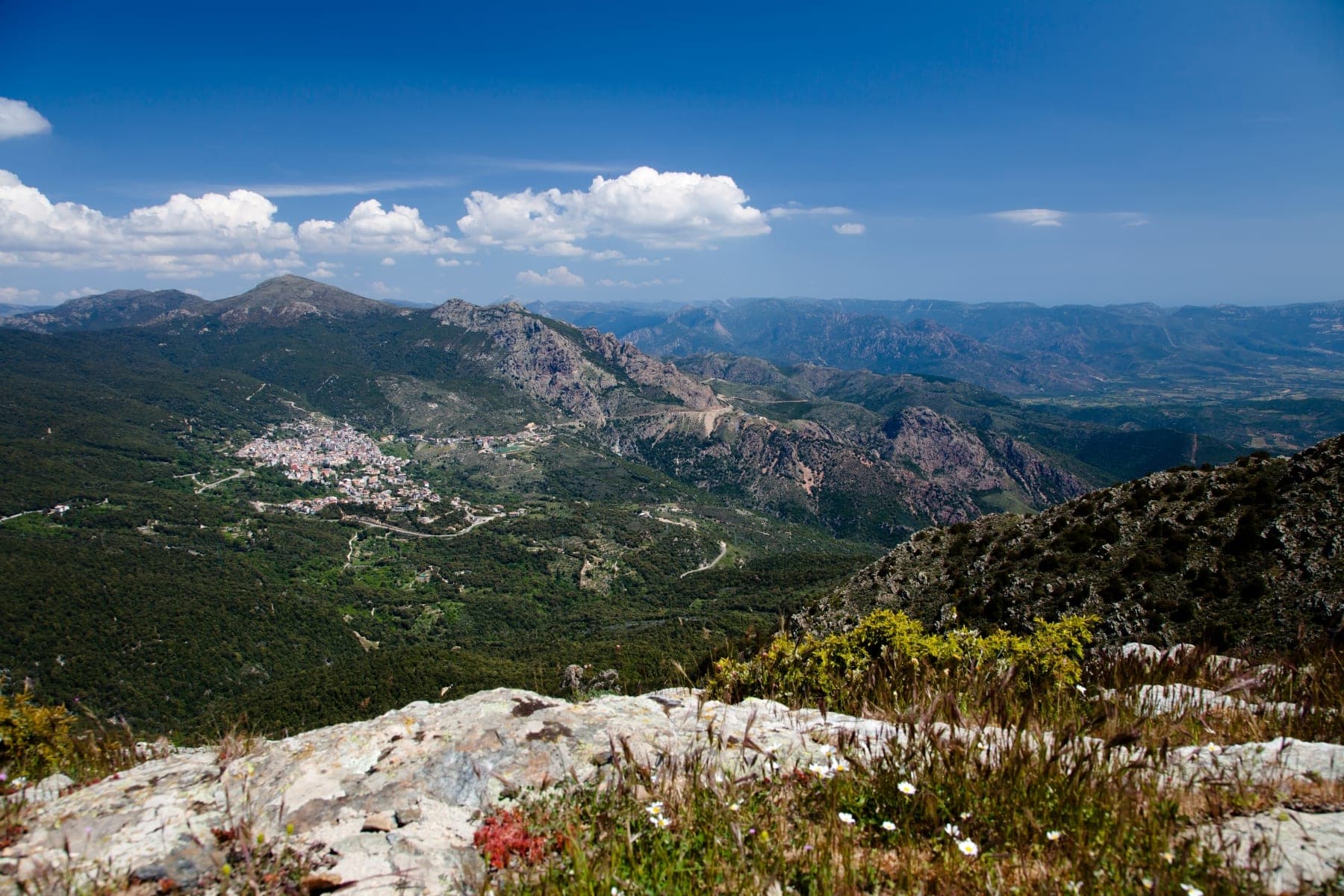
The Montevecchio deposit is a bundle of veins about 10 kilometres long and about 600 metres deep, with individual veins between 1.5 and 7.8 metres thick. There were five concessions: Genna Sciria, Piccalinna, Montevecchio I, II and III. The veins take the names of the mines: Sant'Antonio, Piccalinna, Sanna, Telle, Casargiu.
The Geomining Park of Sardinia, the regional body that looks after the site, reports staggering figures: more than 1,700,000 tonnes of lead metal and about 1,200,000 of zinc, along with silver, copper, bismuth, antimony, cadmium and germanium. These numbers come from a single institutional source, so they are best written "according to the Park". They give the idea: until the 1960s, the Park says, Montevecchio was among the most important lead and zinc mines in Europe.
The neighbouring mines, Ingurtosu and Gennamari, shared the same kind of deposit: together with Montevecchio, the Park says, they form the richest concentration of lead and zinc minerals in Sardinia. It was not an isolated outcrop but a whole district.
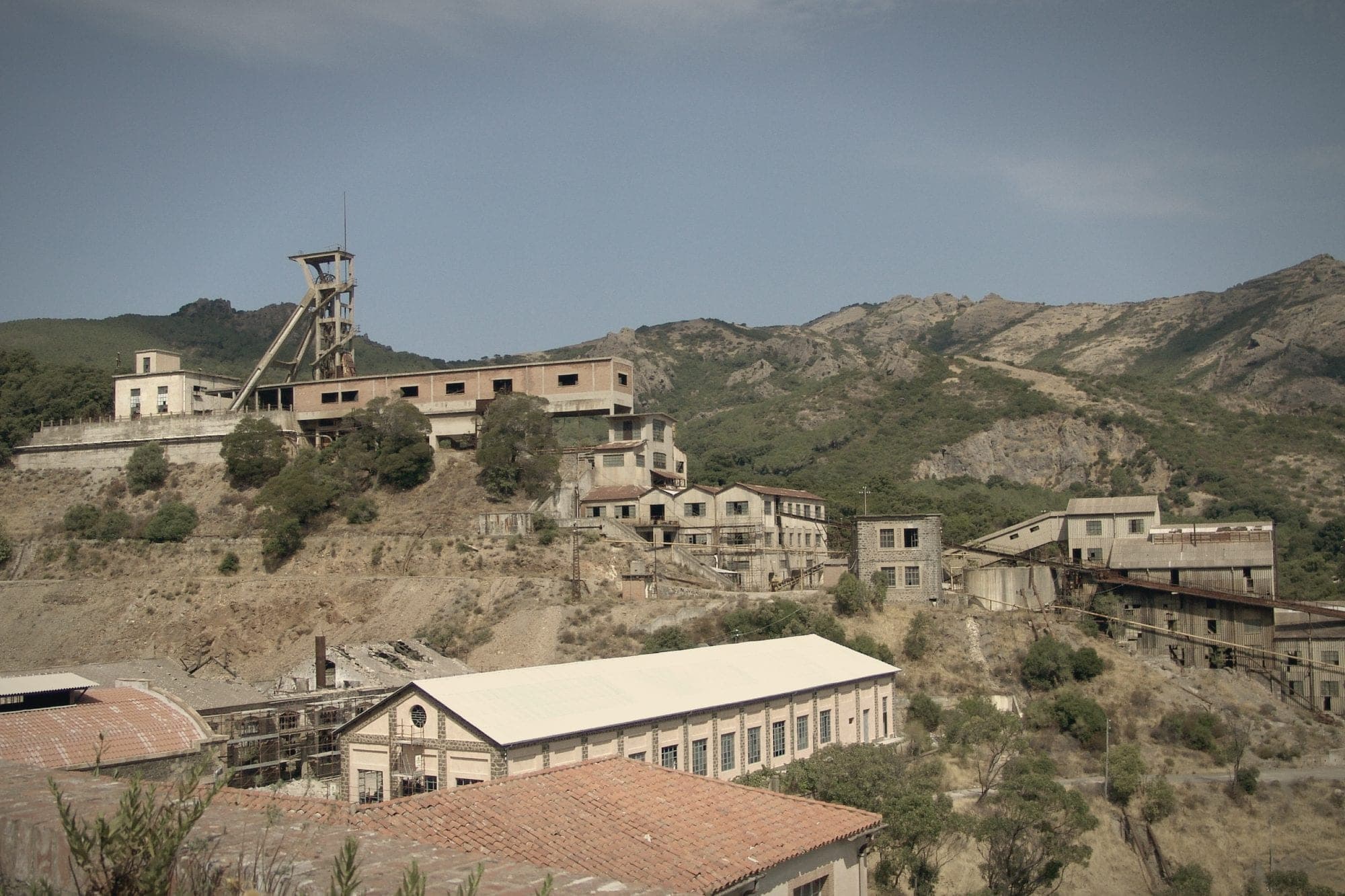
The ore did not come out clean. It was sorted by hand, crushed and washed in plants called laverie (washeries): the one named after Prince Tomaso was inaugurated in 1877. The Anglosarda gallery, dug between 1852 and 1872 for extraction, was later used for transport. The Sartori shaft goes down more than 500 metres. In 1903 a large Sullivan compressor arrived from the United States and can still be seen. These are simple things to say and hard to picture: all of this inside a hillside above Guspini.
Gennas Serapis: the village born from the vein
Around the shafts, from 1856, a settlement grew up: Gennas Serapis, today simply called Montevecchio. Local sources describe a complete village, designed so that workers did not have to go down to the nearest town: homes for workers, homes for clerks and managers, a hospital (1874), a school, a post office, a carabinieri barracks, a chemical laboratory and a geological office, and later a cinema and a football pitch. Everything was built and run by the company. The hospital, according to a travel guide, was considered among the most modern health facilities in Sardinia at the time: a single source, but consistent with the rest of the picture. A village like this was not born of generosity: a community with everything within reach is also a community that stays close to the work, and hardly leaves it.
How many people lived there? Here sources disagree, and it is right to say so. For 1865 they give 1,100 workers. For 1939, about 3,000 inhabitants in Gennas Serapis. Other pages say the settlement reached about 5,000 people. The peak workforce is placed in 1949, with figures between 3,500 and 3,750. The 2011 census counted 355 residents. The right number depends on what you count: those who worked in the mine are not the same as those who lived in the village, and there was more than one village.
The work was hard and began early. According to a 2023 news report, men went down the mine at 14, while women, from the age of 8, did the sorting: separating good ore from waste rock. Part of the pay came as scrip that could only be spent in the company stores. This appears in a single journalistic source, and the social history of Montevecchio deserves more studies than are easy to find online. But the picture, a town where the company provided work, housing, hospital and shop, recurs in every source.
The Management Palace: a house never lived in by the man who ordered it
At the centre of Gennas Serapis stands the Palazzo della Direzione, the Management Palace. Sanna had it built, in classical and neo-Renaissance forms, for two purposes at once: to house the company offices and to serve as a residence for his family. Sources differ slightly on dates: work started between 1869 and 1870, stopped, and the palace was completed in 1877 or in May 1878. One website gives 1886, but that looks like an isolated error.
The best detail is this: Sanna never lived there. He died in 1875, before it was finished. Work resumed in 1877 under the engineer Alberto Castoldi, husband of Zelì Sanna, with a scaled-down design.
Inside, the palace was a company in miniature. On the ground floor, the offices, where the miners collected their pay. On the first floor, the archive. On the second, the apartment of the general manager, with dining and tea rooms, smoking rooms, bedrooms and a blue reception room decorated with frescoes and stucco, with a grand piano, for meetings and receptions. In the attic lived the servants, with the large kitchen where copper pans still hang on the walls. Next door stands a small chapel dedicated to Saint Barbara, the patron saint of miners.
Read the floor plan and you read the hierarchy: who worked underground, who paid, who commanded, who served. Today the palace is a museum with period furnishings, and it still houses the historical archive of the mine, in the same rooms where it was formed.
The archive: memory kept where it was born
The archive is looked after by the Municipality of Guspini, under an agreement from 2002. It holds documents from 1848 to 1991: technical and geological studies, projects, maps, thousands of drawings of structures, civil buildings, machinery and processing plants. The oldest drawings analysed so far date to 1856. From 2002 to 2010 it was reorganised, catalogued and digitised for the cartographic part, and it is open in a public study room. Personnel records, moved to Iglesias in 1993, came back in 2002. According to the Municipality, it is the only archive preserving documentation from the mine's earliest years.
It is here that one could still check what is true and what is not: for instance, how many workers there really were in a given year, or how much lead came out. For now we know it from the summaries of those who have already done the work, and that is why the figures in this article are written with their source beside them.
From the twentieth century to the end: Montecatini, war, crisis
The twentieth century brings big changes of ownership. The economic crisis of 1929 pushes the company into an agreement with Monteponi; in 1933 it is forced to hand over management to Montecatini, a giant of Italian chemical and mining industry. Between 1939 and 1945 production reaches its peak. In 1949 the workforce is said to peak. In 1956 a summer camp for miners' children is built at Funtanazza. In 1971 Sogersa takes over, and from then on, according to local sources, a progressive decline begins that leads to closure.
Many pieces are missing: online sources do not say how many accidents there were, do not give the union history, do not explain well the ties between the company, the town of Guspini and the Arbus area. These are open questions for a scholar, not for a popular writer who wants to stay with what is proven.
The Amsicora shaft and the twenty-seven days
In 1991 the end arrives. On 22 April about 86 workers go down the Amsicora shaft and stay. It has been 143 years since Charles Albert's concession. The protest lasts 27 days, until 17 or 18 May (sources give one date or the other), when the agreement is signed between ENI, the Region and the unions: the mine closes for good.
Today the Amsicora shaft is a ruin beside provincial road 66, in the territory of Arbus. Anyone passing finds not a monument but an abandoned building: all that is left, at that spot, of a protest that lasted almost a month.
Three things to debunk
- "Sanna lived in the palace." No: he died in 1875, before it was finished.
- "The palace dates from 1886." Only one website says so. Institutional sources give 1869/70 to 1877/78.
- "Montevecchio is a UNESCO World Heritage Site." Imprecise. The mine belongs to the Geological, Mining and Environmental Historical Park of Sardinia, recognised by UNESCO in the late 1990s as the first geopark of its network. That is not the same as a World Heritage site.
Seeing Montevecchio in person
The site is open for guided visits, with walking routes among the shafts, washeries, workshops, workers' houses and the palace. The palace and archive stand in the upper part of the village, on the provincial road that climbs from Guspini towards Ingurtosu. It is a place where you can understand, on foot, what it meant to turn a hillside into an industry.
If mines intrigue you, start where it all began: read how the Nuragic people extracted copper in the prehistoric mines of Sardinia, or how the Phoenicians chose the island precisely for its metals in Why the Phoenicians chose Sardinia.
Cover photo: Maksim, CC BY-SA 3.0, Wikimedia Commons