On 6 November 2025 Italy's national statistics institute, Istat, published its count of centenarians as of 1 January that year: 23,548 people aged one hundred or more, two thousand more than the year before. Buried in the tables is a line that contradicts half a century of headlines about Sardinia. The Italian province with the most centenarians sits in Molise, a small region on the mainland: Isernia, with 78.7 per 100,000 inhabitants. The second one is Sardinian — Nuoro, with 65.5. But Sardinia as a region ranks twelfth out of twenty, with fewer than 45 centenarians per 100,000.
The two figures look contradictory and are not. Together they say something quite precise: the island's extreme longevity sits entirely inside one stretch of mountains. That stretch of mountains has a name that has travelled the world for twenty years — the Blue Zone — and a border almost nobody knows.
What the Istat table actually says
Italy had 10,158 resident centenarians in 2009 and 21,211 in 2024: more than double in sixteen years, up 130%. 82.6% are women. The number is growing for a mechanical reason before a biological one: the cohorts born around 1925, far larger than those before them, are now reaching one hundred.
Provincial rankings have to be read as rates, not as absolute numbers, otherwise Rome would always win. Per 100,000 inhabitants, as of 1 January 2025: Isernia 78.7, Nuoro 65.5, Siena and Gorizia 63.5, Imperia 61.2, Genoa 61.1, La Spezia 61.0. The other Sardinian province high on the list is Oristano, eighteenth with 52.7. The national average does not appear in the press release, but it follows from dividing 23,548 centenarians by 58.9 million residents: about 40 per 100,000. Nuoro therefore sits one and a half times above the national average, Oristano a third above it.
Source: Istat, I centenari in Italia (6 November 2025); the Italian average is calculated from 23,548 centenarians and 58.9 million residents
So far Sardinia is in good company and nothing more: two provinces above average, much like Liguria, much like Tuscany. The record appears when you stop counting centenarians and start counting the people who go well past one hundred.
Where Sardinia really does come first: age 105
Istat calls people aged 105 and over semi-supercentenarians. On 1 January 2025 there were 724 of them in Italy, against 654 a year earlier; 657 were women, 90.7%. Supercentenarians, those past 110, numbered 19, and eighteen of them were women.
In this extreme tail the leading Italian province is Nuoro: 9 people over 105 among just over 195,000 residents, that is 4.6 per 100,000. Ascoli Piceno follows with 4.5 and Imperia with 3.8. The national average, again computed from those 724 people, is about 1.2 per 100,000, so Nuoro has nearly four times as many.
Source: Istat, I centenari in Italia, data as of 1 January 2025; the Italian average is calculated from 724 people and 58.9 million residents
Nine people are few, and a number that small swings easily: one death and the rate drops by half a point. But the Sardinian tail also has a long history, made of names and documents. The longest-lived man in Italian history is Antonio Todde, born in Tiana, in the Barbagia highlands, on 22 January 1889 and dead on 3 January 2002: 112 years and 346 days, nineteen days short of his 113th birthday. From 9 December 2000 until his death he was the oldest living man in the world. Second on the all-time Italian list is another Sardinian, Giovanni Frau, at 112 years and 172 days. Two men at the top of the all-time Italian list are the phenomenon that research measured twenty years ago in those mountains.
Why the region only ranks twelfth
At the top of the regional table sits Molise, with roughly 61 centenarians per 100,000 inhabitants, then Liguria at 59.4, Friuli-Venezia Giulia at 55.4 and Tuscany at 49.1. Sardinia, below 45, sits just above the national average and behind eleven other regions.
A distinction is needed here that headlines almost always skip. A high regional rate can come from two different things. It can come from a very old population — few young people, so proportionally more old ones, as in Liguria. Or it can come from a genuinely higher chance of reaching one hundred, which is something else. On a regional scale Sardinia has neither. It does have an age structure that is ageing fast, but the average Sardinian life is not longer than the average Italian one. In 2024 life expectancy at birth in Sardinia was 82.8 years against 83.4 nationally: the island of centenarians sits below Italy, and barely above the Italian south (82.4).
The two facts coexist because they measure different points of the same distribution. Life expectancy describes the centre: how long the average Sardinian lives. The centenarian rate describes the tail: how many people break through the limit. An island can have a mediocre average, for the health and social reasons listed in every report on southern Italy, and at the same time contain a patch of territory where the limit is broken more often than anywhere else. That is what happens here, and it is why the two rankings — twelfth region, second province — have to be read together rather than against each other.
How you draw a Blue Zone
The term "Blue Zone" was born around the year 2000, in Sardinia, out of the work of two people: physician Gianni Pes, of the University of Sassari, and Belgian demographer Michel Poulain. They were doing the least glamorous job imaginable — checking ages, birth record against death record, village by village, to establish which centenarians really were centenarians. Whenever a village passed the threshold, they circled it on the map in blue ink. The circles touched and formed a blot over the mountains of the central-east. The name of a phenomenon that now sells books worldwide comes from the colour of the pen they happened to be holding.
The method is laid out in the paper the two published in 2004 in Experimental Gerontology, with Claude Grasland, Ciriaco Carru, Luigi Ferrucci, Giovannella Baggio, Claudio Franceschi and Luca Deiana. The indicator is called the extreme longevity index, and it does not count how many centenarians a village has today. It counts what share of the people born in that village between 1880 and 1900 reached the age of one hundred. The difference is decisive. Counting the living rewards villages where the old stay and the young leave; counting the born measures the probability that a person born there would make it, and emigration — which in the Barbagia was massive — does not distort the result.
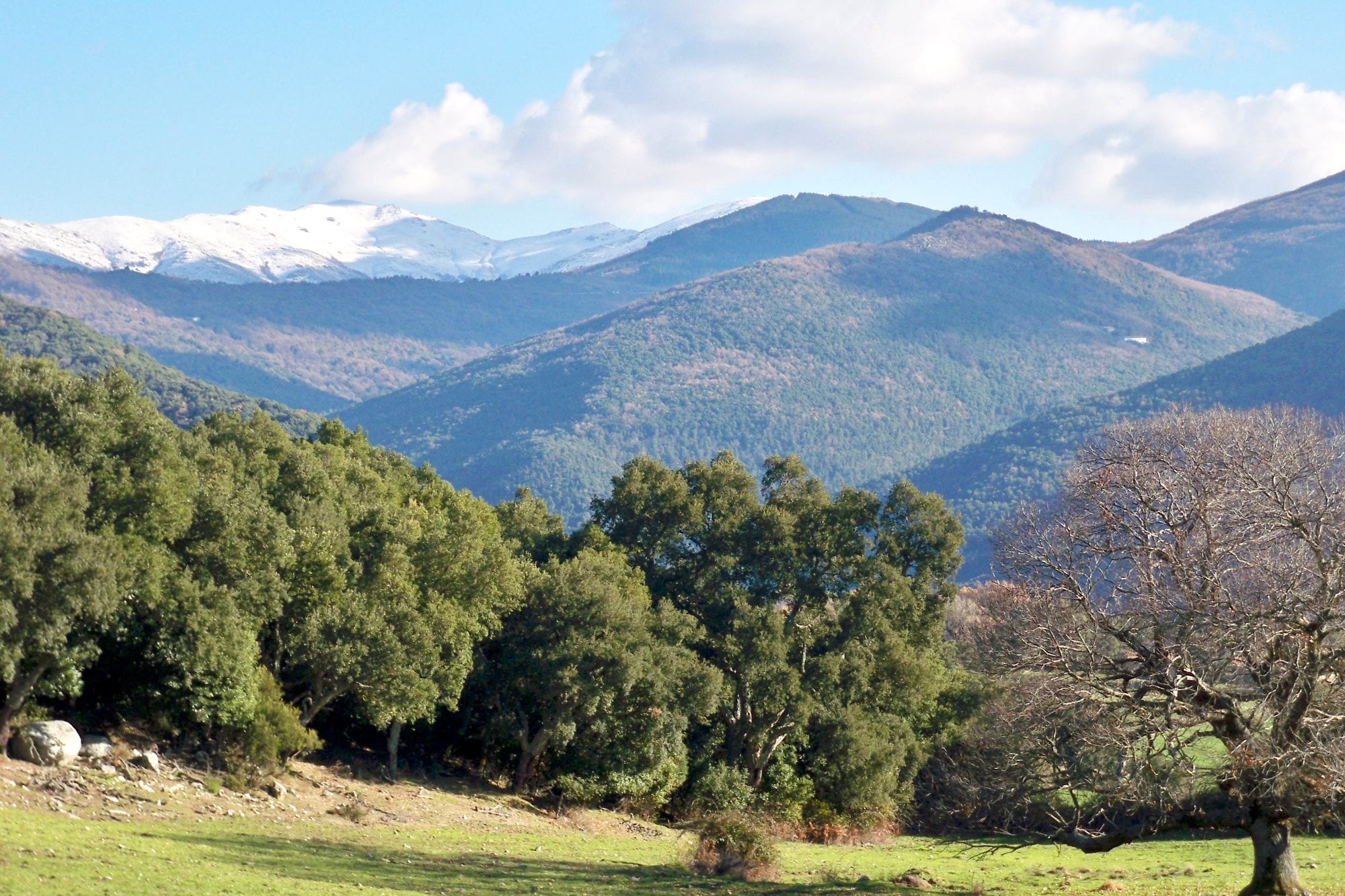
Applied village by village and then smoothed, so that a continuous area emerges instead of a mosaic, the index draws a zone covering the central-eastern part of the island and all the mountain areas of central Sardinia: in practice the Barbagia and the Ogliastra, some fifteen villages, from Villagrande Strisaili in the south-east up to the villages ringing the Gennargentu massif.
What made the area a world case, however, is not the number of centenarians. It is their sex. Elsewhere in the world, women reaching one hundred outnumber men four or five to one; in Italy, as we saw, they are 82.6% of the total. Inside the Blue Zone the ratio of male to female centenarians is 1.35, against 2.43 in the rest of Sardinia. The men there do not fall behind.
On the cause, the paper is honest in a way the popularisations that followed have not been: the mechanism remains unknown. The authors offer a hypothesis — high rates of marriage between relatives and very little immigration would have narrowed the genetic pool of those valleys, letting through traits that protect against the diseases that kill in old age — and note that whatever the effect is, it acts more strongly on men than on women, which points to something hormonal or carried on the sex chromosomes. The paper does not say red wine. It does not say sheep's cheese. It does not say walking uphill.
The record-holding province no longer exists
One administrative detail made the Istat headline out of date the moment it appeared. Those 65.5 centenarians per 100,000 and those nine people over 105 are calculated on a province of Nuoro with more than 195,000 residents — that is, with the Ogliastra inside it: the eastern coastal district and the mountains above Tortolì, which are the heart of the area circled in blue.
That province lasted until 17 July 2025, when the province of Ogliastra, re-established by regional law 7 of 2021, became fully operational. The Ogliastra had already been a province between 2005 and 2016, before being abolished and reabsorbed. Twenty-two municipalities left Nuoro; one, Seulo, joined it from the province of South Sardinia. Nuoro now has 53 municipalities and 142,241 inhabitants; the Ogliastra has 23 and just over 54,000.
In other words, the record published in November 2025 belongs to an entity that had already been split in two by July. When Istat publishes the figures for 1 January 2026, the centenarians of Villagrande Strisaili and those of Tiana will land on two different lines of the same table, and neither line will look like this one. Nothing changes for the people; everything changes for the ranking. As a statistical object, the Blue Zone has just been cut in half by a border drawn for entirely unrelated reasons.
What these numbers do not say
The most serious objection to the Blue Zone concept is not about Sardinia in particular but about the whole category. On 12 September 2024 demographer Saul Justin Newman received the Ig Nobel Prize in demography for work pointing in the opposite direction to the longevity industry: the highest rates of extreme old age, he argues, are well predicted by poverty, by the absence of birth certificates, and by a number of ninety-year-olds lower than expected — in other words by unreliable civil registers, sometimes by pension fraud. He says he has tracked down roughly 80% of the people in the world claiming to be over 110 and found that almost none of them have a birth certificate.
Sardinia is the case that stands up best to this criticism, and not by accident: Italian civil registration has been compulsory since 1866, and documentary age validation was the first step of the 2004 study rather than a check bolted on afterwards. What Newman's argument does hit squarely is a different move: the jump from measurement to explanation. The concentration exists and is documented; the diets, the glasses of wine and the lifestyles that get told as its cause have never been demonstrated by independent data. The same gap between a solid figure and the story built on top of it turns up, on very different ground, in the supposed astronomical geometries of the nuraghi.
One question none of the available sources closes: the extreme longevity index looks at people born between 1880 and 1900, raised on bread, legumes and compulsory walking, without cars and without refrigerators. Someone born in those same villages in 1960 ate, worked and was treated in another world. Nobody has yet published the index for later cohorts, so we do not know whether the Blue Zone is a property of those mountains or of one generation. Meanwhile the same municipalities have the lowest birth rate in Italy and schools that keep closing: the province holding Italy's record for people over 105 may, eighty years from now, not have enough births to produce any more.
Cover photo: Istudente, CC BY-SA 3.0, Wikimedia Commons