On 21 October 2026 Istat, Italy's national statistics institute, released its report on births in 2025. One line in it concerns Sardinia: 0.85 children per woman. It is the lowest figure among Italy's twenty regions, and the only one below one. This is not a one-year dip: it has happened every year since 2020, six years running. To understand what that number means, it helps to put an older one beside it. In 1952 a Sardinian woman had on average 3.8 children, against an Italian average of 2.3: the island had more children than almost anywhere else in the country. In three generations the same island went from top of the class to bottom, and the fall was not gradual.
This article lines up the figures, the years when the curve flipped, and the explanations in circulation — keeping apart what the data says from what it does not.
What 0.85 actually measures
The total fertility rate does not count the children of a real generation. It counts those of a hypothetical woman who passed through her entire fertile life with the rates observed in a single year. It is a snapshot indicator: if women have children later, the figure for that year drops even when the final number of children per lifetime stays the same.
That said, the snapshot is stark. The level that keeps a population stable without immigration is 2.1 children per woman: Sardinia's 0.85 is 40% of that threshold. The Italian average for 2025 is 1.14, already a national record low; Sardinia sits at 75% of that. Next after the island come Molise at 1.02 and Lazio at 1.05, while the top of the table is held by Trentino-Alto Adige, in the Alps, at 1.40. Compared with 2024 Sardinia lost six hundredths, from 0.91 to 0.85, one of the sharpest annual drops of any Italian region.
Source: ISTAT, Demographic indicators, year 2025
There is a second indicator, often confused with the first: the crude birth rate, how many babies are born per thousand inhabitants. In 2025 Sardinia recorded 4.1 per thousand against Italy's 6.0, and according to the 33rd report of Crenos — the economic research centre run jointly by the universities of Cagliari and Sassari — it is the lowest in Europe. The two numbers worsen together for a mechanical reason: not only does each woman have fewer children, there are also fewer women of childbearing age every year. This is where a widespread claim needs dismantling: Sardinia does not have Europe's lowest fertility rate. Eurostat data for 2024 puts sixteen Spanish regions, seven Polish, three Greek, two German and two Lithuanian regions below one child per woman too, and the continental minimum is La Palma, in the Canary Islands, at 0.76. Sardinia's European record is in births per thousand people, which is a different measurement. The global comparison fails as well: South Korea, the case everybody cites, stood at 0.80 in 2025.
1990, the year the curve flipped
Recent Sardinian demographic history reads best in stages. Until the 1970s the regional average stayed around three children per woman, a farming-country figure. During the 1980s it fell below two. In 1990 came the reverse overtaking: for the first time Sardinian fertility dropped below the Italian average, and it never climbed back. In 1998 the island went below one child per woman for the first time. 2019 was the last year with at least one child per woman; from 2020 began the run of six consecutive years below that line which Istat records today.
Sociologist Gianfranco Bottazzi, of the University of Cagliari, writing in March 2025 in the journal Dialoghi Mediterranei, distinguishes two separate demographic crises — a distinction worth keeping, because the two get conflated. The first, from the mid-1950s to the late 1960s, was a crisis of emigration: roughly 140,000 people left on net, 9% of the island's population, heading for Belgium, Germany, Switzerland and the industrial cities of northern Italy. Yet in those same years Sardinian women were having three children each: the island emptied at one end and refilled at the other.
The second crisis, the one that began in the 2000s, works the other way round. Migration is no longer the main hole — in 2024 the balance with foreign countries was actually positive by 2,412 people — while births are. The difference changes the conclusions: in the 1950s Sardinians left, today Sardinians are not born. The first can be reversed with a return ticket. The second cannot.
2024 in two numbers: 7,052 and 18,519
Rates say little until you look at absolute figures. In 2024 Sardinia recorded 7,052 births and 18,519 deaths. The natural balance was -11,467: two and a half deaths for every birth, 2.63 to be exact. Resident population fell to 1,562,381 at the end of 2024 and, according to Crenos, to 1,554,490 on 1 January 2026 — the fifteenth consecutive year of decline.
Behind those two numbers sits an age structure that makes them almost inevitable. The average age of Sardinians rose to 49.2 years in 2024. People over 85 number 65,742, 4.2% of the population. The ratio of old to young is 300 to 100: three people over 65 for every child under 15. In towns with fewer than five thousand inhabitants — 84.4% of Sardinia's 377 municipalities — the ageing index reaches 395.8, nearly four elderly people per child.
This structure produces what demographers call negative momentum: the girls not born in the 1990s are the thirty-year-olds missing today, and that shortfall carries forward. Even if fertility rose to 1.5 tomorrow, births would stay low for decades, simply because there are not enough women of an age to have them.
Why here
Here begins the honest part of the article: measured causes are few, correlations many.
The Crenos 2026 report, which this year takes migration and human capital as its theme, puts the graduate exodus at the centre. In 2023 the net migration balance for graduates aged 25 to 39 was -16.4 departures per thousand resident graduates, against a national average of -6.2: almost triple. These are precisely the people who would have had children in the following years, and who will have them somewhere else. Meanwhile only 25.6% of young Sardinians aged 25-34 hold a degree, against a European average of 44.1%: the island loses the most educated slice of an already narrow base.
Then there are costs. Again according to Crenos, house prices and rents in Sardinia have risen 46.6% since 2018, pushed partly by tourist demand: buying or renting where you were born has become hardest for exactly the age group that would start a family. And there is the timing of life: the average age at childbirth in Sardinia is 33.2 years, the highest in Italy alongside Basilicata and Lazio, against a national 32.7. Every year of delay removes possible children from the end of the span.
One less-quoted figure points to a deeper cultural shift: in Sardinia 59.4% of children are born outside marriage, the highest share in Italy, where the average is 44.1%. That is not in itself a sign of crisis — it is evidence that the Sardinian family changed far faster than the clichés about it, and that the traditional model no longer holds even where rhetoric treats it as eternal.
None of these factors alone explains 0.85. Insecure work, low incomes, health and school services far away in inland villages, the transport costs of island life: they are observed together, not isolated and measured as causes. Anyone claiming to know the reason is simplifying.
The villages where you can see it
In Baradili, in the inland Marmilla hills, 80 people lived in 2026. It is the least populated municipality in Sardinia, with a birth rate close to zero, a medieval village core surrounded by vineyards and almond groves, and the same administrative machinery — mayor, budget, registry office — as a town twenty times its size.
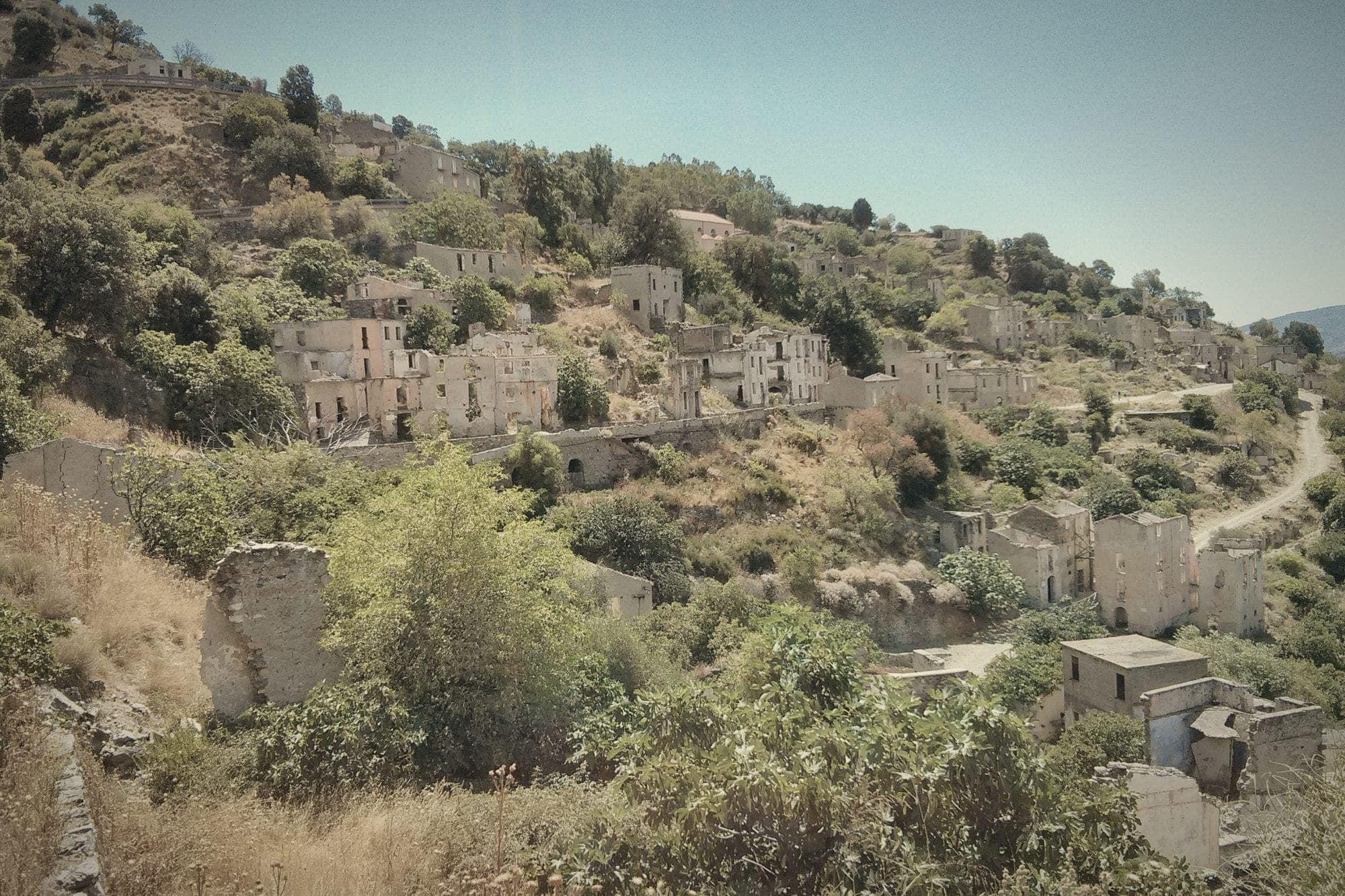
Some sixty kilometres away as the crow flies, in the eastern Ogliastra region, stands Gairo Vecchio: rows of roofless houses on a hillside, not one inhabitant. There, though, demography was not the cause. Between 14 and 19 October 1951 eastern Sardinia took 400-500 millimetres of rain a day for four consecutive days, an absolute record in the island's climate history, and the village — already unstable with landslides, to the point that its name means "land that flows" — was declared unsafe. Its people split into three new villages further down the valley. Gairo Vecchio shows what happens when a village empties all at once; what today's data describes is the same thing in slow motion, and without a flood.
The hardest paradox sits at Perdasdefogu, also in Ogliastra. It is one of the fourteen villages of the so-called Blue Zone, the area that physician Gianni Pes and Belgian demographer Michel Poulain circled with a blue marker in the early 2000s because it had the world's highest density of male centenarians. On 1 June 2012 Guinness World Records certified the nine Melis siblings as the longest-lived family on the planet: 818 years and 205 days between them; a year later the total stood at 828 years and 45 days, with eldest sister Consolata at 105. The same villages that hold the world record for longevity now have the highest ageing index and the schools that close. Living long and having children are different things: Sardinia tops both tables, at opposite ends.
What the regional government is trying, and what the figures say
The main instrument is the birth allowance set out in article 13 of regional law no. 3 of 9 March 2022, whose updated guidelines the regional cabinet approved on 5 June 2025: 600 euros a month for a first child and 400 euros for each additional child, for five years, to families living in or moving to a municipality with fewer than five thousand inhabitants. For 2026 the region has allocated over 51.4 million euros to measures against demographic decline. On 23 October 2026 the second piece arrived: up to 20,000 euros for under-40s who move to Sardinia and work or start a business, 30,000 if the town has fewer than five thousand inhabitants, with 56 million over three years. The operating call for applications had not yet been published at the time of writing.
Does it work? The honest answer is that nobody knows yet. The allowance has existed since 2022, and over the same stretch regional fertility went from 0.95 to 0.85. That is not proof of failure — a measure aimed at small towns has to be measured on those towns, not on the island average, and five years is too short to see the effect of a decision that plays out over twenty — but no public data shows a reversal. Politically the criticism is already there: the Riformatori party rejected the under-40 plan, arguing that "paying young people will not work". That is a position, not a study.
Source: ISTAT
What happens if nothing changes
Istat's projections with a 2024 base give the trajectory. Between 2024 and 2030 Sardinia would lose 4.10% of its population, against 0.81% nationally: a decline five times faster. By 2050 the island would fall below 1,250,000 inhabitants, more than 317,000 fewer residents than today, with the over-65s near 42%, the highest share of any Italian region. By 2080 just over 850,000 people would remain: -45.74% against 2024, compared with -22.30% nationally. Households thin out too: between 2024 and 2050 the island would lose 89,067 of them, with average household size below two people from the 2040s onwards.
Projections are not predictions: they are the output of assumptions about fertility, mortality and migration, and they change when the assumptions do. But they give the scale of the problem. An island with 1.55 million inhabitants today, and a little over 850,000 by the end of the century, is an island with fewer schools, fewer transport links, fewer health centres and fewer town halls able to stay open.
Five things the numbers say that rarely get read
- Sardinia was not always like this. In 1952 it recorded 3.8 children per woman against an Italian 2.3, and its population grew from roughly 600,000 in 1861 to 1.6 million by 2020. The collapse is recent, fast and concentrated in the past thirty-five years: it is not some historical condition of the island.
- Emigration is no longer what empties the island. In 2024 the natural balance was -11,467, while the migration balance with other countries was positive by 2,412. Foreign residents number 54,091, 3.5% of the regional population, up by 2,050 in a year. The hole is in the cradles, not at the ports.
- Sardinia's European record is the birth rate, not fertility. 4.1 births per thousand inhabitants is the lowest in Europe according to Crenos; Europe's lowest fertility rate belongs to La Palma, in the Canaries, at 0.76. Mixing up the two indicators is the commonest error when these figures reach the press.
- The Sardinian family has already changed. 59.4% of children are born outside marriage, the highest share in Italy. Anyone reading the birth collapse as the effect of abandoning the traditional family is describing a transformation that already happened, not a cause.
- Town-level figures are not in the press releases. Istat publishes regional values; to learn how many children were born in a single village you have to go to the municipal population registers. There is currently no public, up-to-date count of Sardinian municipalities with zero births in a year — one of the things that would make the phenomenon far more legible to the people who have to decide.
Where to check these numbers yourself
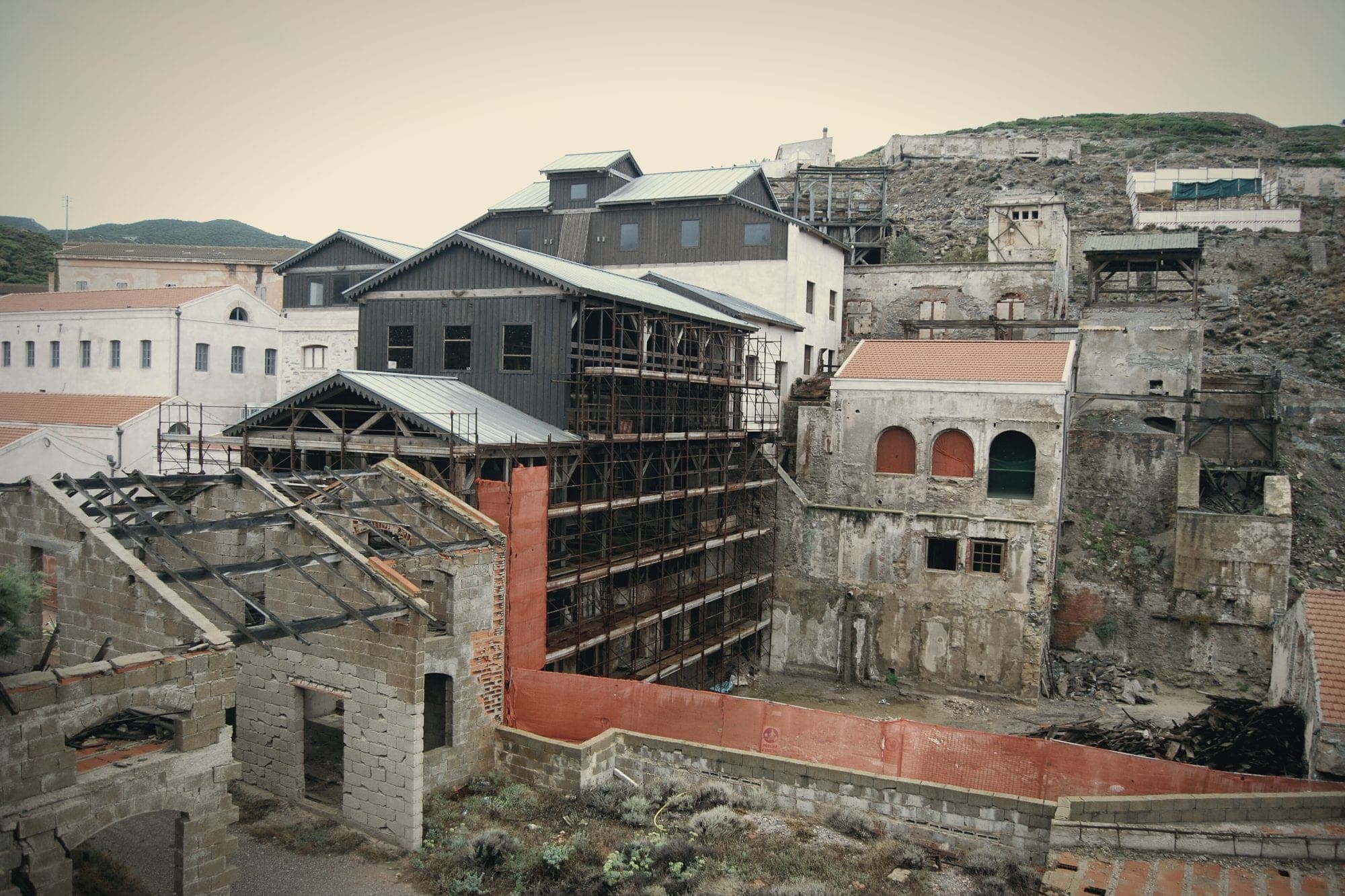
Every figure quoted here is public. Istat publishes its Demographic indicators each spring and its Births and fertility of the resident population report each autumn, with downloadable regional tables; Crenos puts the full volume of its annual report on the Sardinian economy online; Eurostat lets you compare European regions one by one. The rest you see by visiting inland villages out of season, where statistics turn into a street with no children on it. If you want to see how a Sardinian village can empty completely, start with Argentiera, the mining village in the north-west left standing after its mine closed, or with Montevecchio — then ask how many others will get there without any mine closing at all. The Sardinian language measures the same thing from another angle: it passes from one generation to the next, and a generation that is not born does not receive it.
Cover photo: Mbarrieau, CC BY 3.0, Wikimedia Commons