In the autumn of 2010, somewhere between the Campidano plain and the uplands of the Logudoro, a volunteer with a tin of yellow paint drew an arrow on a dry-stone wall. It was the first waymark of the Cammino di Santu Jacu. Painting enough of them to cover the whole route from Cagliari to Porto Torres took two more years of weekends, with no public money at all.
Today the route is sold as "Sardinia's Camino de Santiago": roughly 1,600 kilometres of trails, around a hundred municipalities, a pilgrim credential to get stamped and a certificate at the end. What sits underneath the slogan is better than the slogan. The churches the route strings together are seven hundred years old and are catalogued one by one by the regional authorities. The route itself dates from 2009, and nobody had ever walked it before.
An idea from one winter
It started in the winter of 2009, among a group of Sardinians who had already walked to Santiago de Compostela in Spain. Their question was simple: could something like it work here? The answer was a proposed line between Sant'Antioco and Porto Torres, drawn on a single rule — join up the churches and ruins dedicated to Saint James, Santu Jacu in Sardinian, the island's own Romance language.
In December 2010 the group formalised itself as the association "Amici del Cammino di Santu Jacu", led by Flavio Vandoni, based in the small town of Mandas. The first yellow arrows and stylised scallop shells — both borrowed wholesale from the Spanish camino — had gone up that same autumn. Light waymarking of the entire central axis was finished in October 2012; by 2015 the signs had reached inside the villages, where getting lost is easier than in open country.
The institutional step came at the end of that same year. On 11 December 2012 the Regional Government of Sardinia listed it among its tourist-religious itineraries: the first one, and the base on which the island's other walking routes were later built. A year later, on 7 December 2013, a regional agreement tied in the municipalities along the way.
Churches used as waymarks
The association's own survey counts 38 churches and ruins dedicated to Saint James across Sardinia, 24 of them on the central axis. The rest is the part the brochures skip: abandoned buildings, collapsed walls, dedications that survive only in a place name. A route built on that list is also a map of rural depopulation.
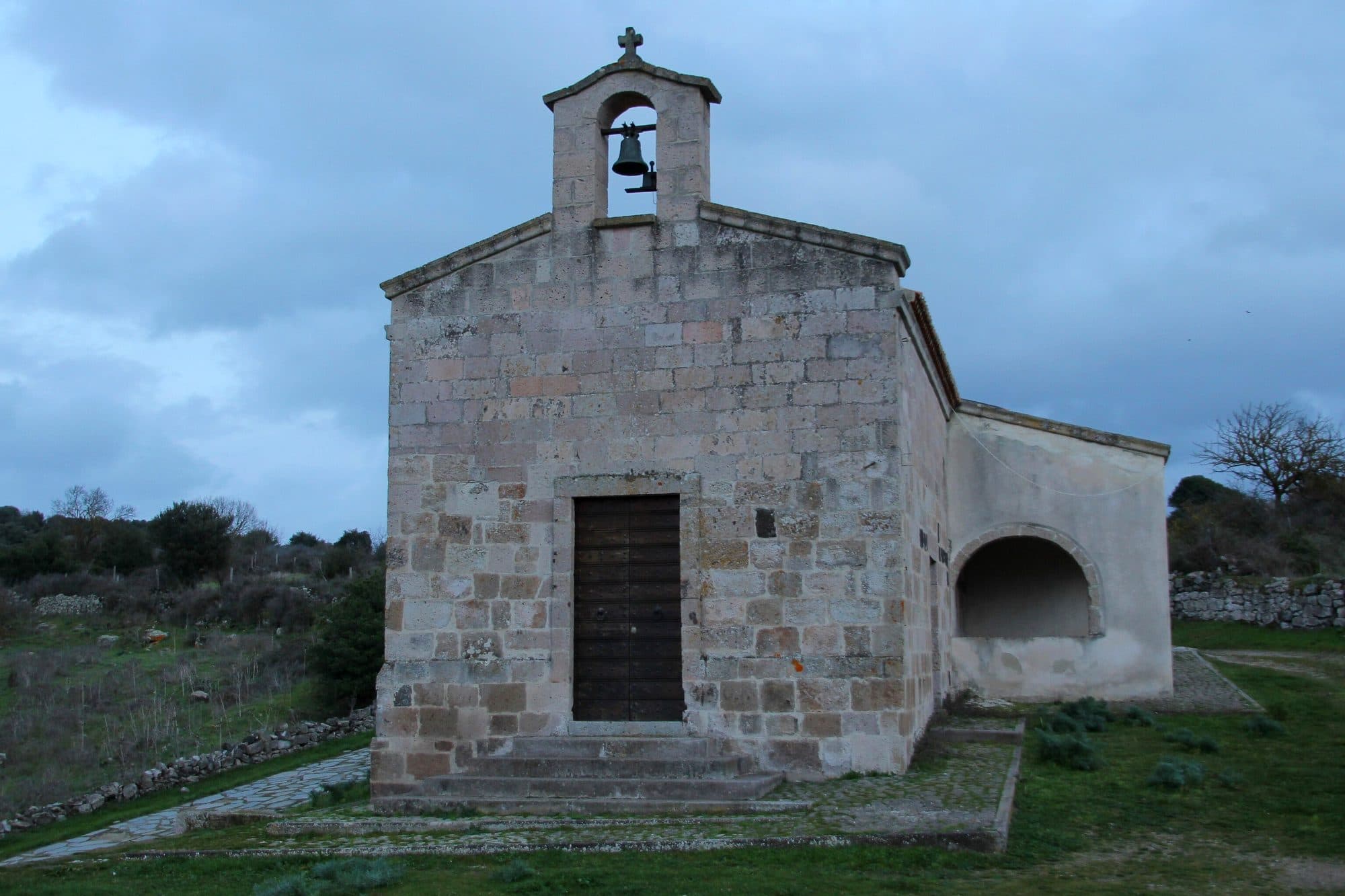
Ittireddu, in the Logudoro, shows it plainly. Its church of San Giacomo stands a kilometre outside the village, medieval in form, built of local limestone with dark volcanic inserts that give the north wall a two-tone banding. The regional heritage service dates it to the first half of the 13th century and suggests it served Cherchedu, a village that emptied out from the 1400s and then vanished. The church stayed where it was; the settlement around it did not.
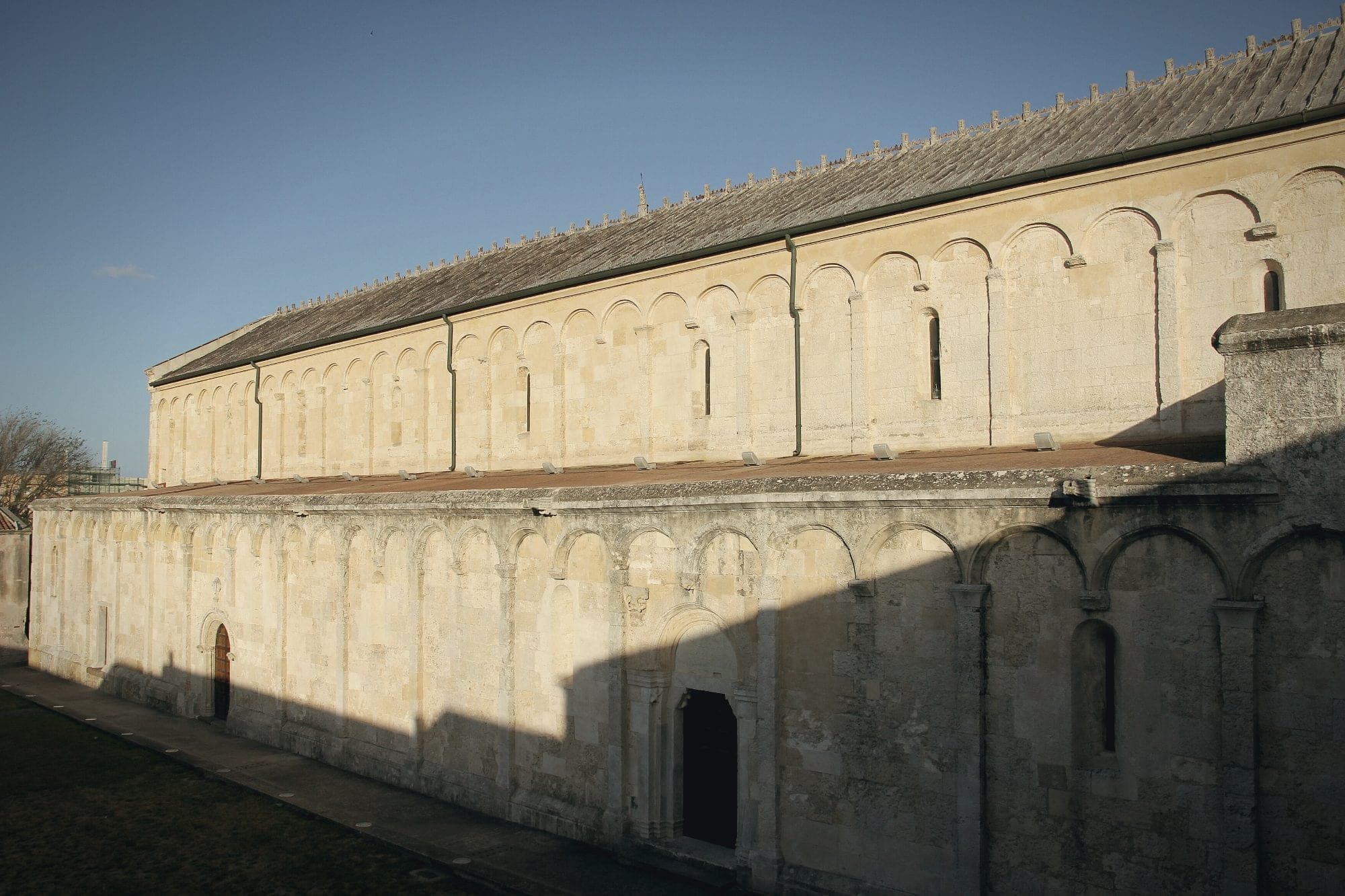
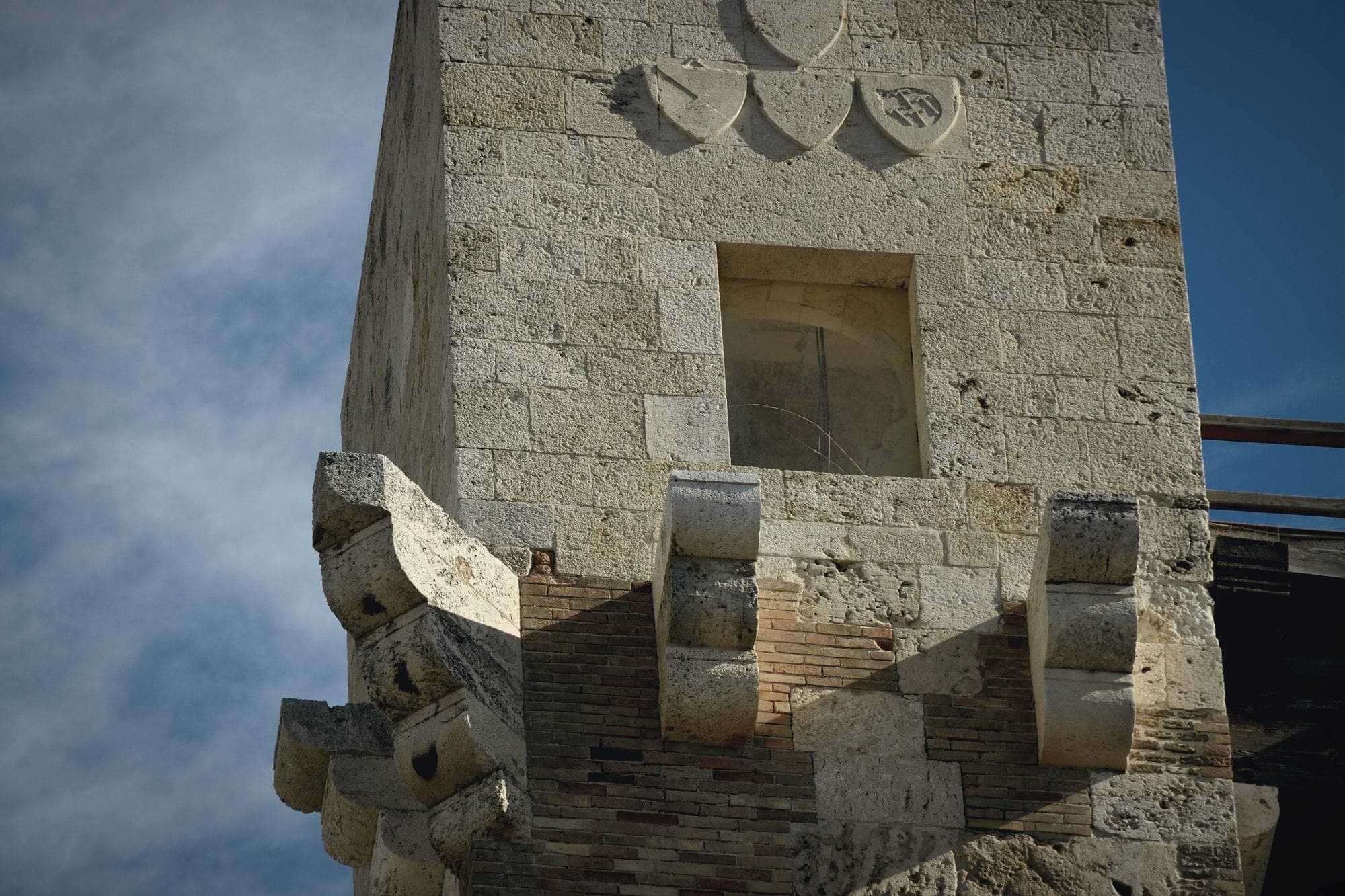
In the city the story runs the other way. The church of San Giacomo in the Villanova quarter of Cagliari first appears in the ordinances of the Castello councillors in 1346 — the years when the city was being fought over by Aragon and the collapsing Sardinian kingdom of Cagliari. It is one of the island's earliest examples of Catalan Gothic, and it became the model for parish churches across central and southern Sardinia between the 15th and 17th centuries, from Assemini to Sestu. A century after that first mention it gained a square bell tower thirty metres high; it was raised to collegiate status in 1630 and consecrated in 1781.
At Orosei, on the east coast, the church of San Giacomo Maggiore is recorded from the 14th century, but its present shape comes from enlargements begun in the 1600s: a cluster of domes under terracotta tiles and a plain bell tower, standing over the old town.
How long is it, actually
This is where the ground gets soft, and it is worth saying so before quoting any figure. For the central axis — the identical stretch from Cagliari to Porto Torres — four different distances are in circulation: 430 kilometres on the front page of the route's official website, about 456 on a detail page of the same site, 460 in the association's material, and 470 in the file published by the municipality of Mandas. Low to high, that is forty kilometres of slack: nearly ten per cent of the walk, or two full days.
For the whole network the gap is wider still. Mandas, the lead municipality, says around 1,600 kilometres; the association that drew the lines says around 1,400. The branches are steadier: 257 kilometres from Porto Torres to Olbia, 142 from Bolotana to Oristano towards the Sinis peninsula, and 120 kilometres in six stages for the Cammino di Sant'Antioco loop between Iglesias and the island of Sant'Antioco.
None of these numbers comes from a survey published by an independent body. They all come from the promoters, and they contradict each other. That is not pedantry — it is why every figure in this article carries the name of whoever is claiming it.
Credential, stamp, Testimonium
The machinery is copied from Spain, and openly so. Walkers pick up a Credenziale, a paper passport stamped along the way; the stamp is called the sello, exactly as in Galicia. It can be collected in person at Cagliari, Mandas, Olbia, Porto Torres, Tempio Pausania, Sorgono and Sant'Antioco.
At the end comes the Testimonium. You qualify with at least 100 kilometres on foot, or five consecutive stages, or 200 kilometres by bicycle, proven by stamps collected in date order. It is handed over at Porto Torres for those walking northwards, at Cagliari for those coming the other way, or sent by post or as a digital file.
That 100-kilometre threshold is the same one the cathedral of Santiago requires for the Compostela, and the borrowing is deliberate — though it lands differently. In Galicia the last hundred kilometres end at the tomb the pilgrim set out to reach. In Sardinia they end at Porto Torres, on the hill above the harbour where the ferries leave for Barcelona. Strictly speaking, the Sardinian pilgrim stops walking at the point where a medieval one would have started.
From Mandas to Malta
Two things have happened in recent years, one inside the island and one well beyond it. On 20 March 2023 a protocol was signed by the regional tourism department, the Sardinian Bishops' Conference and more than sixty municipalities, with Mandas leading: the route became a formal commitment of public bodies rather than of volunteers with paint tins.
Outside, on 10 January 2023, Malta's Ministry of Culture announced the Camino Maltés: a roughly 3,600-kilometre route running from Malta to Santiago by way of Sicily, Sardinia and Catalonia, joining the Camino Francés in Spain. The Maltese section is 35 kilometres long; the Sardinian one is the Cammino di Santu Jacu, which stays autonomous and keeps issuing its own Testimonium.
This is the point where headlines have run ahead of the facts. "Sardinia joins the Camino de Santiago" describes a project its own promoters, the Maltese NGO XirCammini, call a work in progress still in its infancy. It is not a certified historic road. It is a set of modern routes that have agreed to line up.
What we do not know
Three gaps are worth stating.
The first is the serious one. None of the available sources documents a historic Sardinian route to Santiago, or a single document — a condaghe, a will, a travel licence — recording pilgrims leaving the island for Galicia. That the cult of Saint James was present in medieval Sardinia is beyond dispute: the churches say so, one by one. That there was a way, a road actually walked and recognised as such, does not appear anywhere. The 2009 line does not retrace an old road; it connects dots on a map.
The second is about the present. The association published visitor figures up to 2014 — more than three hundred registered pilgrims between 2011 and 2013, fifteen hundred in 2014 — and nothing public since. How many credentials are issued now, how many Testimonium are collected at Porto Torres, how it compares with Sardinia's other walking routes: nobody outside the association knows. Calling it an unknown pilgrimage is an impression, not a measurement.
The third is small but telling. Even the date of the Ittireddu church moves: the regional record says the first half of the 13th century, while the Enciclopedia della Sardegna edited by Francesco Floris puts it in the 12th. The scholarly literature on the cult of Saint James in Sardinia sits in volumes and conference proceedings that never reached the web, and the census of thirty-eight churches is a list compiled by walkers, not a study.
None of which takes anything away from the trails. The Cammino di Santu Jacu brings people on foot into villages that see nobody in winter, and keeps open churches that would otherwise unlock one day a year. It is fifteen years old, it runs over a devotion seven centuries older, and telling it that way makes it more interesting, not less.
Cover photo: Gianni Careddu, CC BY-SA 4.0, Wikimedia Commons