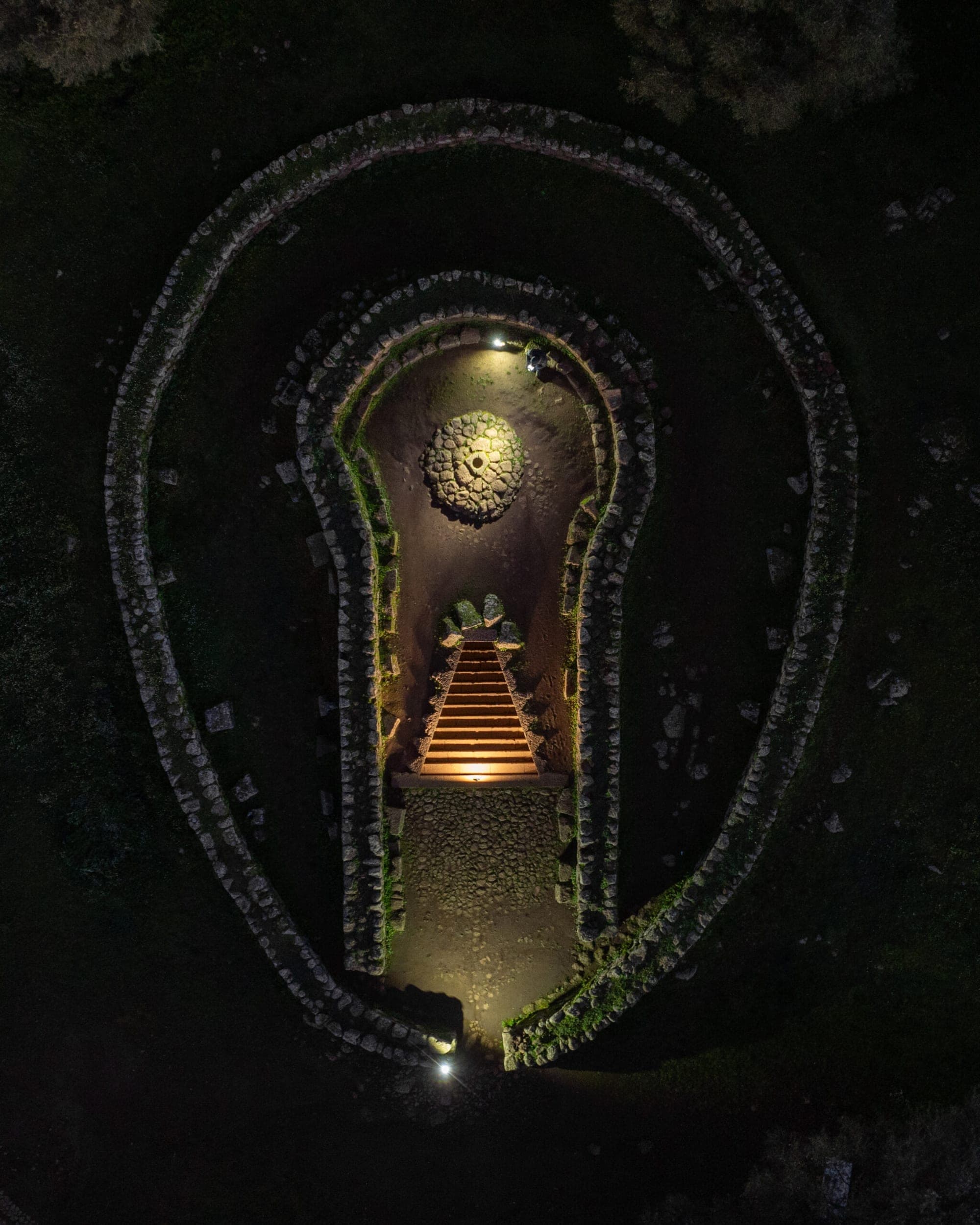
Late on 12 January 2025, at around 11:40 pm, roughly a hundred people stood in the cold around a hole in the ground in the countryside of Paulilatino, in central Sardinia. They were waiting for the Moon. It arrived about 78 degrees above the southern horizon, almost directly over the circular opening that closes the corbelled dome of the sacred well of Santa Cristina. Its light slid down the basalt shaft and settled on the water at the bottom, where from below it looks like a motionless silver disc. It had not happened for eighteen years.
The event is real. It was watched, filmed, reported. And that is precisely where the difficult part begins, because from one true fact — the Moon enters the well — three further claims are routinely drawn that are not yet established: that the alignment was designed, that it is accurate to within a few arcminutes, and that the well was built to predict eclipses.
The distance between that first fact and those three claims has a name. It is called method, and archaeoastronomy has spent sixty years learning it the hard way.
The sky offers too many targets
The starting point is geometry, not archaeology. How many "notable" celestial targets can a wall point at? Two solstices, the equinox, the four lunar extremes, the brightest stars. It sounds like a short list. The problem is how much of the horizon that list covers.
At Sardinian latitudes — Paulilatino sits at 40.06 degrees north — the Sun always rises within an arc of about 64 degrees, between its summer solstice and winter solstice rising points, and sets within an equal arc on the other side. The Moon, which swings wider, covers roughly 79 degrees on each side. Add risings and settings together and the Sun and Moon alone account for about 44 per cent of the full circle of the horizon.
Nearly half of all possible directions, in other words, already point at something astronomically notable. Stars make it worse: the statistician Sherry Towers calculated that the 21 stars brighter than second magnitude cover 84 degrees of horizon between them, giving a chance-coincidence probability of better than one in five. Which means that if you take a wall at random, measure it, and then look up what lies in that direction, the answer "something does" is close to guaranteed before you start.
On its own this observation refutes nothing. But it does mean that finding a match is not news. The news starts when you can show that the match occurs more often than chance predicts.
Too many lines: the lesson of Stonehenge
In 1963 the astronomer Gerald Hawkins published in Nature the idea that Stonehenge was a kind of astronomical computer, and two years later turned it into the book Stonehenge Decoded. He had counted twenty-four significant alignments between stones and celestial targets, and stated that the probability of their being accidental was about one in a million.
In 1966 the archaeologist Richard Atkinson, who had excavated at Stonehenge, replied with a paper called Moonshine on Stonehenge. The title puns on the word: moonshine is both the light of the Moon and, in English, nonsense. Atkinson redid the arithmetic with pencil and paper and found three things.
First: with Hawkins's own numbers, the correct probability was 0.000006, not 0.000001. A small error. The second was large: Hawkins had computed the probability of getting exactly twenty-four alignments by chance, when the sensible statistical question is the probability of getting at least that many. The third was decisive. Among the fourteen points considered there were 182 possible sight-lines, rising to 272 if all the post-holes near the Heel Stone were included. Redone properly, the probability of obtaining twenty-three or more alignments by pure chance came out at 0.46 or 0.97, depending on which set of lines you used. A coin toss, or near certainty.
The mechanism is arithmetic. If a site has n notable points, the sight-lines joining them number n(n−1)/2: fourteen points give 91 lines, twenty give 190, thirty give 435. Multiply by the number of celestial targets and by the tolerance you allow yourself, and the chances of "finding something" rise until finding something becomes inevitable.
Tolerance, indeed. Hawkins accepted deviations of up to 2 degrees — four times the apparent diameter of the full Moon. At the Big Horn Medicine Wheel in Wyoming, John Eddy accepted up to 3.8 degrees; recomputed with those parameters, with 21 possible sight-lines and 18 candidate celestial bodies, about 30 per cent of the matches are expected to be entirely spurious.
The monument you measure is not the one that was built
There is an error more insidious than bad statistics, and in Sardinia it has a precise address.
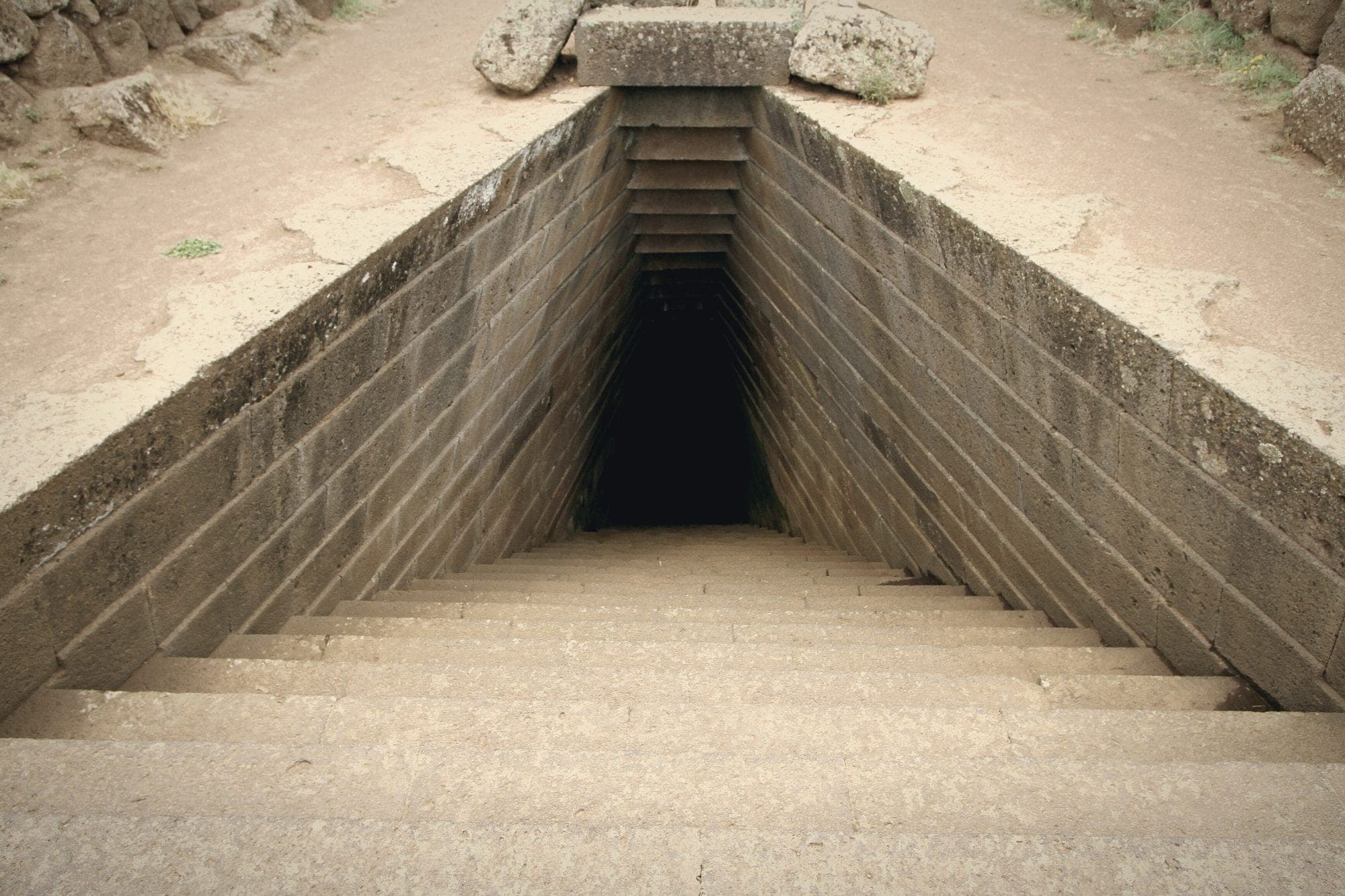
In 1966 the well of Santa Cristina did not look as it does today. The account comes from Ambrogio Atzeni, a civil engineer born in 1930 who ran the site works alongside the archaeologist Enrico Atzeni, in an interview given in February 2020. Of the entrance stairway, he says, "only half the flight of steps existed": the missing steps were carved by stonemasons and are, in his words, still clearly distinguishable from the originals today. As for the opening at the top of the corbelled dome, the stones forming it were found a few metres from the well and put back in place.
Now hold that alongside another fact. In 2011 the Polish scholar Arnold Lebeuf published a book in Kraków reading the well as a lunar observatory built to predict eclipses, and estimated the precision of the dome's geometry at about three arcminutes — one twentieth of a degree. That is instrument-grade precision. The difficulty is that it is attributed to a structure whose staircase was partly re-carved and whose oculus stones were repositioned by a works crew in the 1960s. Nobody cheated: the object being measured simply is not, in every part, the object built in the eleventh century BC. The same doubt runs through our article on Sardinia's sacred wells, which notes that the upper part of the monument probably continued above ground in a building whose height and shape are unknown.
This is not an isolated case; it is a classified error. In Casistica di errori in archeoastronomia, a survey presented in Genoa in 2004 by Giovanni Lupato and Mario Codebò, one case concerns the Iron Age cemetery of Mel in northern Italy: an archaeoastronomical analysis carried out on a necropolis that had been reassembled on the grounds of the heritage office shortly before 1970, with — the authors write — the relative arrangement of the tombs "very different from the original". The alignment being measured was the restorers'.
How accurately does the surveyor actually measure?
The same study contains an experiment worth more than a long argument. The astronomical hypothesis at Mel rested on a coincidence declared possible "in only one case out of 40,000", and assumed a margin of error of 2 degrees. The authors had four different observers measure the same thing: they diverged by 8 degrees. Recomputed with the real error, the probability fell from one in forty thousand to one in a few dozen.
Measurement error in this field is not a footnote; it is half the result. A magnetic compass has to be corrected for magnetic declination, which varies with place and year, and gives nonsense near railings, gates or electrical installations. An azimuth read off a satellite image is only as good as the image resolution. Horizon altitude has to be surveyed, because a hill to the east shifts the point where the Sun appears by whole degrees. And above all: azimuth is not declination. Converting one into the other requires latitude, horizon altitude, atmospheric refraction — and the date.
The date is the ghost at the feast. Because of the precession of the equinoxes, a star's declination shifts by degrees over a few centuries: a stellar alignment computed for 1500 BC does not hold for 900 BC. Since most Sardinian monuments are dated only within a bracket of centuries, a match with a star is a hypothesis resting on another hypothesis.
The simpler explanation: sun, wind, slope
Now to the strongest and most debated Sardinian dataset. Mauro Peppino Zedda and Juan Antonio Belmonte published in the Journal for the History of Astronomy in 2004 a survey of the entrance orientations of 272 single-tower nuraghi — the drystone towers, several thousand of them, that are Sardinia's signature Bronze Age monument — and of 180 central towers of multi-tower complexes. The statistical result is clear: entrances prefer the southern quadrant. Their interpretation is astronomical: the Sun rising at the winter solstice, or the Moon at the extremes of its cycle.
But there is a competing explanation, as old as Sardinian archaeology itself. A south-facing doorway catches light and warmth all day and turns its back on the maestrale, the cold north-westerly that dominates the island. Traditional farmhouses on the southern plains do exactly the same, and nobody calls them observatories.
Here is the logical knot, and it is not only Sardinian: two explanations that predict the same result cannot be told apart by that result. If both the astronomical and the practical hypothesis predict south-facing entrances, the fact that entrances face south does not choose between them. Deciding would need something extra — for instance, checking whether the preference survives unchanged where the slope of the ground or the prevailing wind differs.
A clue in that direction comes from Michael Hoskin, who measured over 2,600 Mediterranean monuments, 725 of them dolmens surveyed in person. In Tombs, Temples and their Orientations (2001) he records in northern Sardinia a strong tradition of east and south-east orientation, continuous with the older dolmens; in southern Sardinia, he writes, orientations face in every direction of the compass. Half the island follows no rule at all. It is the most honest fact in the whole business, and the one popular accounts never mention. A comparative study of 2014 by A. César González-García, Zedda and Belmonte confirms the difference between the two halves of the island.
What still stands at Santa Cristina
Back to the well, with the tools assembled so far, separating the claims one by one.
First: "at the equinox the Sun's rays enter the well perpendicularly." This one is false, and latitude alone disposes of it. At Paulilatino the equinox noon Sun stands about 50 degrees above the horizon; even at the summer solstice it never exceeds 73.4 degrees. A vertical ray does not exist at Sardinian latitudes on any day of the year. What people observe at the equinoxes involves light running down the sloping staircase — a different geometry and a different story.
Second: "the Moon passes over the opening." This one holds, and a calculation confirms it. At a major lunar standstill the Moon reaches a declination of about 28.6 degrees, more than the Sun ever does, because the tilt of its own orbit adds to the tilt of the ecliptic. At latitude 40.06 degrees its maximum altitude at culmination works out at about 78.5 degrees. The people watching on 12 January 2025 saw it at roughly 78 degrees. The arithmetic matches: the only celestial body that can pass almost vertically above that opening is the Moon, and only in the months around a standstill, which returns every 18.6 years.
Third: "therefore the well was built for that purpose." This remains open. The phenomenon is a possible consequence of the geometry of any domed well with an open oculus built at this latitude; to show that it is a design you would need other wells behaving the same way, a published instrumental survey and a declared significance test. The lunar alignment was first reported in 1973 by Carlo Maxia, Lello Fadda and the astronomer Edoardo Proverbio. It has been retold many times since, and independently verified few.
Fourth: "the well served to predict eclipses." Here the leap is longer still, because it credits the builders not only with observation but with systematic record-keeping over time and with the computation drawn from it. That is Lebeuf's thesis, and no independent check has so far confirmed it.
How an alignment is tested today
The discipline, meanwhile, has given itself rules. There are three of them, and they are strict.
The first comes from Clive Ruggles, who in the 1970s and 1980s re-surveyed the sites on which Alexander Thom had built his picture of high-precision megalithic lunar observatories, and found them far less solid than they had looked. His rule: the criteria for selecting which monuments to measure are fixed in advance, on archaeological grounds and not on astronomical hints. You measure everything that meets the criterion, not only what works.
The second is statistical. In 2020, in the Journal of Archaeological Science, Fabio Parracho Silva proposed the first full framework: each measurement is treated as a probability distribution, transformed into declination by a procedure analogous to radiocarbon calibration, aggregated with the others and run through a test that returns a p-value. Before that, he notes, the field had been fixated on surveying large numbers of structures in the hope that a peak in a histogram would speak for itself.
The third is cultural. A statistically significant alignment is still not proof: you also want archaeological evidence of intentionality and evidence that the target meant something to that culture. In a 1997 paper titled Whose Equinox?, Ruggles showed that even the concept of the equinox has at least four different practical definitions that do not coincide, and that assuming it in prehistory is a modern habit dressed up as a datum. In 2023, in Antiquity, Giulio Magli and Belmonte applied the same rigour to the supposed 365.25-day "Stonehenge calendar", calling it "totally unsubstantiated, being based as it is on a series of forced interpretations and unsupported analogies".
Five ways to spot a false alignment
A figure with no tolerance attached. "It points exactly at the solstice" means nothing until you know within how many degrees. At 2 degrees almost everything points at something; below a tenth of a degree it starts to be interesting. If the tolerance is not stated, it is usually because it is wide.
The target chosen afterwards. Measure an orientation, then search the sky for whatever lies in that direction, then announce the first candidate found. That is the difference between a prediction and a justification. The warning sign is a single study offering several different targets at once — solstice Sun, standstill Moon and a star, all compatible with the same direction. It does not make them wrong; it means the statistical test has to come before the choice.
"A one-in-a-million probability." It is the phrase that turns up reliably in the cases later dismantled. At Stonehenge it was worth about a coin toss; at Mel it was "one in forty thousand" and shrank to one in a few dozen as soon as the spread between observers was measured.
A restored monument treated as intact. Before measuring to the arcminute you need to know what collapsed, what was put back up, in which year and on what basis. Half a staircase re-carved in 1966, or a cemetery reassembled in a courtyard before 1970, moves the numbers more than any refinement of calculation.
The earthly explanation never considered. Slope, wind, light, the view down the valley, the course of a river. In the Lupato and Codebò survey, four earthworks in the Veneto taken for solstitial observatories turned out to be aligned because they follow the banks of an old channel of the river Piave. In the same study, a theory that circulated nationally pointed at a small hill called "Casteller" — a name found on no historical map, and suspiciously close to the sign of the "Castear" pizzeria that stands on top of it.
Why this makes the monuments more interesting, not less
Dismantling an alignment takes nothing away from the people who built the monument. It takes something away from the people retelling it, which is a different matter.
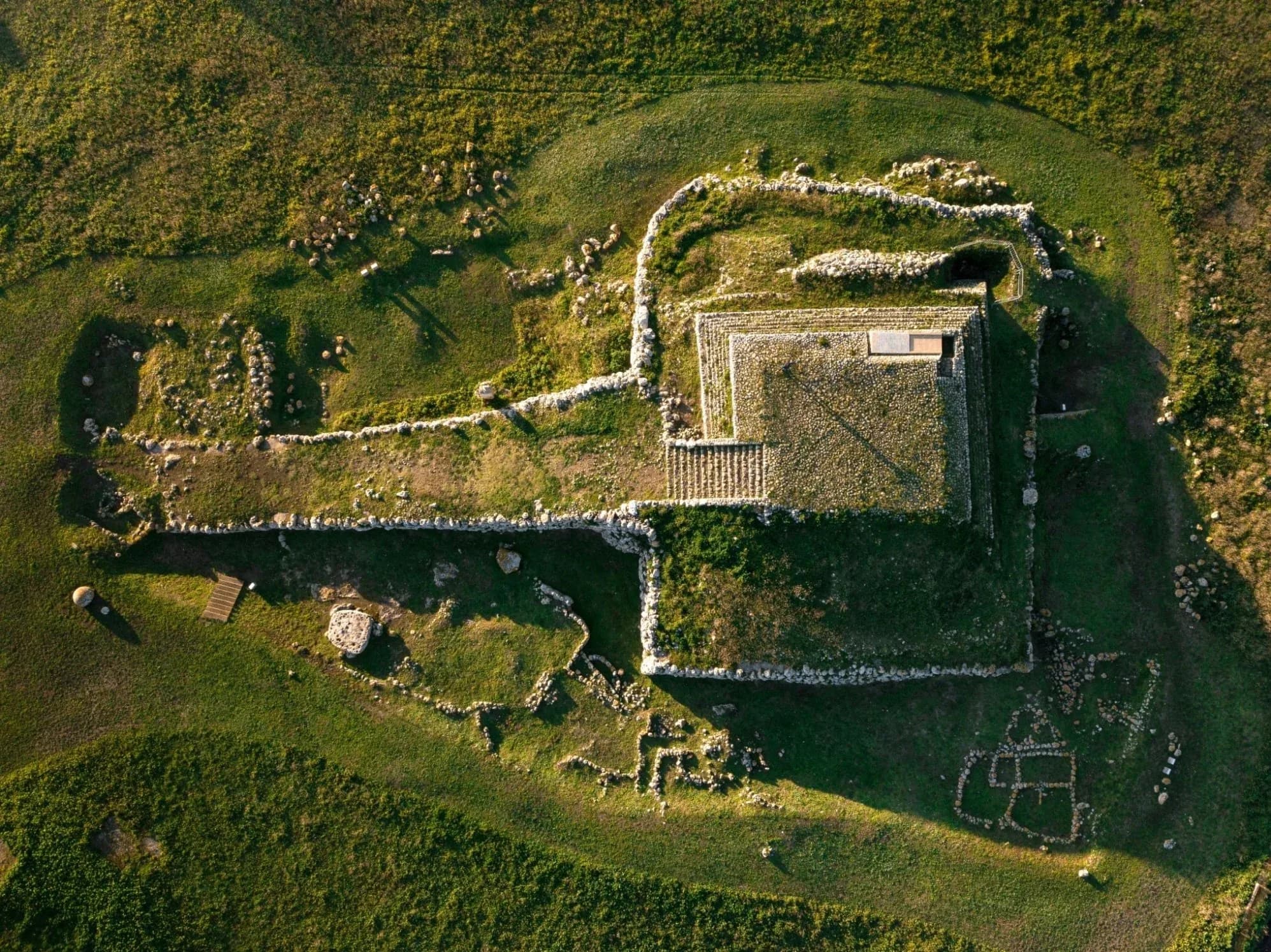
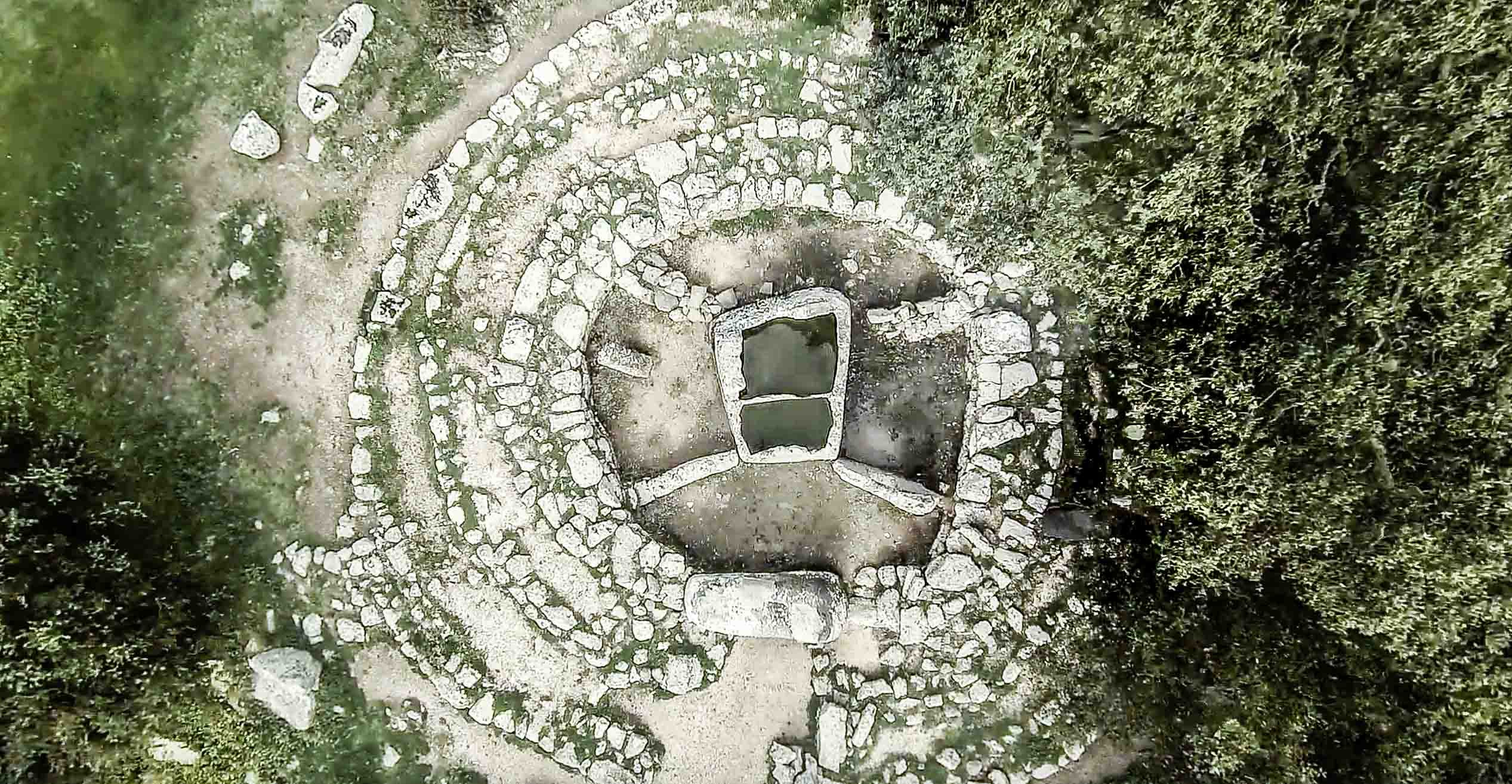
The well of Santa Cristina remains a piece of stone-cutting that looks impossible at close range: basalt, a brutally hard volcanic rock, dressed into blocks that close in regular rings up to an oculus about thirty centimetres across. Monte d'Accoddi remains the only monument of its kind in the Mediterranean, with its ramp and the standing stones planted in the fields around it — stones that in 2009 a research group led by Zedda and Magli used as sighting marks towards the eastern horizon, proposing three different targets at once: the winter solstice Sun, the rising of Sirius and the southern extreme of Venus. And the aligned menhirs of Pranu Muttedu still stand where someone decided to set them five thousand years ago.
The right question is not whether the Nuragic people watched the sky. They did, as every people dependent on the seasons has. The question is which specific claims the available evidence can carry, and which it cannot. Answering "we don't know yet" is a result, not a defeat.
Seeing it for yourself
The archaeological area of Santa Cristina lies in the municipality of Paulilatino, just off the SS 131 highway between Oristano and Sassari, and is open all year. Besides the well it includes a Nuragic village, a tower and a country church surrounded by cumbessias, the small houses built for pilgrims. At the March and September equinoxes there are always guided visits devoted to the light inside the well.
To see the Moon stand almost vertically above the oculus again, however, you will have to wait for the next major lunar standstill: the cycle runs 18.6 years, and comes round again around 2043. Anyone who was there in January 2025 was lucky. Anyone going now knows what they are looking at — and what has not been proved yet.
Cover photo: Carlo Pelagalli, CC BY-SA 3.0, Wikimedia Commons