On 17 August 1420, in the Sardinian town of Alghero, a man signed a document and collected 100,000 gold florins. His name was William III of Narbonne, he was the elected judge of Arborea, and what he sold was not a piece of land or a castle. It was sovereignty over the last independent state in Sardinia. That signature ended more than five centuries of judicate history.
This is the fourth and final part of the series, and it is the one about a wrong date. Almost everywhere you will read that Arborea held out until 1410. That date is ten years wrong, and the reason it is wrong tells you more about this kingdom than anything else. In 1410 Arborea lost its capital, but it did not surrender. It kept going, with an elected judge fighting on from the north, until somebody put a price in his hand.
A kingdom born when the sea turned dangerous
All four Sardinian judicates were born the same way, as we described in the part on Cagliari. In 687 the Byzantine civil and military offices on the island merged into a single iudex provinciae; the island stayed divided into four partes, each with its seat in a coastal city; and once central authority stopped mattering, the lieutenants turned into sovereigns. The four seats were Calari, Torres, Fausania-Olbia and Tharros.
This is where Arborea diverges. Its judges ruled the central-western sector and for several centuries held off seaborne raids from inside the fortress of Tharros, the Phoenician, then Punic, then Roman city on the tip of the Sinis peninsula. Then they stopped. The Istituto Storico Arborense of Oristano dates the abandonment to around 1070: raiding made the coast untenable, the court moved inland, and a new fortified centre grew up by Oristano.
That decision reads differently next to the other three. In Torres the court left the coast for Ardara and later for Sassari; in Cagliari the capital sat in a lagoon area; Gallura, as the third part showed, did the exact opposite and kept its seat on a harbour facing Tuscany. Of the two capitals on the water, Tharros was abandoned and its story ends there; Civita was erased by Pisa. The one kingdom that survived the thirteenth century is the one that had already pulled back from the sea four hundred years earlier.
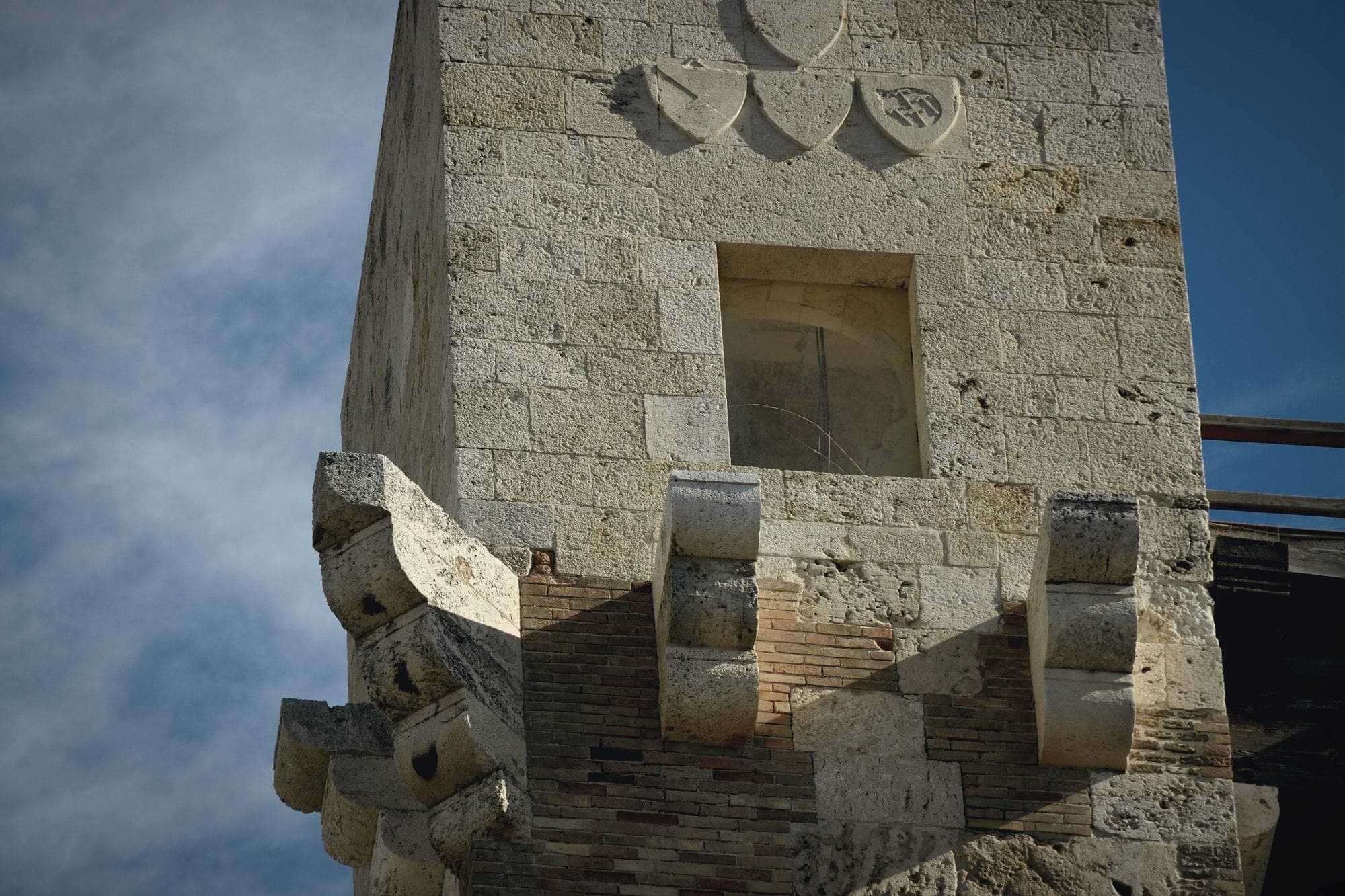
Four centuries after the move, the new centre had walls and gates. The tower of San Cristoforo, now known as the tower of Mariano II, was raised in 1290 by judge Mariano II: twenty-eight metres of sandstone, nineteen up to the first ring of battlements, built on a U-shaped plan with the open side facing into the town. It was the north gate. The inscription that confirms the date, badly worn when it was found, is now in the Antiquarium Arborense museum.
Barisone I: the king who bought a crown on credit
Before the real war, it is worth dismantling the story everyone tells about Arborea, because it mirrors how this kingdom worked.
In 1164 judge Barisone I obtained from Emperor Frederick Barbarossa the investiture as king of Sardinia. It was not a coronation, as it is often described: it was a granted title, to be used as cover for conquering the other three judicates. And Barisone could not pay for it. The 4,000 silver marks the emperor demanded were advanced by the Republic of Genoa, and the debt turned him into a Genoese hostage for seven years.
The rest is documented failure: in 1180 he tried to take the judicate of Calari and failed, and he died in early 1185 having unified nothing. For a judge of Arborea who really did come to control the island you have to wait almost two centuries — and he bought no title. He took it by war.
Mariano IV, raised in Barcelona to fight Barcelona
Mariano IV was born in Oristano around 1319, second son of judge Ugone de Bas-Serra. As a boy he was sent to Barcelona with his brother Giovanni to be educated, and the Dizionario Biografico degli Italiani — Italy's standard biographical dictionary — is blunt about how he was treated there: as a member of the royal family. In 1336 he was knighted, married the Catalan noblewoman Timbors de Rocabertí, and represented his brother Pietro III at the coronation of Peter IV of Aragon in Zaragoza, where he was given a very specific honour: holding the reins of the king's horse.
Thirty years later he was the man who reduced that same king to two cities.
He became judge in early 1347, when Pietro III died without heirs. In 1353 he abolished serfdom across his territory. The same year the first war against Aragon began, ending with the peace of Alghero on 13 November 1353 and then the treaty of Sanluri on 11 July 1355, which restored the status quo. The second war redrew the map: between 1364 and 1370 Arborea took Sassari (1369) and reached the point where the Aragonese held, in the whole of Sardinia, only Cagliari and Alghero.
That figure deserves a pause. Arborea is usually described as the second largest judicate, about 4,500 square kilometres according to the regional heritage record — an estimate, with a rival estimate of around 5,500 in circulation. But in its best years the kingdom did not control its own surface area: it controlled the entire island minus two cities. It is the only moment in which medieval Sardinia is almost entirely under a Sardinian ruler, and it lasts only a few years.
Mariano IV died of plague in May 1375. The date you will usually see, 1376, is an uncorrected error; the Dizionario Biografico fixes it.
Who actually wrote the Carta de Logu
What survives of Arborea is not a monument. It is a law code. And almost everything commonly said about the Carta de Logu — that it dates from 1392, that Eleonora wrote it — needs handling with care.
The code was not written in a day. Mariano IV first issued the Ordinamentos de vingias de lavores e de ortos, a rural code of 27 chapters on fields, vines and livestock, later absorbed into the larger text; and according to the Dizionario Biografico he promulgated the Carta de Logu himself, probably between 1367 and 1374, weaving together Roman-canon law and local custom.
Eleonora of Arborea — born in Catalonia around 1340, regent for her son Mariano V after her brother Ugone III was murdered in 1383 — produced the definitive version, the one that reached print: 198 chapters. Scholars disagree about the date, and the disagreement is worth stating in full. Francesco Sini, of the University of Sassari, lays out the positions: Besta proposes 1392, Cortese the months between spring 1390 and the winter of 1390-91, while the date of 1395 is "a simple conjecture by Mameli". The Dizionario Biografico places the promulgation between 1385 and 1391. The ISTAR, the historical institute of Oristano itself, writes "around 1392" and counts 162 chapters rather than 198.
The 1392 you read everywhere is not a fact. It is one hypothesis, and not the best supported one.
One more thing about Eleonora that the rhetoric tends to skip. Her husband Brancaleone Doria, held prisoner by the Aragonese and released on 1 January 1390, declared that same year — in a line the sources preserve — that the judgess had nothing to do with it, because since he came out of prison he was everything. The woman who gave her name to the most durable law in Sardinian history had to defend her own authority at home as well as abroad.
30 June 1409: the larger army loses
In 1407 Mariano V died of plague without direct heirs, and a succession crisis opened. In 1409 the Corona de Logu, the assembly of the realm, elected William III of Narbonne, grandson of Beatrice, Eleonora's sister. He inherited a war: on 6 October 1408 Martin the Younger, king of Sicily, had landed at Castel di Cagliari with the Aragonese army.
They met on 30 June 1409 on the plain south of Sanluri castle — the same village where peace had been signed fifty-four years earlier. The Aragonese camp was at a place called Flumara; the main clash happened on a rise still called Bruncu de sa battalla, "the hill of the battle".
The numbers, chronicle estimates though they are, say something counter-intuitive. Martin fielded 8,000 infantry and 3,000 cavalry. William fielded 17,000 infantry, plus French cavalry and a thousand hired Genoese crossbowmen: nearly double. And he lost. The Aragonese army, the ISTAR notes, was "well armed and well trained", and it broke through the centre, splitting the Arborean line in two. The issue was not courage. A kingdom that puts twenty thousand men in the field takes them from its villages, because it has no standing army, and against eleven thousand professionals that does not hold.
What followed was a massacre, and the place names still carry it. One Sardinian contingent was wiped out at a spot called S'Occidroxiu, "the slaughterhouse". Inside the Sanluri stronghold, two hundred Genoese crossbowmen, a hundred French and Lombard infantry and hundreds of civilians died. Estimates of the total dead, resting on a single source, run to five to seven thousand. On 4 July Villa di Chiesa — today Iglesias — surrendered too.
And the winner? Crossing the Flumini Mannu river shortly before the battle, Martin the Younger had caught malaria. He died in Cagliari on 25 July 1409, twenty-five days after his victory, and was buried in the city's cathedral. The most consequential war in medieval Sardinia was won by a man who did not live to see what it changed.
1410 is not the end
On 29 March 1410, in the monastery of San Martino, Leonardo Cubello signed the capitulation of Oristano. The judicate entered the Kingdom of Sardinia as the Marquisate of Oristano, and he became its first marquis. Why he surrendered without a fight under the walls is still argued: a deal struck in advance, a political calculation in exchange for the title, or simply the impossibility of holding out after Sanluri and the fall of Bosa. No document settles it.
William III, though, signed nothing. After Sanluri he took refuge in Monreale castle above Sardara, and from the north of the island he kept the war going for ten more years, through truces, negotiations and attempts to retake lost ground. For those ten years the judicate still existed: it had an elected judge and an army. What it no longer had was a capital.
It ended on 17 August 1420 in Alghero, when William ceded every prerogative of sovereignty to the Crown of Aragon in exchange for 100,000 gold florins. Not a surrender, and not a city razed to the ground like Santa Igia in 1258: a sale, with the price written down. The longest-lived of the four Sardinian kingdoms is also the only one that was never conquered.
Five things that usually go untold
The law outlived the state by four centuries. In 1421, one year after the sale, the Carta de Logu was extended to the whole Regnum Sardiniae: the Aragonese took the law code of the kingdom they had just bought and made it binding across the island. It stayed in force until 1828, when the Civil and Criminal Laws of Charles Felix, promulgated the year before, came into effect. That is 408 years of law beyond the death of the state that wrote it.
Eleonora's castle is not Eleonora's castle. The keep at Sanluri is known as the castle of Eleonora of Arborea, and it is the only medieval castle in Sardinia that survives almost intact and habitable. But no document attests that the judgess ever lived there — as the very sources that use the name admit. It is a tradition, not a fact.
Four centuries of dynasty left almost no objects. The judicial archives of Arborea are gone, and nearly everything we know passes through Aragonese paperwork. Among the very few finds tied directly to the ruling family is a small marble sarcophagus, discovered in 1950 at Tramatza in the sacristy of the Maddalena church, now in the Antiquarium Arborense.
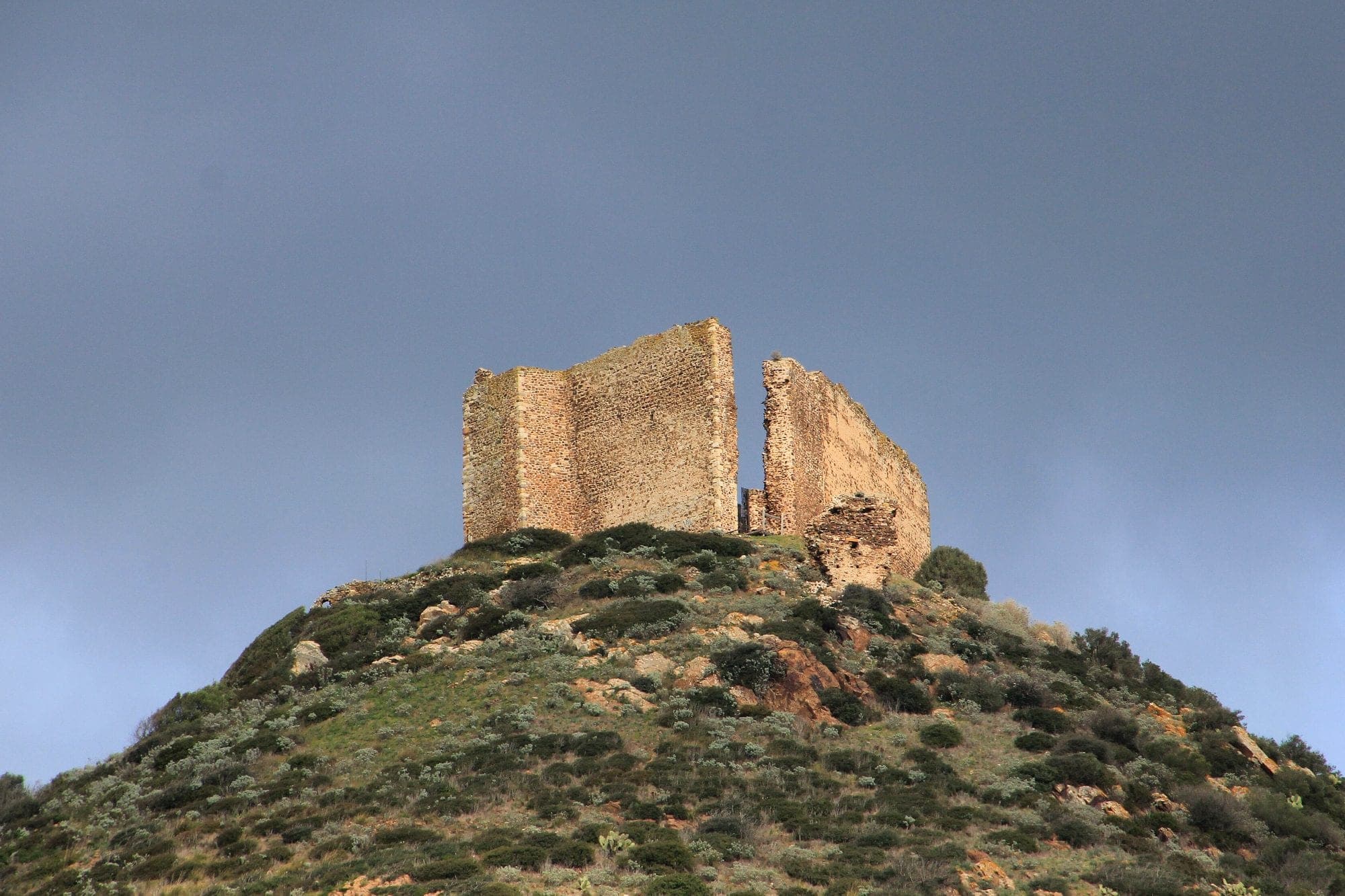
The largest fortress on the island belongs to neither Cagliari nor Sassari. The Monreale complex above Sardara covers about five hectares and has eight towers, square and round, the only Sardinian castle built that way. The walls reach ten metres in height and two in thickness, the keep stands at 280 metres, and excavations between 1987 and 2011 uncovered the ruins of an entire medieval village inside the circuit.
The last claim comes half a century later. The title had been sold, but the matter was not quite closed: in 1470 Leonardo Alagon, last lord of the Marquisate of Oristano, retook Monreale after his victory at Uras. Eight years later he was decisively beaten near Macomer, and the castle passed to the counts of Quirra as the centre of the barony of Monreale.
What you can still see
The tower of Mariano II, Oristano
It stands in Piazza Roma, at the head of the main street, and you can drive round it without realising it was the north gate of a walled city. Look for the sandstone ashlars, the round arch that narrows into a pointed one above it, the ring of battlements at nineteen metres and the small turret that adds ten more. Of the town walls, five to six metres high, little remains: this tower and the Portixedda tower.
Monreale castle, Sardara
On a hill a few kilometres off the SS 131 road, reached by an easy footpath. From the keep, at 280 metres, the view takes in the whole Campidano plain as far as the Gulf of Cagliari — which is exactly why the castle is there. First documented in 1309, first recorded as a royal residence in 1324. Inside there were cisterns, grain silos and an underground kitchen. Finds from the excavations are held at the Villa Abbas museum in the village.
Sanluri castle
A square plan with four corner towers, in the middle of the village, on the road running inland from Cagliari. It is not a ruin: it is plastered, roofed and open to visitors, now divided into museum rooms. South of the village lies the battlefield plain, with the place names that keep its memory.
The Antiquarium Arborense, Oristano
The town's archaeological museum, founded in 1938 in the neoclassical Palazzo Parpaglia and the third public museum in Sardinia. On the first floor is a scale model of fourteenth-century Oristano with its walls in place: the quickest way to grasp the shape of a capital of which only two towers now survive.
That closes the series. The richest fell first — Cagliari, in 1258; Torres died out a year later; Gallura ended by inheritance between 1296 and 1298. Arborea held on one hundred and sixty-two years longer than the first of them, and it did so by moving away from the sea, writing its own laws and, in the end, selling itself at the market price.
Cover photo: Gianni Careddu, CC BY-SA 4.0, Wikimedia Commons