During the Middle Ages, while feudal Europe forged its identities around castellanies and monarchical dynasties, Sardinia charted a singular political path: the emergence of four independent, sovereign kingdoms known as the Judicates (Giudicati in Italian). Among these self-governing realms, the Judicate of Torres — also referred to as Logudoro — spanned the vast northwestern quadrant of the island. Its territory encompassed the fertile plains of the Nurra, the rolling hills of Anglona, the rugged heights of Goceano and Marghine, and inland valleys reaching the borders of Gallura and Arborea. While the neighboring Judicate of Cagliari was the first to collapse, destroyed by a Pisan-led siege in 1258, Torres ended one year later in an entirely different way: no siege, no capital razed to the ground. Its political centre of gravity had drifted inland for two centuries, away from an exposed coastline, and in the end the dynasty ran out before the territory did.
This is the narrative of a medieval state born from the ashes of a major Roman maritime emporium, evolving across a millennium into a complex tapestry of autonomous urban communes, Genoese feudal lordships, and sea-lanes linked to the broader Tyrrhenian trade networks.
Roman Roots: The Rise of Turris Libisonis and the Riu Mannu Bridge
To understand the origins of the Judicate of Torres, one must look back to 46 BC, when the Romans established Colonia Iulia Turris Libisonis at the present-day site of Porto Torres. Unlike older Sardinian coastal settlements founded by Phoenician or Punic traders — such as Tharros or Sulki — Turris was conceived directly as a Roman colonial deduction, strategically positioned at the midpoint of the Gulf of Asinara. The new harbor quickly evolved into the primary shipping hub for grain harvested across the fertile Nurra plain and for ore mined in the surrounding hills.
The scale of Roman civil engineering remains visible today along the course of the Riu Mannu river. Here, during the 1st century AD, Roman engineers constructed a massive stone bridge stretching 135 meters in length, supported by seven arches built with alternating blocks of red trachyte and white limestone. This viaduct served as more than a monumental passage: it formed the essential artery of northern Sardinia's road network, linking the busy port to interior routes heading south toward Karalis.
Following the collapse of the Western Roman Empire, Sardinia entered a tumultuous period under Vandal rule between 455 and 533 AD — a complex era detailed in our study on Vandal Sardinia. Throughout this era, Turris retained its role as an administrative anchor and port. The subsequent Byzantine reconquest under Emperor Justinian in 533 AD reaffirmed the city's primacy, establishing local administrative councils (decuriones) and landed elites (possessores). The city's religious prominence was sealed in 650 AD, when Pope Martin I formally recognized the independence of the Turritan bishopric.
Between the 8th and 9th centuries AD, the gradual retreat of Byzantine naval power from the western Mediterranean, coupled with escalating Arab maritime raids, severed direct administrative ties between Sardinia and Constantinople. In response to this power vacuum, island leaders reorganized local administration into four autonomous territorial units, laying the groundwork for the medieval Judicates: as we described in the episode on Cagliari, the deputies governing the four Byzantine partes stopped being delegates and became sovereigns.
The Great Inland Migration: Retreating from Malaria and Pirate Raids
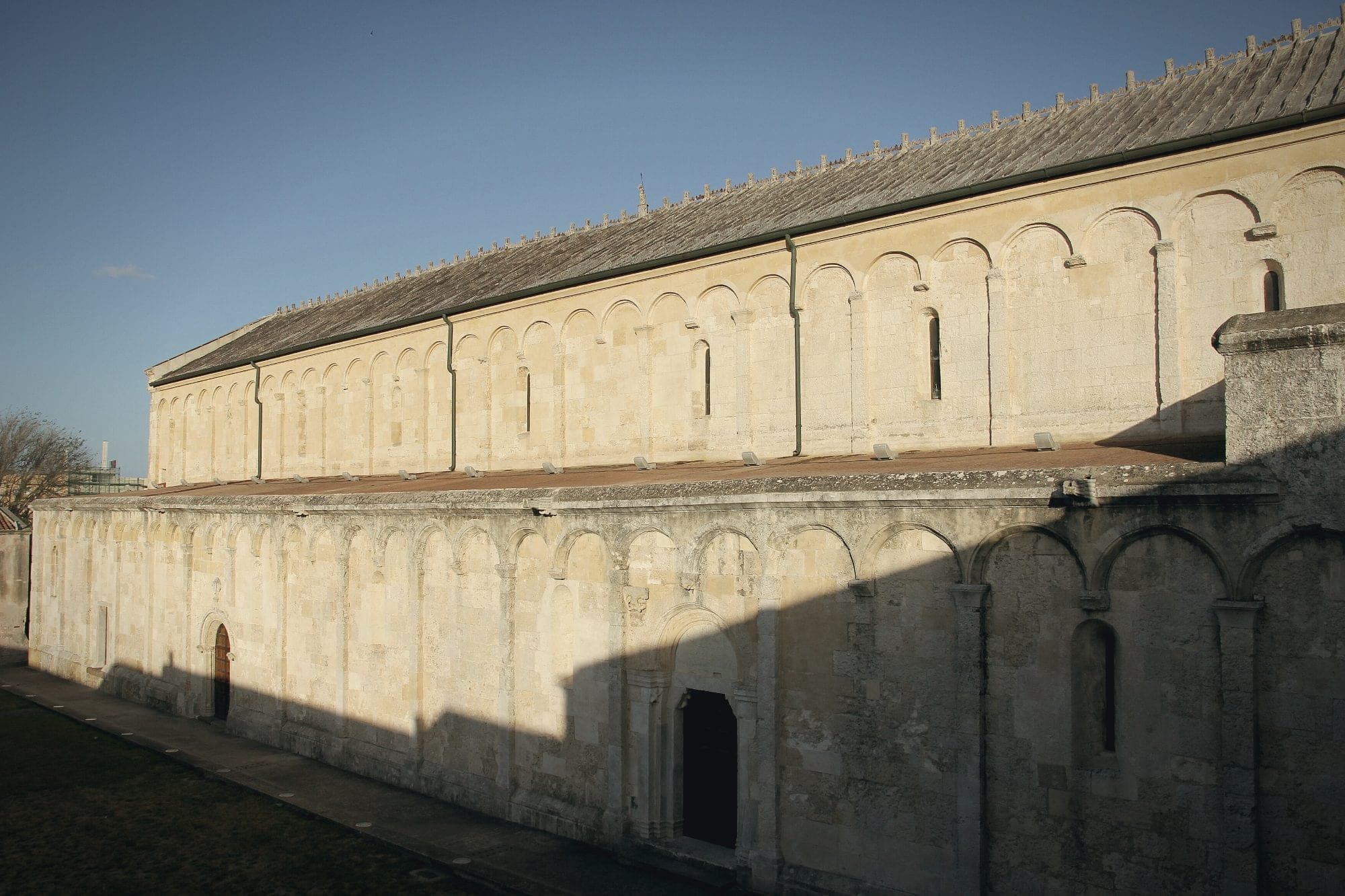
At the dawn of the Judicate era, the capital of the northern state remained centered at the coastal site of Turris Libisonis. Around 1065, Judge Gonnario Comita began construction of the Basilica of San Gavino, finished around 1080 and still the largest Romanesque church in Sardinia. He hired master masons from Pisa, and the result resembles nothing else on the island: limestone blocks, two opposing apses — one facing east, one facing west — and no facade at all, because you enter from the side, through a Gothic-Catalan portal added in the 15th century. It rises on the hill of Monte Agellu, over palaeochristian cemeteries and earlier basilicas of the 5th to 7th centuries: the site was sacred half a millennium before the Judicate existed.
Yet even as the walls of this great cathedral were being raised, the political authority of Torres was quietly searching for safer ground. The coastline, once a prosperous gateway under Roman rule, had become increasingly precarious. Two constant dangers threatened the coastal population:
- Saracen naval raids, which launched swift, destructive incursions against unfortified lowland settlements.
- Endemic malaria, exacerbated by silting river mouths, neglected Roman drainage systems, and stagnant coastal marshes.
This dual threat forced a gradual retreat of administrative and royal structures into the inland hills. Historians continue to debate the precise timeline of this migration. The royal court initially established its main seat at Ardara, building the palatine chapel of Santa Maria del Regno. Constructed from dark basalt blocks, this church houses one of the largest wooden altarpieces (retablo) surviving in Sardinia. From Ardara, the judges of Torres governed their realm, held general assemblies (curies), and signed international treaties with maritime republics.
Over time, however, another inland town began drawing population, economic capital, and political weight away from Ardara: Sassari. Situated on a protected elevated plateau, abundant in natural freshwater springs, and surrounded by productive agricultural land, Sassari grew rapidly into the financial heartbeat of northern Sardinia. The town's merchant and artisan guilds developed a fierce tradition of self-governance, growing increasingly restless under the dynastic oversight of the Judical court.
Who Kept the Records: the Condaghes of Logudoro
The institutional machinery of the Judicates — the judge, the Corona de Logu assembly, the territory split into curatorie made up of villages called biddas, each run by a curatore appointed for a fixed term — was the same in all four kingdoms, and we described it in the episode on Cagliari. In Torres, though, that system left behind a written record that has not survived the same way elsewhere on the island.
These are the condaghes: property and judicial registers compiled in monasteries, where an abbot noted down year by year the donations received, the sales of land and of servants, the boundary disputes and the verdicts. The best known is the Condaghe of San Pietro di Silki, written in Sardinian between 1065 and 1180 in the Benedictine convent of Silki, in Sassari, and kept today in the city's University Library. They are not chronicles; they are accounts. That is exactly why they matter — a chronicle records what the ruler wanted remembered, while a property register records who owned what, what an olive grove was worth, and what the villagers were actually called.
And they wrote them in Sardinian. While the rest of Europe kept its records in Latin, a monk in 12th-century Logudoro was minuting a lawsuit in the vernacular: one reason the Sardinian language is documented so early.
Adelasia of Torres and the Tragic Collapse of 1259
The final chapter of the Judicate of Torres is linked to the figure of Adelasia of Torres, the last ruling judicess, born in 1207 at Ardara. She found herself trapped in a geopolitical chess match involving the Papacy, the Republic of Genoa, the Republic of Pisa, and the Holy Roman Emperor Frederick II.
Her first marriage, to the Pisan Ubaldo Visconti, dates from 1219: Adelasia was twelve years old. Ubaldo died in 1238, and that same year she married Enzo of Swabia, the legitimized natural son of Emperor Frederick II. Frederick promptly bestowed on his son the title of "King of Sardinia," provoking fury from the Papal See, which claimed feudal suzerainty over the island. Enzo's Sardinian career was brief: the marriage was annulled in 1246, and in 1249 he was captured by Bolognese forces at the Battle of Fossalta and spent the rest of his life — more than twenty years — imprisoned in Bologna.
Adelasia was left to rule a kingdom fractured by noble insurrections, papal pressure, and the rising autonomy of Sassari's merchant class. Stripped of effective authority, she withdrew to Goceano Castle (also known as Burgos Castle): a fortress built in the first half of the 12th century by Judge Gonnario II de Lacon-Gunale, on a granite spur 647 meters above the upper Tirso valley, with three rings of walls and a main tower over fifteen meters tall. The sources call those years a "voluntary imprisonment": nobody locked her in, but she never came back down.
With Adelasia's death in 1259, the Judicate of Torres ceased to exist for want of direct heirs. The gap from the end of Cagliari is exactly one year: in 1258 the Pisans and a coalition of the three remaining Judicates — Torres included — had razed the capital Santa Igia. Torres was on the winning side of that war, and twelve months later it dissolved without anyone attacking it. It did not fall to a single foreign power; it came apart.
"Upon Adelasia's death in 1259, the state of Torres dissolved like snow under the sun: the crown vanished, leaving its fragments to be claimed by Genoese nobles and the rise of Sassari."
The royal lands were partitioned among regional powers:
- The Doria Family, powerful Genoese aristocrats, seized the Nurra and Anglona regions, establishing Castelsardo (then Castelgenovese) as their coastal stronghold.
- The Malaspina Family, another prominent Ligurian house, consolidated holdings around Bosa and Osilo; a third Genoese house, the Spinola, took its own share.
- Sassari declared itself a Free Commune: on 24 March 1294 it signed an act of confederation with Genoa, and its Statuti sassaresi — written in Logudorese Sardinian rather than Latin — were ratified on 28 October 1316.
That is the difference from Cagliari. There, an army destroyed a capital on a specific date. Here the crown simply ran out, and three Ligurian lordships and one self-governing town settled onto a territory with no sovereign left.
5 Fascinating Historical Facts About Torres and Its Territory
- The Roman bridge that carried trucks: the bridge over the Riu Mannu at Porto Torres is 135 meters long, and it is no distant ruin. It stayed open to vehicles until the 1980s, petrochemical lorries included, before being reserved for pedestrians. Its deck had been covered in asphalt since the early 20th century; restoration work in 2020 stripped it off and found the original Roman paving stones underneath.
- The "Bainzini", meaning the people of Porto Torres: in the Sassarese dialect someone from Porto Torres is not a portotorrese but a bainzinu, after the Sardinian name of the basilica, Santu Bainzu. The nickname still coexists with "turritani" and "portotorresi": a town that lost its capital status centuries ago is still named after the saint of the church that certified it.
- Submarine vs. Whaler (1943): On May 25, 1943, off the coast of Porto Torres, a small local fishing vessel named Onda (a converted whaling boat) ground to a sudden halt: its trawling nets had become entangled in the submerged hull of an Allied submarine.
- Austro-Hungarian Prisoners on Asinara: during World War I, Asinara Island — just off the coast of Porto Torres — was turned into a massive prisoner-of-war camp. The figures tell the story: 23,861 prisoners embarked, 23,339 landed alive on the island between 1915 and 1916, and around 8,000 died there of disease and exposure. More than five hundred did not survive the crossing itself.
- The Industrial Mirage: In 1962, industrialist Nino Rovelli initiated the SIR petrochemical complex at Porto Torres. Designed to transform northern Sardinia into a refining power, the project ultimately faltered, leaving behind complex environmental and industrial challenges.
Visiting the Heritage of Torres Today
Exploring the legacy of the Judicate of Torres offers an engaging route through coastal Roman ruins and inland medieval strongholds.
Porto Torres and the Antiquarium Turritano
Porto Torres holds the multi-layered history of the ancient coastal capital. Beyond the Roman bridge over the Riu Mannu, visitors can explore the National Archaeological Museum Antiquarium Turritano, inside the excavated precinct of ancient Turris Libisonis, with mosaics, marble statues, and Roman inscriptions. Nearby, on the hill, stands the Basilica of San Gavino: a working church rather than an archaeological site, and look for the portal on the south flank, because there is no facade to walk up to.
Goceano Castle in Burgos
For the final phase of the kingdom, travel inland to the village of Burgos. The ruins of Goceano Castle stand at 647 meters above the upper Tirso valley: three rings of walls and a main tower over fifteen meters tall. Abandoned by the Aragonese, the castle is a ruin — and it is precisely where the story of the Judicate ends.
Ardara and Sassari
Ardara still has the church of Santa Maria del Regno, the palatine chapel of the judges, with its altarpiece. Sassari, the town that inherited the Judicate, preserves the medieval fabric of its old centre: the Free Commune that confederated with Genoa in 1294 was born there.
The disappearance of the Judicate of Torres in 1259 left northern Sardinia without a unified state structure, clearing the path for the Crown of Aragon's invasion in the 14th century. Yet the stone arches of San Gavino, the heights of Goceano, and the records preserved in the condaghes endure as testaments to a kingdom that shaped island politics for nearly two centuries. The series continues with Gallura, the judicate that held on for another forty years.
Cover photo: Gianni Careddu, CC BY-SA 3.0, Wikimedia Commons