In 1296 a thirty-year-old man died in Sardinia. He had governed the city of Pisa alongside Count Ugolino della Gherardesca, Dante Alighieri would place him in Purgatory, and on paper he ruled the fourth of Sardinia's four medieval kingdoms. His name was Nino Visconti, judge of Gallura. The heir he left behind was a girl of about five, Giovanna. She never took possession of the kingdom: by 1300 Gallura was being run by a Pisan deputy, in 1308 she was married off to a lord of Treviso who was murdered four years later, and in 1323 she was living in Florence on a subsidy from the city council.
This is part three of a four-part story, one instalment per kingdom. Gallura tells it better than any of the others, because here the kingdom was not knocked down by a siege. It was inherited by someone who could not defend it.
The smallest of the four, and the only one facing the sea
Medieval Sardinia was not one state but four. They are called giudicati — judicates — and they all began the same way, as we described in the instalment on Cagliari: between the 8th and 9th centuries Byzantine authority over the island faded, the civil and military offices that had governed it merged into a single iudex Sardiniae, and the lieutenants of the four outlying districts stopped being delegates and became sovereigns. Below them the land was divided into curatorie, clusters of villages — biddas — each run by a curatore appointed for a fixed term, with a general assembly, the corona de logu, at the top.
Gallura, the north-eastern kingdom, was the smallest of the four by area, by population and by revenue: granite, woodland and pasture, with its wealth concentrated along the coast and in the Baronie district north of Nuoro. But it had one thing none of the others had, and at first glance it looks like a weakness. Its capital stood on the sea.
The city was called Civita, it rose on the ruins of Roman Olbia, and the name first appears in a written document in 1113. In the same period the other kingdoms were doing the opposite. In Torres, to the north-west, the court abandoned a malarial, raid-exposed coastline and moved inland, first to Ardara and then into the orbit of Sassari. In Cagliari the capital, Santa Igia, sat low in a lagoon, screened by marshes. Gallura kept the seat of government on a harbour, inside a gulf that opens towards the Italian mainland.
That was not carelessness. It was the whole point. From that gulf you look at Tuscany — and Tuscany looks back.
A cathedral of granite and brick, built in three campaigns
Very little of Civita the capital survives. The city walls that carried the judges' coat of arms over the gate are gone; the palace and the royal crypt are an archaeological hypothesis attached to a block of central Olbia near Corso Umberto, not a monument you can walk into. What you can see, and see very clearly, is the church.
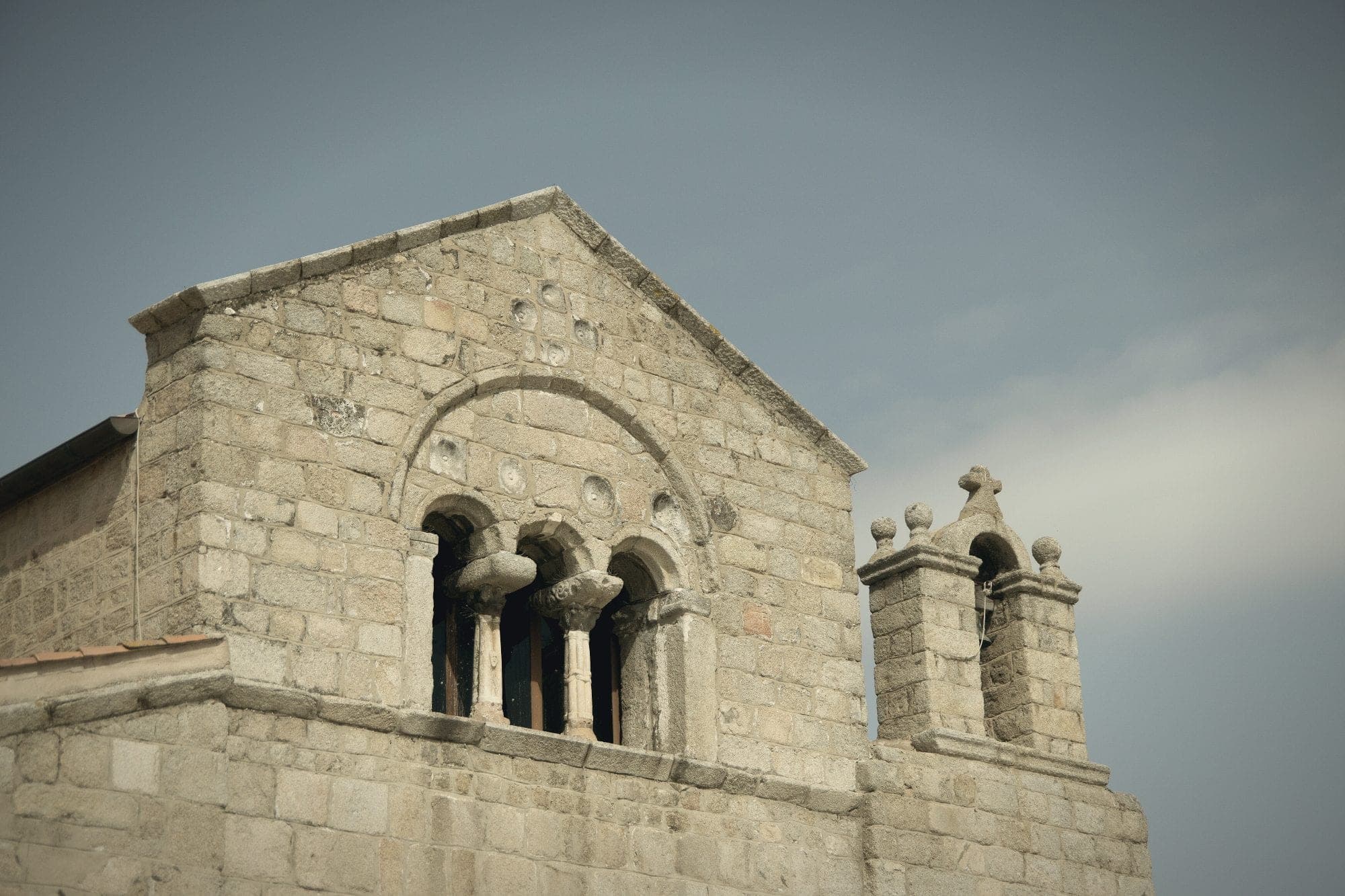
The basilica of San Simplicio was commissioned by the judges of Gallura — tradition credits the start to judge Costantino III, between the late 11th and early 12th century — and it went up in three distinct phases that are still legible in its walls. In the second half of the 11th century came the apse, the piers, the columns and part of the naves; in the first decades of the 12th, the roofing and the completion of the naves and outer walls; by the middle of the 12th century, the façade. The building technique is mixed, granite and brick in the same wall face, and the result has no equal in the region: in a corner of Sardinia where Romanesque architecture is rare, this is the best preserved Romanesque basilica on the entire island.
Two details say more than a floor plan. First: the church was built as the cathedral of the diocese of Civita, and it stayed one until 1839, when the diocese was suppressed. A city name that vanished in the 1200s survived another five and a half centuries as the name of a diocese.
Second: beneath the church and the square in front of it lies a cemetery, Roman and then Christian, where the martyrs of Olbia were buried. The judges did not pick an empty site. They put their cathedral on top of the burial ground of the ancient city — the one thing in Civita older than they were.
1205, or maybe 1207: the marriage that handed over a kingdom
Gallura's native dynasty, the Lacon-Gunale, ended with a woman. Elena, daughter of judge Barisone, inherited the kingdom when her father died, and she was Sardinia's first reigning female sovereign — not a regent, a title-holder.
Then she married a Pisan, Lamberto Visconti, and with him the rights to the kingdom passed into a Tuscan house. Historians disagree on the date. The Treccani encyclopaedia says Elena "brought her rights over Gallura to her husband Lamberto Visconti of Pisa" in 1205; other chronologies put the wedding in 1207. Two years' difference in an eight-hundred-year-old marriage changes nothing substantial, but it shows how thin the documentary base is for the whole affair.
From there the line is Pisan, and it reads like an ordinary list of successions: Lamberto rules until 1225; his son Ubaldo Visconti from 1225 to 1238, married to Adelasia of Torres — the woman whose death in 1259 would end the northern kingdom — but with no direct heirs; his cousin Giovanni Visconti from 1238 to 1275.
And it is Giovanni who gives the game away. In 1258, when the Pisan-led coalition razed Santa Igia and the kingdom of Cagliari was carved into three, one of those three shares — the north-eastern one, Ogliastra and Sarrabus — went to him, the judge of Gallura. The smallest of the four kingdoms took part in dismembering the richest and came out larger. Thirty-eight years later it was gone.
Nino Visconti, the judge Dante put in Purgatory
Nino Visconti inherited the title in 1275 from his father Giovanni, and he was still a child: he had been born in Pisa in 1265. Yet almost none of his life was spent in Sardinia.
On his mother's side he was the grandson of Ugolino della Gherardesca, the count Dante would lock in the thirty-third canto of the Inferno, and the two of them governed Pisa together: in 1286 grandfather and grandson issued acts of government jointly. Then they fell out, the city changed hands, and Nino ended up on the losing side. He denounced Archbishop Ruggieri before the Holy See for the killing of the Gherardesca; he fought on the Guelph side against his own city; and in 1293 he was captain general of the Taglia of Tuscany, the military league of the Guelph cities.
After the peace of July 1293 he could not return to Pisa. In 1293-94 he moved to Genoa, and then — only then — to his own kingdom of Gallura. That detail explains a great deal: the last sovereign of the kingdom came to govern it in person because he had nowhere else left to go.
He died in 1296, "in the flower of his years", asking that his heart be carried to Lucca. Dante meets him in Purgatory (canto VIII, lines 46-84) and calls him "noble judge Nino" — the only firm evidence of a friendship between the two men, and worth more than any chronicle, because it fixed Gallura in a text Europe would go on reading for seven centuries.
In 1296 the kingdom of Gallura had a ruler famous across Tuscany, a place in the Divine Comedy, and nobody able to take up his inheritance.
Giovanna, a judge without a judicate
The heir was Giovanna Visconti, only child of Nino and Beatrice d'Este, born shortly before 1291: she was about nine in 1300. She was judge of Gallura in title, and in title only. She never held the kingdom.
Everyone moved on her rights: Pisa, Genoa, Naples, Aragon and the Papacy, each with a marriage plan that would have swung her to their side. In 1308 she was married to Rizzardo da Camino, the Ghibelline lord of Treviso. The marriage produced no children and ended abruptly — Rizzardo was killed in April 1312, leaving her cash bequests.
The rest is documented line by line. By 1323 Giovanna was living in poverty in Florence, supported by a grant from the city. She died in Milan in 1334, shortly after her mother. Dante names her in Purgatory VIII, in the lines where her father speaks of her tenderly and asks for prayers on her behalf: she is, the text says, the one tie of affection he has left on earth. The child a judge asked prayers for died on another city's charity.
Meanwhile, in Sardinia, from 1300 Gallura was placed directly under Pisa through a vicar.
1296 or 1298: when does a kingdom actually end?
There are two end dates, and it is worth keeping both rather than picking one.
1296 is the year Nino died: the ruling dynasty ends and effective power passes to Pisa. 1298 is the date the Sardinian regional heritage service assigns to the institutional fall of the judicate. In between lie two years in which the kingdom still exists on paper, with a child as title-holder and nobody representing her on the ground.
Pisa, for its part, did not merely take control. It erased the capital. Civita was replaced by a new walled town, Terranova, laid out around the republic's shipping. The Sardinian and Gallurese names of the city — Terranoa, Tarranoa — come from that refoundation. The name Olbia only came back in the 20th century.
And none of it was a sudden stroke. Between Elena's marriage in 1205 or 1207 and the Pisan vicar of 1300 lie almost a hundred years: three generations of judges with Tuscan surnames, family ties to the houses of Pisa, and a kingdom that lost its independence one piece at a time, by inheritance rather than conquest. When Gallura stopped existing, nobody had to destroy a city to make it happen — unlike what had been done to Santa Igia forty years earlier.
5 things the short version leaves out
Tempio Pausania was never the capital. Guidebooks and local tradition happily make Tempio, inland, the heart of the kingdom, pointing to a supposed "house of Nino Visconti" near Piazza Gallura. The sources say otherwise: Tempio appears as Templo in a document of 1173, an agreement between the cathedral chapter of Pisa and the bishop of Civita, and it was the chief village of the curatoria of Gemini. The capital, the bishop's seat and the favoured royal residence were at Civita, on the coast. No document proves anyone lived in that house.
The court did not sit still. There was one capital, but the judges of Gallura spent part of the year in fortified residences inland: the castles of Balaiana and Baldu at Luogosanto, and the castle above Posada at the kingdom's southern edge. Specialists are careful about how regular those stays were, because continuous archive evidence is missing. It is a custom reported by historians, not a documented calendar.
A castle named after a pigeon. The castle at Posada is called "della Fava" — of the broad bean — after a 13th-century legend: the starving defenders supposedly stuffed a pigeon with beans and let it drop into the enemy camp. Seeing the bird's full crop, the besiegers concluded there was food to spare behind the walls and went home. It is a legend and should be treated as one: the regional heritage service records it as the origin of the name, not as an event.
The heart sent to Lucca. Nino Visconti died in Sardinia, but asked for his heart to be taken to Lucca. A Sardinian sovereign ruling a kingdom on the sea, dying in that kingdom, and sending his heart to Tuscany: that is the shortest possible summary of what three generations of Pisan marriages had made of the dynasty.
The erased capital is now the biggest city in Gallura. Civita, wiped out, renamed Terranova and reduced to a walled village, is called Olbia again and today has 61,790 inhabitants — nearly five times Tempio Pausania, with 12,869. The harbour that was the kingdom's weak point in the 1200s is exactly why that city, eight centuries later, is the economic centre of north-eastern Sardinia.
What you can still see
Four centuries of kingdom have left one basilica and two castles. All three are standing, and all three can be visited.
The basilica of San Simplicio, Olbia
A short kilometre from the port, on a slight rise just outside the modern old town, in a paved square that now wraps around three of its sides. Look for the gabled façade in granite ashlar, the three-light window above, the open bell-gable, and the contrast between grey granite blocks and courses of red brick in the arches. It is a working church, not an archaeological site.
Pedres Castle, Olbia
Five kilometres south of the city, on a granite outcrop at about 140 metres. Two walls on different levels: a four-sided one halfway up, a polygonal one around the summit. At the top stand a square tower roughly ten metres high in granite and tuff, a rectangular hall with groin vaults, and a cistern. It was most likely built in the 13th century under the Visconti; by the mid-14th century it had been entrusted to the Knights of St John of Jerusalem, and later passed to the Aragonese. You reach it on foot, by a short steep climb.
Fava Castle, Posada
A square battlemented tower inside an irregular four-sided wall, with cisterns, above the hill village of Posada, 56 km from Nuoro along the SS 125 road. The regional heritage service is blunt about the date: there is no reliable evidence, and the castle is presumed to have been standing already in the 13th century. This is where Gallura met the contested border with the kingdom of Arborea, which is why a fortress of this size sits in such a peripheral spot. Around 1380 it went to the Aragonese, returned to Sardinian hands under Brancaleone Doria, and after the fall of Arborea became a barony of the Carròs family. There is an entry fee.
Luogosanto
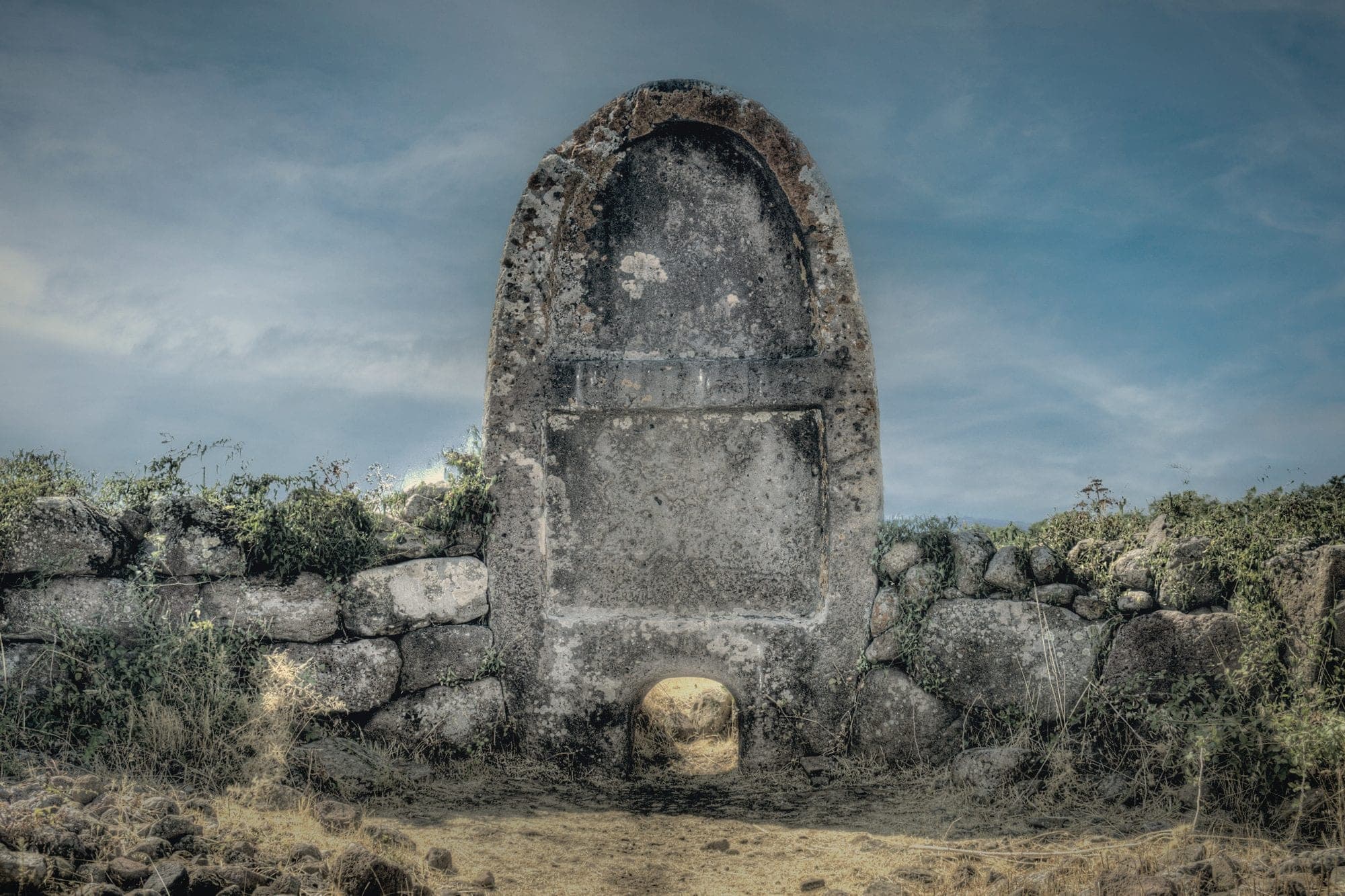
Inland, north of the Limbara massif, the ruins of the Baldu royal palace and the castle of Balaiana tell the other half of the story, the one away from the water. They lie in the municipality of Luogosanto, in a landscape of granite and scrub — the same country where, three thousand years earlier, Gallura was building its great giants' tombs.
The story of the four kingdoms ends with Arborea, the only one to outlast the 13th century and survive until 1420: a hundred and twenty-two years longer than Gallura. For where all four came from, there is the piece on the Vandal and Byzantine centuries; for the first to fall, the one on Cagliari.
Cover photo: Clemensfranz, CC BY-SA 4.0, Wikimedia Commons