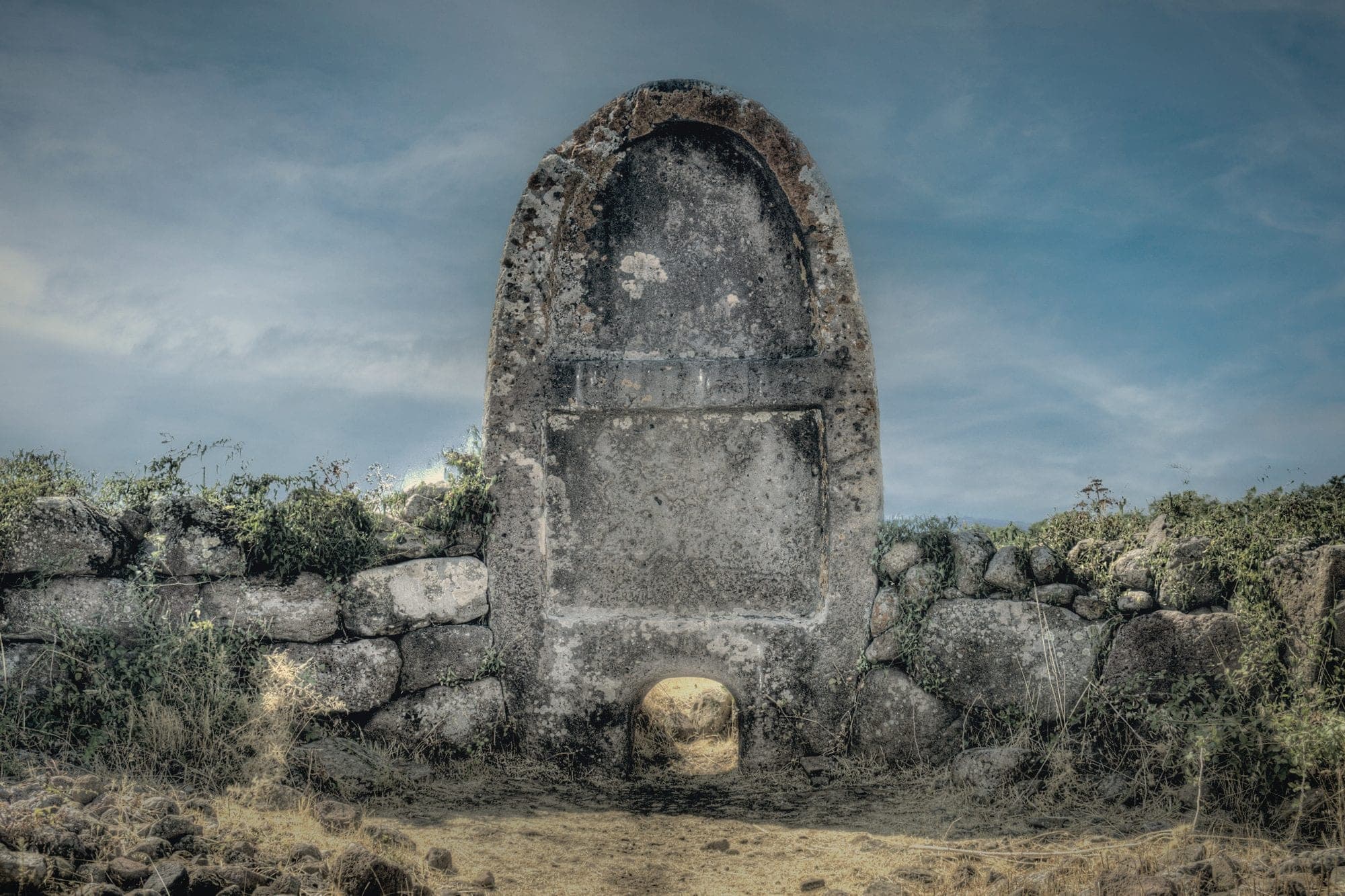
Imagine standing before a monumental granite wall that opens into two grand, sweeping wings, tracing a perfect semicircle against the Sardinian sky. In the center of this stone amphitheater, a tiny, low opening—hardly large enough for a child to crawl through—leads into a narrow, dark gallery stretching up to twenty meters into the earth. For centuries, the farmers, shepherds, and travelers who stumbled upon these imposing structures in the wild interior of the island called them "Tombs of the Giants" (Tombe dei Giganti). The explanation seemed self-evident to the popular imagination: only beings of superhuman stature could have quarried, transported, and raised such colossal stone blocks, and only a giant would require a burial chamber of such immense length.
However, when the prominent Sardinian archaeologist Giovanni Ugas began a scientific excavation of the San Cosimo tomb in Gonnosfanadiga in March 1981, the reality that emerged from the damp earth was far removed from local folklore, yet infinitely more fascinating. Beneath the collapsed ceiling slabs lay not the bones of mythical titans, but a dense, chaotic, and highly fragmented stratum of human remains, mingled with prehistoric pottery shards, bronze ornaments, and sharp blades of volcanic glass. The discovery shattered the romantic myths, replacing them with a profound scientific puzzle that still fuels archaeological debate today: not who was buried inside these megalithic monuments, but how many people actually laid there.
The magic number: what the bones of San Cosimo reveal
For generations, the consensus among early antiquarians and mid-twentieth-century archaeologists was that the Giants' Tombs served as the public parish cemeteries of the Bronze Age. They were assumed to be collective, egalitarian burial grounds where entire Nuragic villages deposited their dead over centuries, leading to estimates of hundreds, or even thousands, of individuals resting within a single monument. When the first reports from the San Cosimo excavation were compiled in the early 1980s, researchers initially echoed this sentiment, pointing to the sheer volume of fragmented skeletal material to suggest a population of "hundreds of dead."
However, modern archaeology relies on physical anthropology and osteology to turn raw bone weight into historical truth. In 1994, the physical anthropologist Motta conducted the first rigorous, systematic study of the human remains recovered from San Cosimo. To do this, he applied a fundamental osteological metric known as the MNI (Minimum Number of Individuals).
Rather than guessing based on the total volume or weight of the bone fragments, the MNI method systematically counts specific, non-duplicable bones of the human skeleton. Anthropologists look for highly durable skeletal elements, such as the right astragalus (an ankle bone), the petrous part of the temporal bone (the densest bone in the skull, housing the inner ear), the left femur, or specific adult molars. If an excavation yields forty-one left petrous bones, it is a mathematical certainty that at least forty-one distinct individuals were deposited in that space, regardless of how fragmented the rest of the skeletons might be.
The results of Motta’s study provided a shocking reality check to those expecting a crowded prehistoric necropolis. In the tomb of San Cosimo—one of the largest and most monumental collective graves on the entire island, boasting a burial chamber nearly twenty meters long—the MNI analysis identified a maximum of 41 individuals (with subsequent refined taphonomic analyses suggesting the number might actually be as low as 38).
Let us put this number into historical perspective. The San Cosimo tomb was actively used as a sacred burial site for several centuries during the Middle and Recent Bronze Age (roughly between 1600 BC and 1200 BC). An average Nuragic village of the era, such as those surrounding the major Nuraghi, is estimated to have housed between fifty and one hundred residents at any given time. Over a span of four hundred years, a community of that size would produce thousands of deaths. If only forty-one people were laid to rest in the village’s grandest monument over four centuries, we are left with a glaring, unavoidable question: where did everyone else go?
The mystery of the missing hundreds: taphonomy vs. social elite burials
The surprisingly low body count in these monumental tombs has divided the archaeological community into two main schools of thought, each offering a different window into the social and environmental reality of Bronze Age Sardinia.
Taphonomy and the chemical destruction of bones
The first explanation is rooted in taphonomy—the study of how organisms decay and become fossilized or preserved over time. Scholars such as Maria Grazia Melis argue that we must not mistake what has survived for what was originally there.
Sardinia’s geological landscape is incredibly diverse, but many of its most famous archaeological regions, particularly in the northern and central highlands, are dominated by granite and volcanic rocks. The soils derived from these formations are highly acidic. When rainwater filters through the gaps in the stone slabs of a Giant’s Tomb, it mixes with this acidic soil, creating a highly corrosive environment for calcium carbonate—the primary component of bone. Over three thousand years, this acidic bath can completely dissolve human skeletons, turning solid bone into soft mush and eventually into unrecognizable dust.
In many excavated tombs, archaeologists find only teeth, which are protected by highly resistant enamel, while the long bones and skulls have completely vanished. Therefore, the "missing hundreds" may simply have been dissolved by the slow, relentless chemistry of the earth, leaving only the most recently buried or the most chemically resilient bones for modern scientists to find.
An elite burial ground for the Nuragic aristocracy
The second hypothesis is social and political. It proposes that the Giants' Tombs were never intended for the general public, but were instead exclusive mausoleums reserved for a select, ruling elite.
On the surface, this theory seems to contradict the general view of Nuragic society. Unlike the lavish tombs of Mycenaean Greece or Pharaonic Egypt, which are stuffed with gold, weapons, and exotic luxury imports, the grave goods found in Giants' Tombs are remarkably modest. They usually consist of simple clay vessels, bronze buttons, bone pins, and occasional obsidian tools. There are no "kingly" graves that stand out as vastly richer than others.
However, the elite status of those buried inside may not have been expressed through portable wealth, but through the monument itself. The construction of a Giant’s Tomb required an immense investment of communal labor. Transporting multi-ton granite blocks and carving them with primitive bronze chisels required organizing hundreds of workers, who had to be fed and housed.
It is highly plausible that only specific ruling clans, priestly lineages, or founding families had the right to be interred within these sacred stone chambers. In this light, the tomb was less of a public cemetery and more of an architectural claim to power and land ownership. By placing their ancestors in a massive, highly visible stone monument at the edge of the village’s territory, the ruling clan was making a permanent statement to rivals and travelers: "Our ancestors reside in this stone, therefore this land, these pastures, and these water sources belong to us." The common folk of the village were likely buried in simple, unmarked earth graves, or perhaps in natural rock clefts and caves that have left little to no trace in the archaeological record.
Reshuffling: finding order within the skeletal chaos
For an untrained observer, entering a newly opened, unlooted Giant’s Tomb during an excavation would be a deeply unsettling experience. Rather than finding neat rows of articulated skeletons lying peacefully side-by-side, archaeologists are invariably confronted with a chaotic, jumbled heap of bones—a skull resting on a pelvis, arm bones mixed with ribs, and jawbones scattered randomly along the floor.
In the early days of Sardinian archaeology, this led to bizarre theories. Some scholars suggested that the Nuragic people practiced excarnation (defleshing), leaving the bodies of the deceased out in the open to be picked clean by vultures and wild animals before gathering the dry bones and tossing them into the tomb. Others hypothesized complex, macabre rituals involving the intentional dismemberment of corpses.
Modern forensic archaeology has provided a much simpler, more practical explanation. The Nuragic people practiced primary inhumation: when a person died, their body was carried into the tomb fully intact and laid flat on the stone floor of the corridor, likely wrapped in a shroud or dressed in organic clothing that has since rotted away.
However, because the stone chamber was narrow—usually measuring between one and one and a half meters wide—space was at a premium. When another member of the elite died months or years later, the tomb had to be reopened. To make room for the new arrival, the living relatives would enter the dark corridor and literally push the skeletal remains of the previous occupants aside.
Using wooden poles, rakes, or their bare hands, they swept the dry bones of their ancestors toward the side walls or shoved them deeper into the darkness at the far end of the gallery. This process of mechanical reshuffling (remaneggiamento), repeated dozens of times over generations, gradually disarticulated the skeletons, mixing the bones of grandfathers, mothers, and children into a collective, communal matrix.
Rather than a sign of disrespect, this was a profound expression of communal identity. In death, individual differences, wealth, and ego were erased. The dead literally merged with one another, joining a singular, undifferentiated mass of "Ancestors" who collectively watched over the living community.
Architectural evolution: from European megaliths to Nuragic mastery
The Giants' Tombs did not appear overnight; they represent the culmination of a structural and spiritual evolution that spanned more than a thousand years, reflecting the island's transition from the Stone Age to the height of the Bronze Age.
The orthostatic style and the portal stone
The earliest phase of these monuments, dating to the Early Bronze Age (c. 2200–1600 BC), is known as the orthostatic style. These tombs were built using massive, upright stone slabs (orthostats) set vertically into the ground to form the walls of the burial chamber, which was then covered with flat horizontal slabs.
This style is heavily influenced by the older megalithic traditions of Western Europe, specifically the allées couvertes (covered gallery graves) found in France, Spain, and the British Isles. It proves that prehistoric Sardinia was never isolated; it was an active participant in a vast maritime network of architectural and religious ideas.
The defining feature of these early tombs is the monumental stele centinata—a colossal, single slab of granite or basalt carved into a rounded, arched shape that stood at the very center of the semicircular facade. This stele acted as a symbolic door. At its base, a tiny, square opening was meticulously carved. This "portal" was far too small for a human body to pass through; instead, it served as a symbolic barrier between the living and the dead, a threshold through which offerings could be passed or through which the spirits of the ancestors could temporarily emerge to hear the prayers of their descendants.
The ashlar masonry revolution
As the Nuragic civilization entered its golden age during the Middle and Recent Bronze Age (c. 1600–1200 BC), their architectural capabilities underwent a dramatic revolution. The crude, rustic orthostatic slabs were replaced by isodomic ashlar masonry—the same sophisticated technique used to construct the soaring towers of the Nuraghi and the breathtaking subterranean Sacred Wells.
In these advanced tombs, such as San Cosimo and Is Concias (near Quartucciu), the central arched stele disappears. Instead, the facade is built using horizontal courses of perfectly squared, finely dressed stone blocks, laid without mortar. The blocks are slightly inclined inward as they rise, creating a smooth, elegant, and incredibly stable curved wall. The interior corridor is no longer a simple box of flat slabs; it is a beautifully engineered corbeled vault, where each layer of stone juts slightly inward until they meet at the top, capped by flat lintels.
This architectural shift shows a society that had moved from simple tribal organization to a highly organized, stratified civilization capable of commissioning master stonemasons to create state-funded monuments of eternal endurance.
+-------------------------------------------------------------+
|               EVOLUTION OF NURAGIC TOMBS                    |
+-------------------------------------------------------------+
|  EARLY BRONZE AGE (c. 2200-1600 BC)                         |
|  - Orthostatic construction (upright slabs)                 |
|  - Large central "stele centinata" (arched portal stone)    |
|  - Directly derived from European "allées couvertes"        |
+-------------------------------------------------------------+
|  MIDDLE/LATE BRONZE AGE (c. 1600-1200 BC)                   |
|  - Isodomic ashlar masonry (precisely cut stone blocks)      |
|  - No central stele; instead, a curved wall of stone rows  |
|  - Vaulted ceilings (corbeled chambers)                     |
+-------------------------------------------------------------+
Rituals in the exedra: banquets, baetyls, and the cult of the ancestors
To understand a Giant’s Tomb, one must look outside the burial chamber. The grand, semicircular plaza flanking the entrance is called the exedra. This open-air theater was the true heart of the monument—the space where the living met the dead.
During excavations led by the legendary Sardinian archaeologist Enrico Atzeni in 1962 at the tomb of Is Concias, researchers uncovered vital clues about the rituals performed in these sacred spaces. In the dirt floor of the exedra, they found the remains of multiple ritual hearths. These were not campfire sites for weary travelers; they were ceremonial kitchens.
The Nuragic people practiced ritual banqueting. During funerals, annual festivals, or astronomical events, the community would gather in the exedra to cook and consume communal meals in the direct presence of their ancestors. Eating and drinking with the dead was a way to fortify the social bonds of the living, ease the grief of loss, and secure the metaphysical protection of the deceased for the village's crops and livestock.
The physical remains of these banquets—shattered drinking cups, animal bones (mainly sheep, goats, and pigs), and charcoal—were left scattered across the exedra floor as sacred offerings.
At many sites, the exedra also hosted baetyls (betili in Sardinian)—upright, conical stone pillars that stood like silent sentinels near the entrance. Some of these baetyls are carved with stylized female breasts, while others feature deep, circular "eyes." Archaeologists interpret these stones as representations of protective deities or ancestral spirits, serving as physical vessels for the divine forces that governed the cycle of life, death, and rebirth.
5 Facts about Giant’s Tombs
- Astronomical alignments: The vast majority of Giants' Tombs are oriented toward the south-southeast. This alignment was not accidental; it allowed the first rays of the rising sun during the winter solstice or equinoxes to shine directly through the tiny portal of the tomb, symbolically bringing warmth and life back into the dark chamber of the dead.
- The "incubation" ritual: Ancient Roman writers, including Simplicius and Aristotle, recorded a curious pagan custom practiced in Sardinia: people would sleep next to the monumental stone tombs of their ancestors for several nights (a practice known as incubation). They believed the spirits of the dead would send them prophetic dreams, cure illnesses, or release them from curses.
- The spiritual link to Mont'e Prama: The famous stone warriors and archers of Mont'e Prama represent a younger, Iron Age evolution of the same ancestral cult. While the Giants' Tombs are older collective graves, the Mont'e Prama statues were placed over individual graves to immortalize the heroic ancestors of the ruling elite.
- Water and the underworld: Many Giants' Tombs are located in close proximity to natural springs, rivers, or later sacred wells. In the Nuragic cosmos, water was the ultimate medium of transition—a sacred element that connected the physical world to the dark, watery depths of the underworld.
- The "Ogre's House": Before nineteenth-century antiquarians popularized the term "Giant’s Tomb," local Sardinians often referred to these ruins as Domu 'e s'Orcu (House of the Ogre) or Altare de su Re (The King's Altar), reflecting a deep-seated, superstitious dread of these ancient, silent places of power.
Where to see them: San Cosimo, Is Concias, and Pascaredda
To truly appreciate the scale and atmospheric power of these monuments, you must step away from the museums and visit them in their natural landscapes:
- San Cosimo (Gonnosfanadiga): Located in a fertile, sun-drenched plain in south-western Sardinia, this tomb is an absolute giant. Its massive exedra and incredibly long, beautifully preserved stone corridor offer the perfect place to contemplate the osteological mysteries solved by modern science.
- Is Concias (Quartucciu): Tucked away on the dramatic, wild slopes of the Sette Fratelli mountain range near Cagliari, this tomb is famous for its exceptionally well-preserved ashlar facade. Standing before its imposing stone wall and the collection of ancient baetyls is an unforgettable, spiritual experience.
- Pascaredda (Calangianus): For those seeking a magical, untamed atmosphere, this tomb is hidden deep within a shadowy, silent cork oak forest in the northern Gallura region. It is a textbook example of a row-built, granite tomb. Its stone slab roof is completely intact, allowing you to peer into the dark, moss-covered chamber exactly as it was left thousands of years ago.
The Giants' Tombs did not house giants, but they were built by a people of giant vision, ambition, and engineering skill. These silent stone corridors are not just monuments to decay; they are architectural anchors of memory, designed to ensure that the names, lives, and spirits of the ancestors would never be swallowed by the passage of time. Three thousand years later, standing in the shadow of their massive stones, we can still hear their message loud and clear.
Cover photo: Ángel M. Felicísimo from Mérida, España, CC BY 2.0, via Wikimedia Commons (https://commons.wikimedia.org/wiki/File:Tomba_dei_giganti_di_Imbertighe_(52381125471).jpg)