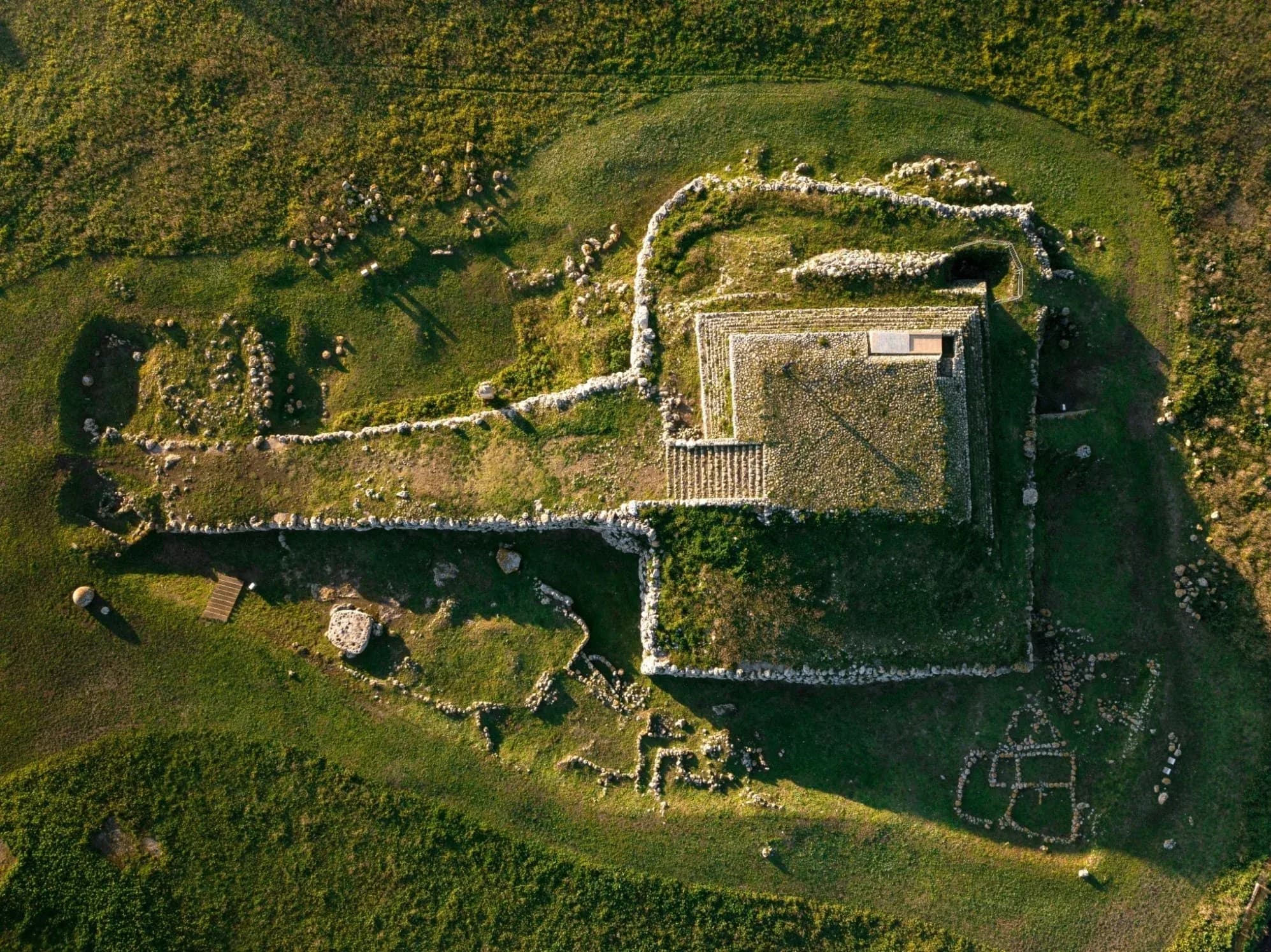
Driving along the SS 131 highway from Sassari towards Porto Torres in north-western Sardinia, the flat landscape is suddenly broken by a geometry that simply shouldn't be there. It isn’t the typical truncated cone of a nuraghe tower, the iconic symbol of the island. Instead, it is an immense stepped pyramid, preceded by a monumental stone ramp. At first glance, it looks like a fragment of ancient Mesopotamia dropped by mistake into the heart of the western Mediterranean.
Yet, the prehistoric altar of Monte d'Accoddi is neither a trick of the landscape nor an import from the Middle East. It is the masterpiece of a complex, indigenous civilization capable of moving thousands of tons of stone to reshape the earth and reach closer to the sky. More surprisingly, it is incredibly old. When the pharaohs were planning the very first pyramids in Egypt, Monte d'Accoddi was already standing. By the time the Nuragic builders erected their famous stone towers across Sardinia (around 1500 BC), this sanctuary was already a ruined, overgrown mound that had been abandoned for a millennium.
Its story is one of archaeological mystery, an accidental discovery, and a building site that lasted centuries, witnessing generations of prehistoric people hauling limestone blocks to elevate their altar into the clouds.
The Discovery: A False Hill and Ercole Contu’s Intuition
Until 1952, Monte d'Accoddi was nothing more than a grassy hill. Its very name, which in 19th-century land registers appears as Monte de Code (mountain of stones), hinted at the presence of rocks, but to local farmers, it was just a natural rise in the ground covered in Mediterranean scrub. During World War II, the flat top of the mound was even used as an anti-aircraft battery, with soldiers digging trenches that damaged the upper archaeological layers without anyone realizing what lay beneath their boots.
The turning point came in the early 1950s. The landowners, the Segni family, were carrying out deep agricultural plowing when massive squared stone blocks surfaced. The local heritage office was notified, and a young archaeologist named Ercole Contu was dispatched to the site. Contu possessed a formidable clinical eye. Observing the unnatural regularity of the hill and the alignment of the protruding stones, he instantly understood he was not looking at a simple village or a necropolis.
Systematic excavations began in 1952 and lasted until 1959. The sheer volume of work was staggering: thousands of cubic meters of dirt and collapsed rubble had to be removed. As the workers' pickaxes dug deeper, a shocking geometry emerged. Huge retaining walls sloping inward appeared, followed by a monumental, straight ramp over 40 meters (131 feet) long cutting through the slope to reach the summit.
Contu realized he had unearthed a unique monument. Nothing like it existed—nor does it exist today—anywhere else in the Mediterranean basin. Academic excitement was immense, but the excavation techniques of the 1950s couldn't yet unravel all the building phases. It would take further digs in the 1970s and 1980s to prove that the giant structure Contu found was actually just the final version of the sanctuary.
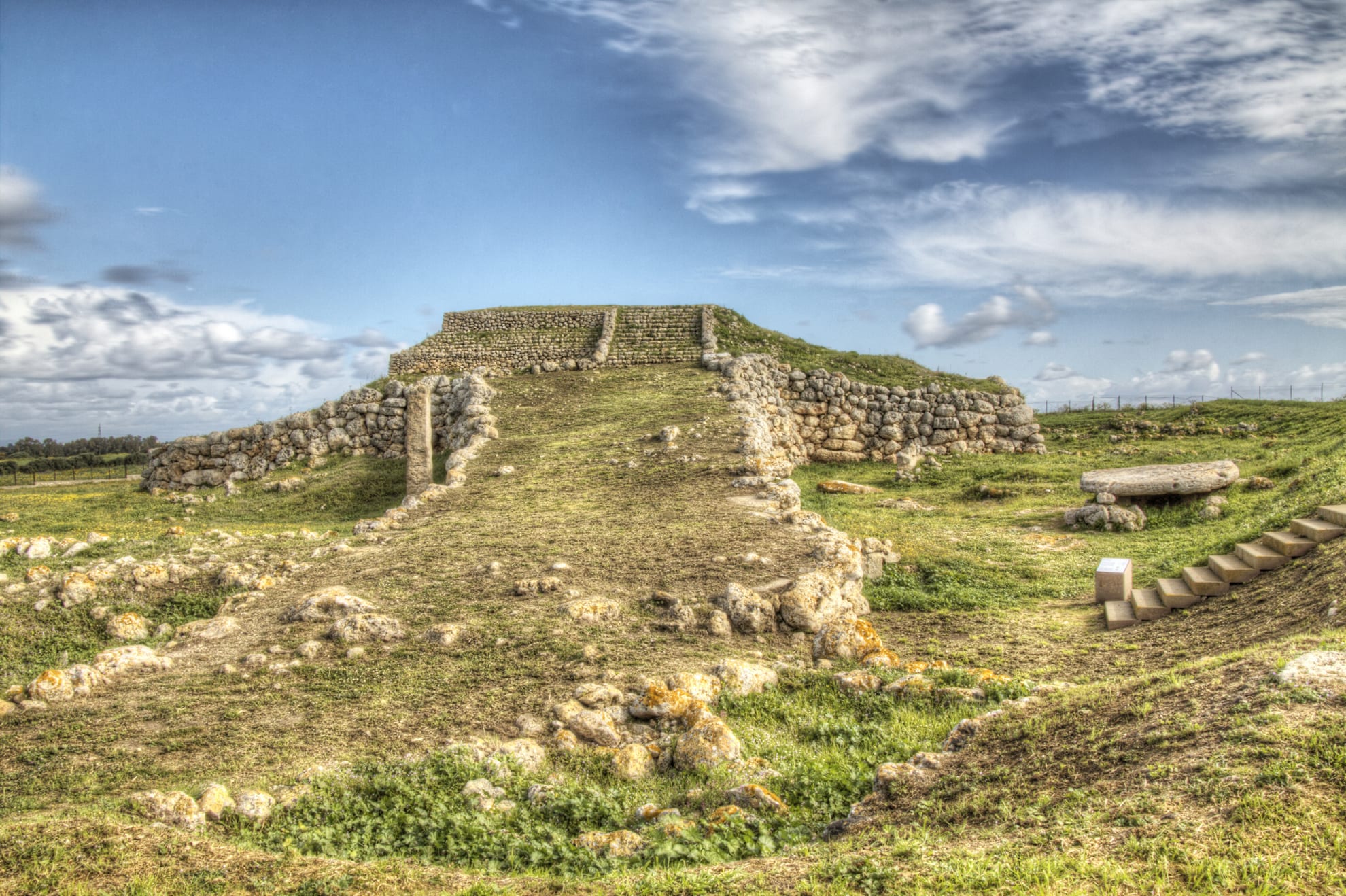 The monumental access ramp, stretching over 41 meters, added during the sanctuary's second building phase.
The Red Temple: The Sanctuary's First Life
To truly understand Monte d'Accoddi, we have to travel backward in time, peeling back the layers of earth. Between 1979 and 1989, archaeologist Santo Tinè conducted crucial new excavations, digging deep exploratory trenches straight into the heart of the structure. What he found rewrote the site's history.
Hidden beneath the imposing stepped pyramid we see today lies an older, smaller monument. Archaeologists call it the "Red Temple" (Tempio Rosso), built around 3200 BC during the Late Neolithic period by the Ozieri culture. This first structure was a truncated pyramid with a square base of 27 by 27 meters (88 by 88 feet), standing about 5.5 meters (18 feet) tall. On its flat summit stood a rectangular shrine, of which only fragments of the floor and perimeter walls survive today.
The most captivating detail of this first phase is its color. The entire surface of the temple, including the shrine's floors and walls, was plastered in a vibrant red using red ochre. In prehistoric Mediterranean symbolism, red ochre represented blood, life, and regeneration, and it was widely used in Sardinian rock-cut tombs (the domus de janas). Imagine the visual impact in the Sassari plain five thousand years ago: a massive, bright red cube, visible for miles against the green landscape.
However, this first sanctuary met a tragic end. Tinè's excavations revealed a thick layer of ash, charcoal, and red plaster baked at extremely high temperatures. Around 2800 BC, the Red Temple was destroyed by a devastating fire. Whether this was an accident or a deliberate act of war remains unknown, but the local community's reaction was extraordinary. Instead of abandoning the ruined site, they decided to bury it and turn it into something even grander.
The Great Ziggurat: A Feat of Engineering
Over the ashes of the Red Temple, the subsequent Abealzu-Filigosa culture (Copper Age, 2800-2400 BC) achieved a cyclopean feat of engineering. Rather than clearing the rubble, the builders used it as a core for an immensely larger structure, encasing the old temple inside a new stone shell—a technique archaeologists compare to the layers of an onion.
The new altar—the one visible today—became a giant stepped ziggurat. The base was expanded to 36 by 29 meters (118 by 95 feet). The outer retaining walls were built using massive, rough-hewn blocks of local limestone (marl), some weighing several hundred kilograms, laid entirely without mortar. The gap between the old red walls and the new outer shell was filled with tons of stones, earth, and remnants of sacrificial offerings, creating a solid foundation that could bear enormous weight. It is estimated that the original height of this second terrace exceeded 10 meters (33 feet).
The most stunning feature of this phase is the access ramp. Measuring 41.5 meters (136 feet) in length and about 7 meters wide at its base, it cuts through the space in front of the altar, rising steadily to the summit. Picture the construction site: there were no wheels, no draft animals used to pull stones, and no pulleys. Every single block was quarried with bone, stone, and early copper tools, carried on human shoulders or wooden sledges, and placed by sheer muscle power. This required decades of coordinated labor, proving the existence of a highly organized society capable of feeding and directing hundreds of workers for a single religious purpose.
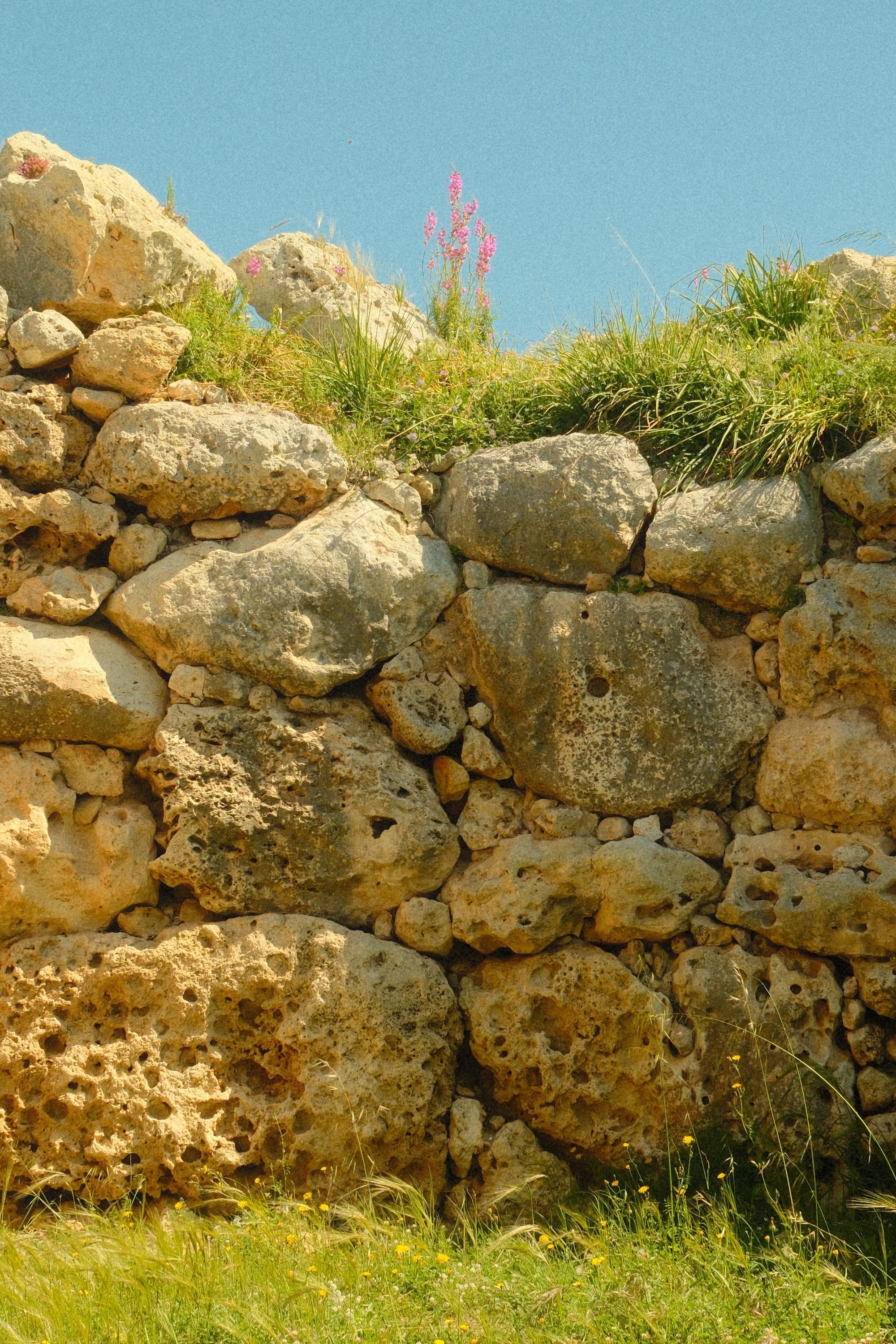 The dry-stone masonry technique used for the second-phase retaining walls, featuring large, rough-hewn limestone blocks.
The Sacred Stones: Menhir, Omphalos, and Altars
The main monument, despite its massive size, did not stand alone. Around the base of Monte d'Accoddi's ramp, a sacred landscape unfolded, populated by heavily symbolic stones that are still visible today.
To the left of the ramp stands a colossal menhir (standing stone). At 4.44 meters (14.5 feet) tall and weighing over five tons, it is one of the largest monoliths in Sardinia. Made of limestone, its base is squared off, tapering toward a rounded top. Its function was clearly symbolic and directional, perhaps representing a male deity or acting as an axis connecting the earth and the heavens—a stone guardian welcoming pilgrims.
A short distance from the menhir lie two stones that continue to fascinate scholars. The first is a large, flat limestone slab, over three meters long, split down the middle and featuring holes bored through its edges. This stone is widely interpreted as a sacrificial altar. The holes were likely used to tie down large animals (cattle or sheep) before sacrifice. The blood of the victims would spill directly onto the ground, a ritual intended to fertilize Mother Earth.
The most enigmatic object, however, is the great Omphalos (a Greek term meaning "navel of the world"). It is a giant spherical boulder, artificially worked to resemble a flattened egg, roughly one meter in diameter. A second, smaller spherical stone was found nearby. In prehistoric Mediterranean symbolism, the egg shape is deeply tied to regeneration, fertility, and the birth of the universe. Placing it at the foot of a towering altar suggests that Monte d'Accoddi was perceived as the cosmic center of their world, the exact point where life was constantly renewed through ritual.
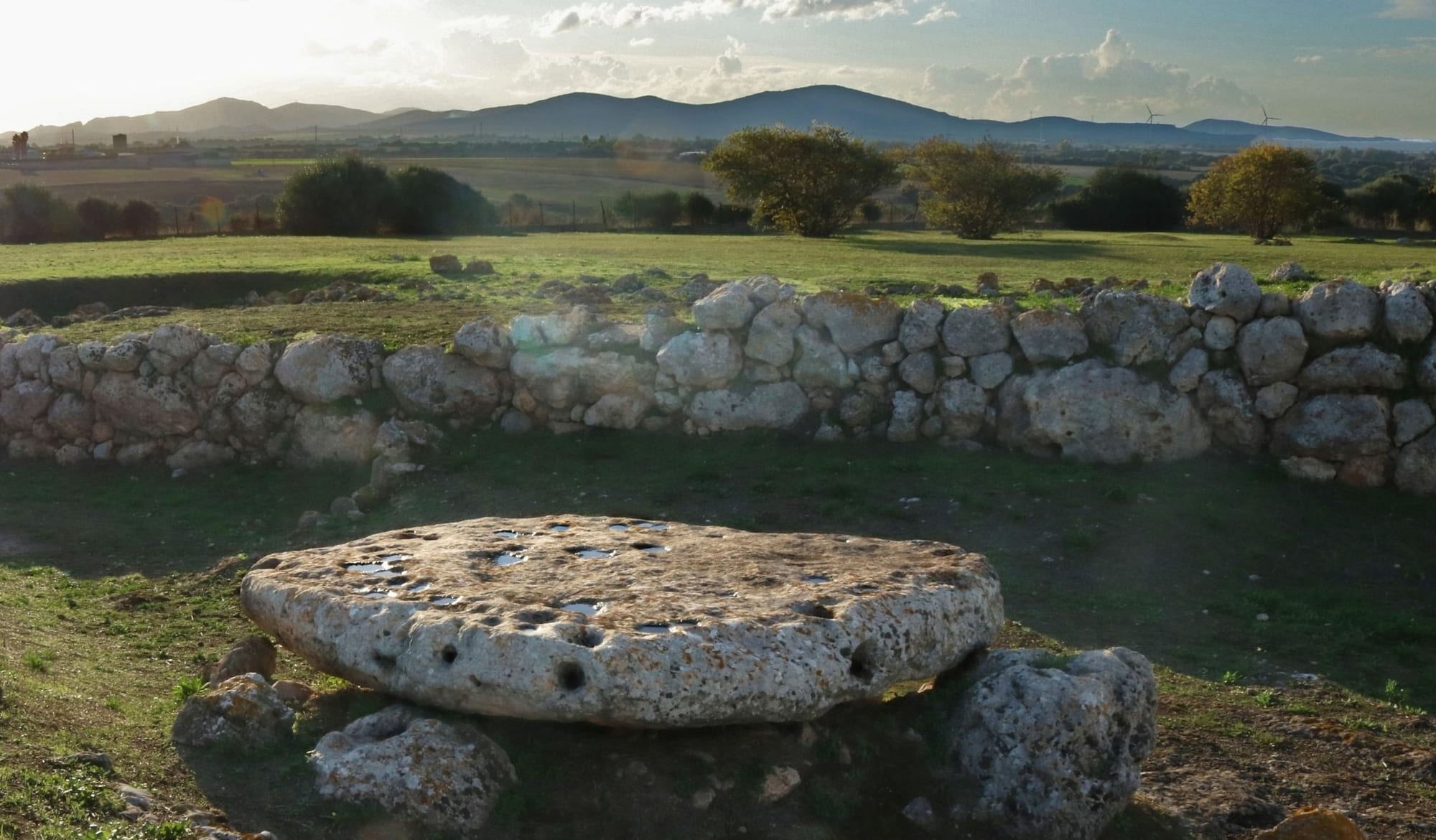 The omphalos (or egg-stone) found near the access ramp, a powerful symbol linked to agricultural fertility rites.
Mesopotamia or Sardinia? The Enigma of its Origins
When Ercole Contu completed his initial excavations, the architectural resemblance to Mesopotamian ziggurats (like those in Ur or Uruk) was so striking that it sparked theories of direct contact. Scholars imagined that travelers, merchants, or priests from the ancient Near East had reached Sardinia in the 4th millennium BC, bringing their architectural blueprints with them.
Today, modern archaeology has entirely discarded this theory. Radiocarbon dating has become highly precise, and the study of material culture (pottery, tools, lifestyle) proves that Monte d'Accoddi was an entirely indigenous development. There is not a single shard of Mesopotamian pottery at the site. Instead, scientists point to "convergent evolution": human societies separated by thousands of miles, facing the exact same desire to build a high place to reach the gods and visually dominate a plain, independently invented the same architectural solution—the stepped pyramid.
But what exactly happened at the top? Very little remains of the final shrine that once crowned the second terrace. However, excavations in the collapsed rubble yielded extraordinary artifacts, including stone sculptures shaped like bovine horns. This led archaeologists to hypothesize that the upper temple was adorned with these large stone horns, symbolizing the Bull God, the traditional counterpart to the Mother Goddess in prehistoric Sardinia.
Some experts, including archaeoastronomer Eugenio Proverbio, measured the ramp's alignment and discovered that the monument's central axis is precisely oriented toward significant celestial points. Facing south, it is calculated that in 3000 BC, the ramp pointed directly toward the rising stars of the Southern Cross (which was visible from the northern hemisphere at the time), or perhaps served to track the sun and moon during solstices. The sanctuary thus doubled as a massive stone calendar, a vital tool for a farming community that needed to perfectly time planting and harvesting seasons.
The Decline and the Mystery of Abandonment
No temple lasts forever. Around 1800 BC, with the dawn of the Early Bronze Age (the Bonnanaro culture), Monte d'Accoddi suddenly lost its central religious role. Sardinian society was undergoing a radical shift: a warrior aristocracy was emerging, the use of metals became widespread, and communities began to fragment. This period of turmoil was the prelude to the explosion of the Nuragic Civilization shortly after.
This time, the great ziggurat was not violently destroyed; it was simply abandoned. Worship moved elsewhere, the shrine at the top collapsed, and the wind and rain began to cover the great stone steps with soil. Yet, the site retained a lingering aura of sacredness. Even though the grand collective rituals ceased, the people of the Bonnanaro culture used the monument's ruins to bury a child, as if entrusting the young soul to the protection of the sleeping altar.
From that moment on, silence fell over the plain. Monte d'Accoddi became just the Monte de Code, a grassy hill hiding its monumental secret, waiting for millennia for the strike of a pickaxe to bring it back to the light.
How to Visit Monte d'Accoddi Today
Today, the archaeological site of Monte d'Accoddi is one of the most fascinating parks in Sardinia, meticulously maintained and open to the public year-round. It is located just a short distance off the SS 131 highway, at kilometer 222, heading towards Porto Torres.
The best time to visit is undoubtedly the late afternoon, especially in spring or autumn. In the slanting light of the sunset, the shadows highlight the rugged limestone blocks, and the pyramid’s silhouette stands out sharply against the sky, partially restoring the awe it must have inspired in pilgrims in 3000 BC. Walking up the 40-meter ramp to reach the windswept summit is a physical experience as much as a cultural one: your steps fall exactly where prehistoric men and women walked five thousand years ago as they tried to build a stairway to heaven.