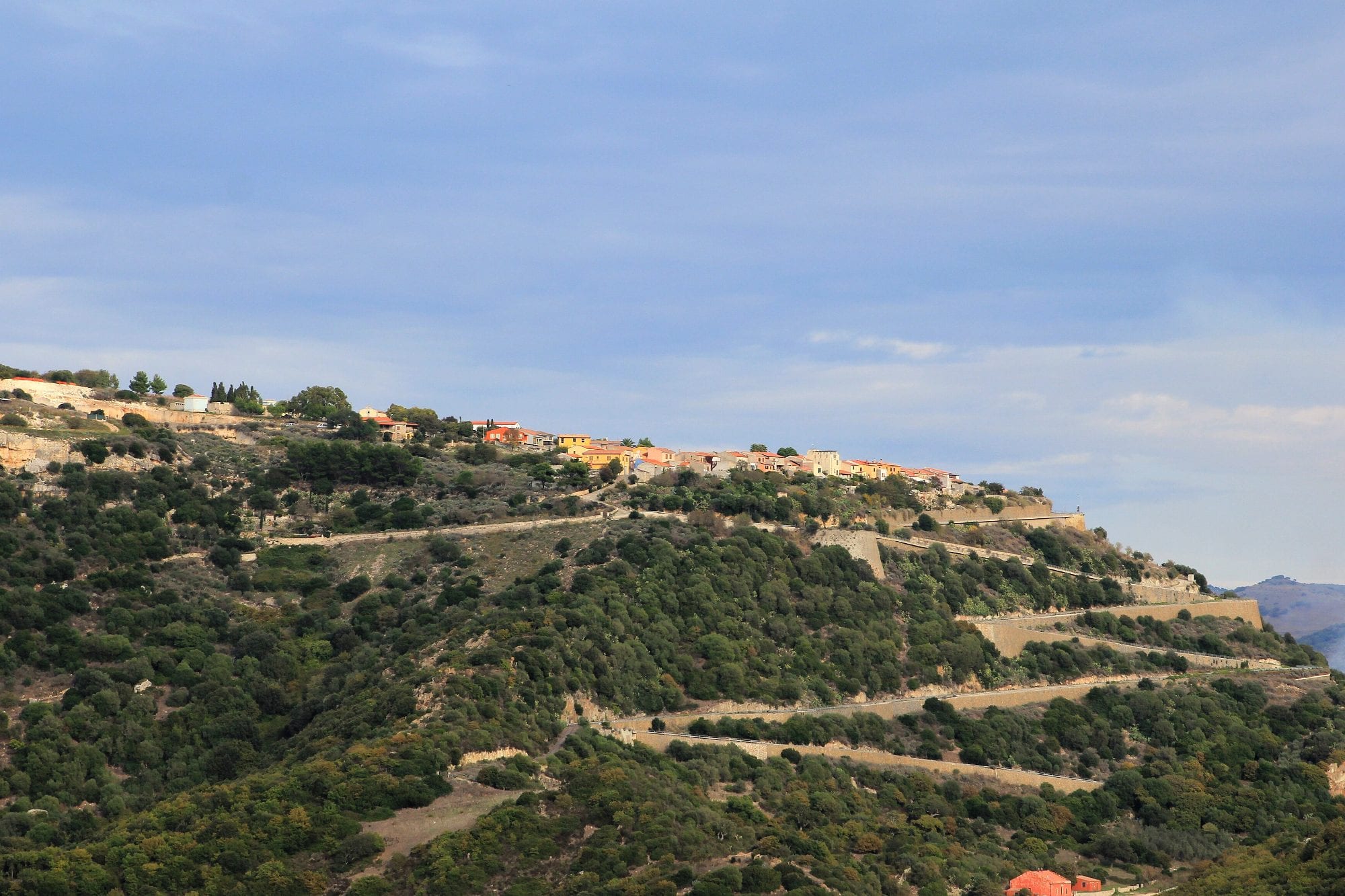
On a limestone tableland above the Temo reservoir, in the province of Sassari, there is a village of 105 people. In the early 1900s there were around 450. Monteleone Rocca Doria has been emptied twice: the first time in 1436, when besiegers razed it and spared only the churches, the second time now, with no siege and no date to remember.
Istat's permanent census, dated 31 December 2024, puts villages like this one in a statistical class of their own: municipalities of up to a thousand inhabitants. Sardinia has 131 of them out of 377, and 70,671 people live inside that class. There, 4.8 children are born per thousand inhabitants each year and 17.3 people die: three point six deaths for every birth. That is not the figure for Sardinia, which is ageing faster than Italy as a whole. It is the figure for a third of its municipalities, where the island's numbers turn into something else.
A third of the municipalities, 4.5% of the people
The 131 municipalities under a thousand inhabitants are 34.7% of Sardinian municipalities and hold 4.5% of the population: 70,671 residents out of 1,562,381. That is the first thing those numbers say, and it explains why they vanish inside regional averages. A village of two hundred people weighs as much as a city block, but it has a mayor, a budget, a registry office and a territory to keep running, exactly like a municipality twenty times its size.
The regional picture around them is already sliding. In 2024 Sardinia lost 8,072 residents, 0.5% in twelve months, settling at 1,562,381 people spread over 24,100 square kilometres: 64.8 inhabitants per square kilometre, barely a third of the Italian density. Across the 131 smallest municipalities that same surface is close to empty, and the regional average does not show it.
Comparing rates is what puts places of different size back on the same footing. The birth rate counts births per thousand inhabitants in a year, the death rate counts deaths: two measures you can set side by side without the size of the village distorting them. In Sardinia the ratio between the two, in 2024, is 2.6 deaths for every birth — 18,519 deaths against 7,052 births. In municipalities of up to a thousand inhabitants it rises to 3.6.
Source: ISTAT, Permanent population census, 31 December 2024
A gap of one point sounds small until you turn it into people. In one year, across the 131 municipalities, a little over three hundred children are born among 70,671 residents and roughly twelve hundred people die. That natural balance eats, every twelve months, the equivalent of one of those villages, picked at random among the larger ones in the class.
Nearly four old people for every child
The ageing index counts how many people over 65 there are per hundred children under 15. A hundred means parity. Italy stood at 207.7 in 2024, Sardinia at 282.5 — it was 266.6 just a year earlier. In municipalities of up to a thousand inhabitants the index reaches 395.8: nearly four old people for every child.
Source: ISTAT, Permanent population census, 31 December 2024
The average age in the same class is 52.0 years, against 49.2 for the region and 46.9 for Italy. Three years above the Sardinian average, in demographic terms, is not a detail: it is the distance between a population that reproduces little and one that has almost stopped.
Behind that figure sits a mechanism of selection, before any question of fertility. Whoever leaves an inland village is usually between twenty and forty, and leaves at precisely the point when they would have had children; whoever stays has finished having them. So the village loses twice over: the people, and the births those people would have had there. Sardinia has the lowest fertility rate in Italy, 0.85 children per woman in 2025, and in the smallest municipalities that figure meets a population already skewed by age.
Boroneddu, where the average age is 58.2
The record belongs to a municipality of four and a half square kilometres facing Lake Omodeo, in the province of Oristano. In Boroneddu the average age at 31 December 2024 is 58.2 years, the highest in Sardinia: six years above the already high average of its class, nine above the regional one.
In the same year Boroneddu lost 8.3% of its residents, the steepest fall of all 377 Sardinian municipalities. On 1 January 2026 it counted 135. In a village that size, 8.3% is a little over a dozen people: in a city it would be a rounding error, here it is a street left empty. That is why percentage rankings of small municipalities need reading with care, and also why they are true all the same.
At the other end of the same province, in the Alta Marmilla hills, Baradili remains the least populated municipality on the island with 76 inhabitants at the 2024 census. Those are numbers that fit inside a bus, and they hold up a town hall.
The coast grows, the interior does not
Ageing is not uniform, and the same census shows it with two municipalities heading the other way. Girasole, in Ogliastra, has the lowest average age in Sardinia: 44.3 years, nearly fourteen below Boroneddu, and below the national average. Trinità d'Agultu e Vignola, on the coast between Gallura and Anglona, is the fastest-growing municipality of 2024: +6.8% more residents in twelve months.
The two cases share one thing: the sea nearby, and an economy built around it. Where tourism, second homes and seasonal work arrive, young residents arrive too — with all the problems that model brings, starting with house prices. Where none of that arrives, the curve goes down. The line that divides demographic Sardinia today does not run between north and south, but between the coastal strip and the inland villages twenty kilometres away.
You can see the same thing in the Blue Zone of Ogliastra and Barbagia, the area studied worldwide for its density of centenarians. The very villages that hold the longevity record are the ones with the emptiest schools: people live a long time and are born very rarely, in the same municipality.
What an emptying island costs
A figure in euros exists, debatable as it is. The research centre of Confindustria Sardegna, the regional employers' association, compared the 2005 age structure with that of 2025 in a 2026 study: the 15-64 band, meaning people of working age, fell from 69.6% to 62.8% of residents. Translated into heads, that is more than 106,000 working-age people missing today relative to the proportion of twenty years ago. Applying municipal employment rates and average value added to that number, the study estimates 1.705 billion euros of productive capacity never activated and 44,238 theoretical jobs that never entered the count.
It is an estimate, built on a counterfactual — what would have happened if the age structure had stayed as it was in 2005 — and like every estimate of its kind it depends on the assumptions of whoever makes it. What it does give is an order of magnitude for a phenomenon usually told through closed shutters and cats on the steps.
The most legible counter is still the school system. In the 2014-2015 school year Sardinian pupils numbered 212,047; in 2025-2026 they number 171,387, 19% fewer in eleven years. To keep schools open in the small villages, the regional government now runs 187 multi-grade classes, meaning classes that put children of different ages together: 147 in primary and 40 in lower secondary schools. Projections for the next fifteen years point to a fall in pupil numbers close to 40% by 2040: at that point the multi-grade class is no longer enough, and the question becomes whether the village still has a school.
Two ways to empty a village
Back to where we started. Monteleone Rocca Doria appears in the documents in 1364, grows around the Doria castle and controls a stretch of north-western Sardinia for decades. In 1436, after a long siege and a surrender by starvation, it passes to the Aragonese: the village is destroyed, only the churches survive, and those left alive go down the hill to found Villanova Monteleone. Whoever stays rebuilds something up there, around the church of Santo Stefano.
Five centuries later, that something is 13.39 square kilometres with 105 residents: 7.84 inhabitants per square kilometre, at 379 metres above sea level. Below, in the Temo reservoir, lies the only known Phoenician settlement in the north of the island, Sa Tanca 'e sa Mura. The first time it took three years of siege and an army. The second is happening by subtraction, a dozen people a year in one place, four in another, and nobody outside the municipality noticing.
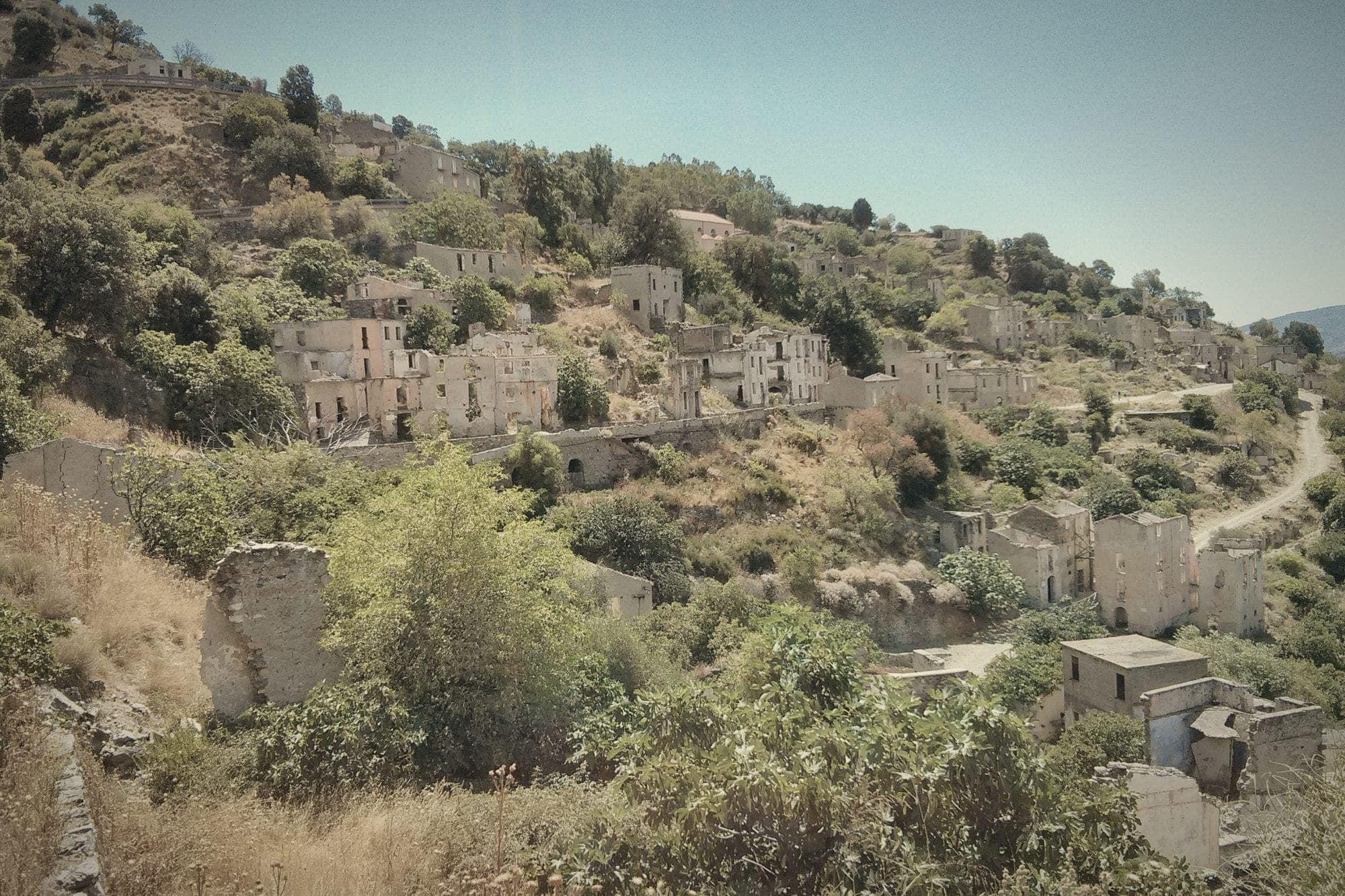
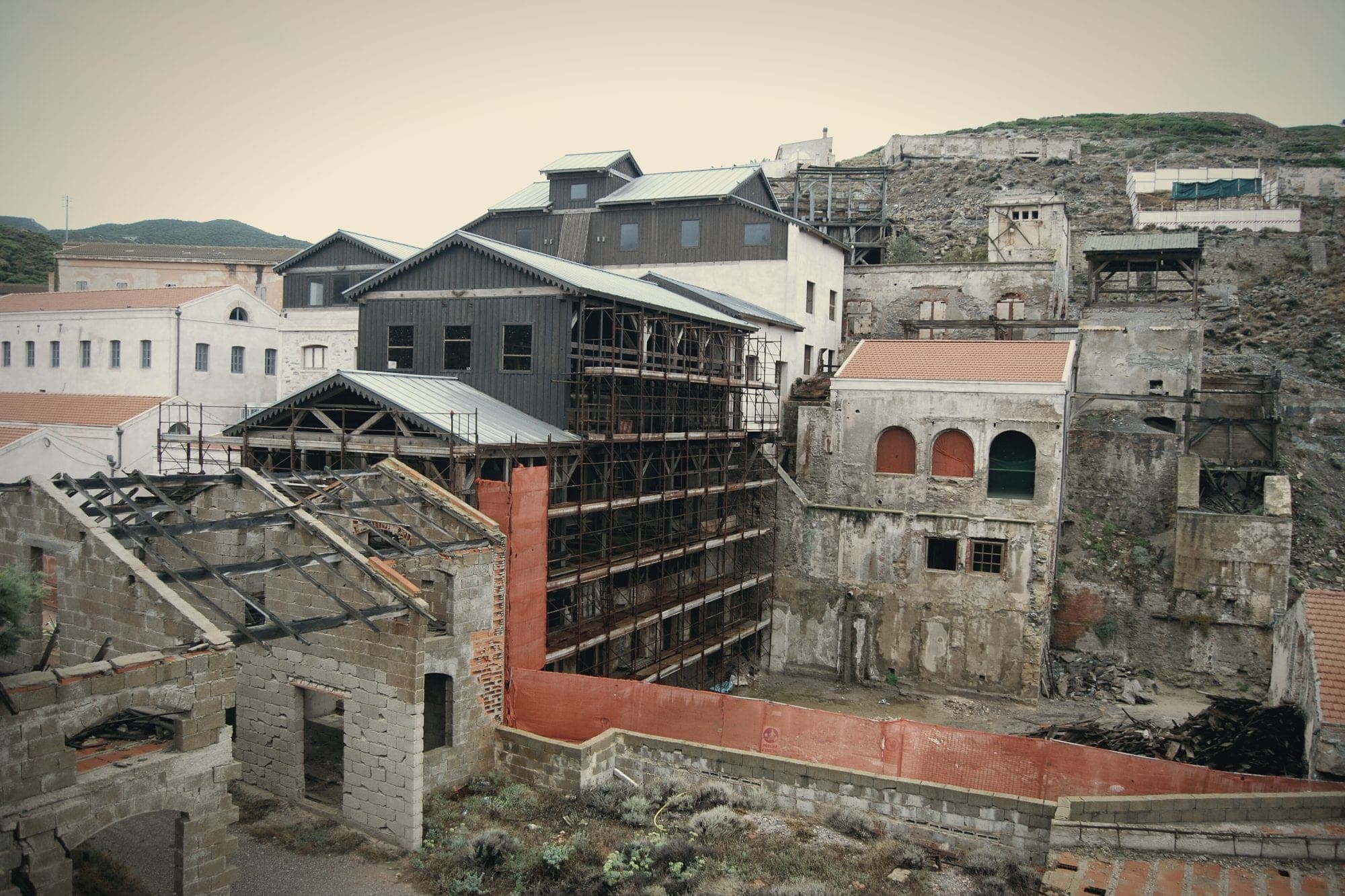
The practical difference is that the first depopulation left a new village down in the valley. This one leaves nothing: whoever leaves the 131 municipalities under a thousand inhabitants does not found a hundred and thirty-second, they go to Cagliari, to Sassari or off the island. The mining villages of Sulcis and the Guspinese, like Argentiera, emptied when the mine closed, in a precise year everybody remembers. In the inland villages nothing closes, and that is exactly why it is harder to notice: 3.6 deaths for every birth make no noise, they only make arithmetic.
Cover photo: Gianni Careddu, CC BY-SA 4.0, Wikimedia Commons