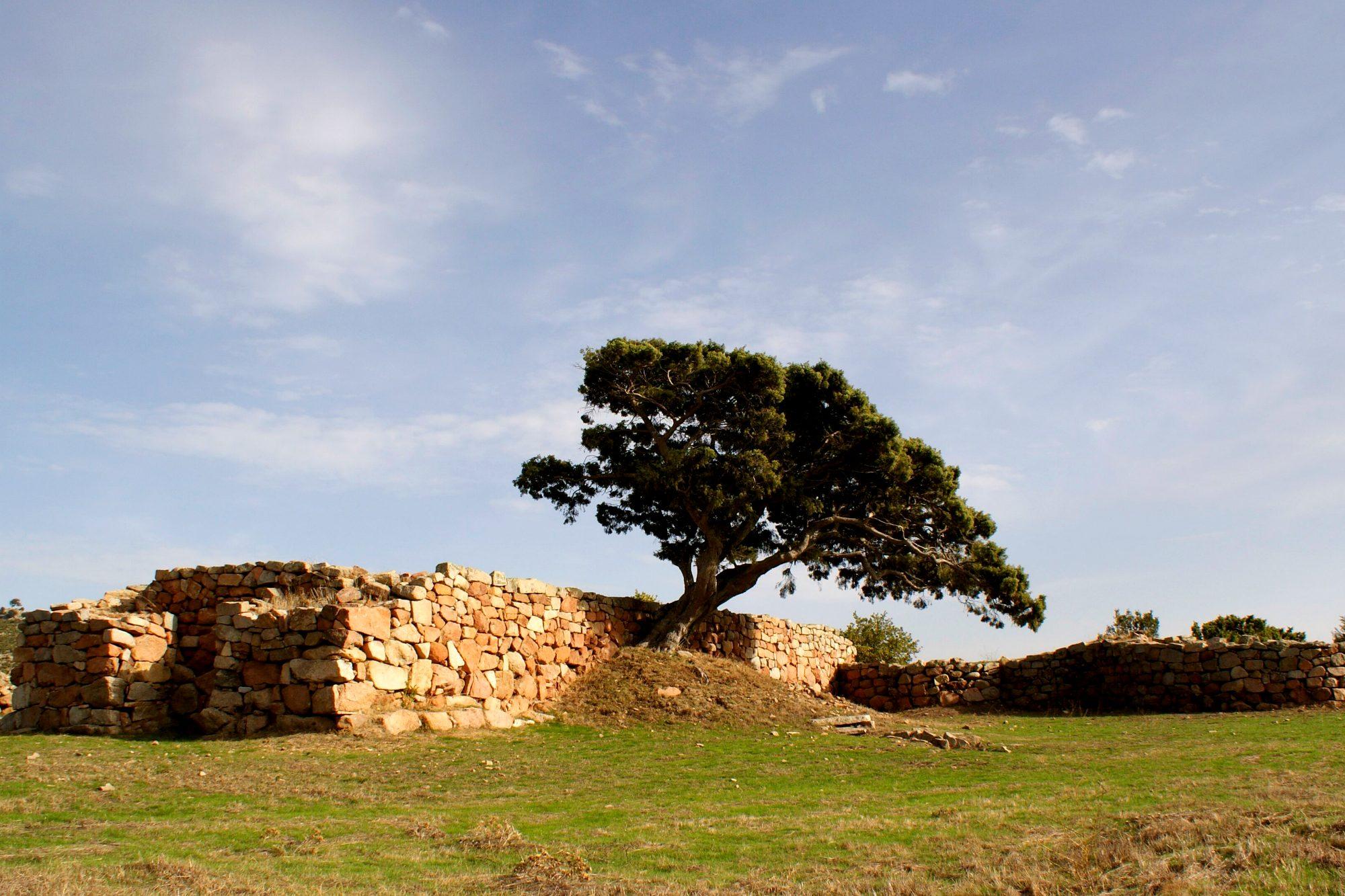
Built into the thickness of a stone wall, on a mountain ridge in eastern Sardinia, there was a niche. Inside it stood some thirty ceramic jugs, lined up one beside the other, and at their base two metal objects: a drinking horn cast in lead with a bronze handle, and a small bronze button. Nobody had touched them since someone, late in the Bronze Age, decided to leave them there.
Archaeologists found them between July and September 2026 at S'Arcu 'e is Forros, in the territory of Villagrande Strisaili, in the Ogliastra region. This is a sanctuary village — a settlement built around temples rather than around a single fortress tower — that has been under excavation since 1984, and that Italy's Ministry of Culture still calls the most important metallurgical centre of Nuragic Sardinia. After a ten-year pause the dig reopened, and the results were announced on 27 September to roughly three hundred people who had climbed up for the European Heritage Days.
What came out of the ground between July and September
The 2026 campaign was directed by Enrico Dirminti, staff archaeologist of the Superintendency for Archaeology, Fine Arts and Landscape of Sassari and Nuoro. It picked up exactly where the dig had stopped a decade earlier. In 2016 a monumental stepped structure had emerged — something like a tiered stand facing a paved open space — but only two thirds of it had been excavated. Finishing it was the first goal of 2026, and it was done.
Next to those steps, though, something unplanned appeared: a circular building roughly six metres across, with a hearth at the centre of the room. That is a large hut, the kind that in Nuragic villages hosts gatherings rather than a single family, and the niche with the jugs was cut into its wall.
The rest of the haul comes from the same room. The lead drinking horn with its bronze handle is an unusual object. The bronze button is tiny. There are also two Roman coins, one silver and one bronze: the site saw activity into Roman times, so they are no shock, but nobody has yet published which layer they came from, which is why they should not be tied to the deposit in the niche.
The metal finds left almost immediately for the Li Punti conservation centre near Sassari, where cleaning and analysis will show what alloy the horn is made of and how lead and bronze were joined. All of this happened in public view: the season was part of "Scavi aperti" (Open Excavations), run by the Archeonova cooperative with the Superintendency and the municipality of Villagrande Strisaili, which brought visitors into the trenches for weeks while digging was under way.
The well that surfaced on the last pass
The season was effectively over when the team began clearing the ground in front of the hut's doorway. The mouth of a Nuragic well appeared under the soil. Archaeologist Matteo Tatti, who has worked on this site since the 2016 campaigns, described it as a complete surprise: the structure emerged while loose earth was being lifted, and it was on nobody's plan.
The position is what makes it interesting. The well does not sit off to one side; it sits directly in front of the door of the hut with the hearth. The two were almost certainly used together. What that pairing meant — water and fire a few metres apart, in a quarter of the village where metal was being smelted — is precisely the question the dig left open.
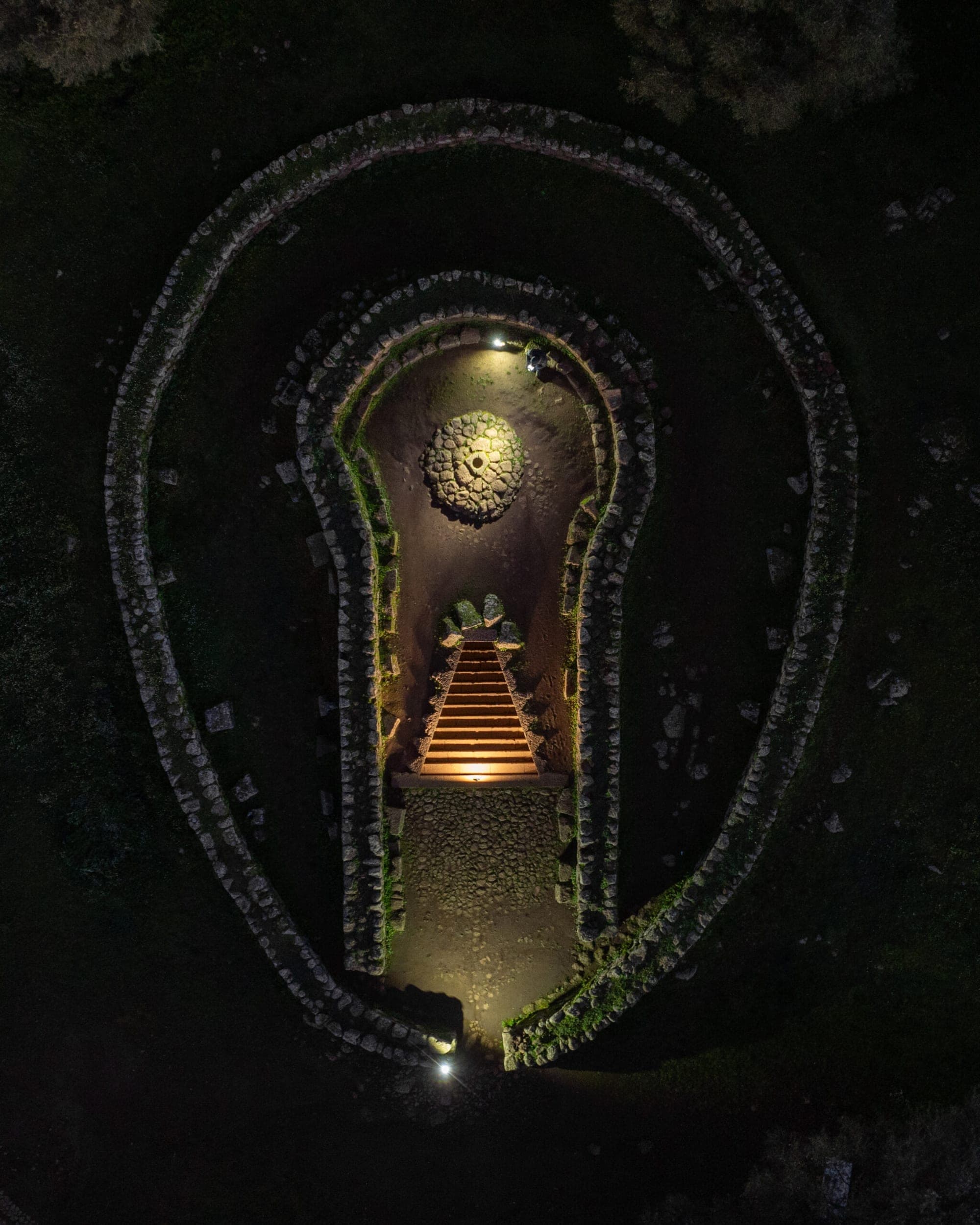
A word of caution on the label. The sources say "Nuragic well", not "sacred well". The Nuragic sacred well is a specific architectural type, with a covered stairway and a corbelled tholos chamber, as at Santa Cristina, and nobody has claimed this one belongs to it. Until an excavation report appears, it is a well in front of a door, and that is plenty.
A sanctuary with the furnaces inside it
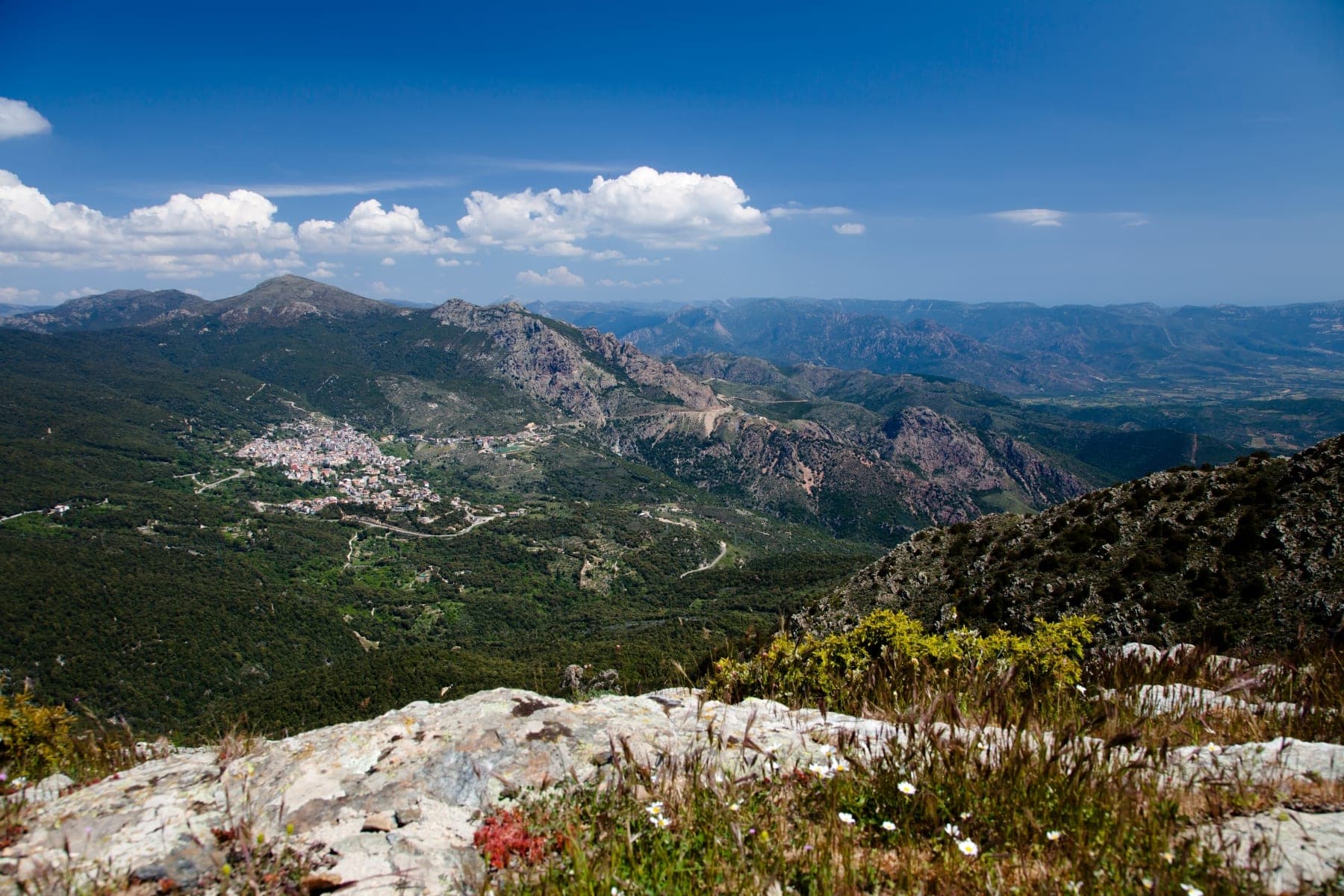
To see why that niche matters, look at where it is. S'Arcu 'e is Forros is not an isolated tower: it is a complex of temples, houses and workshops that grew on a ridge between Barbagia and Ogliastra, in the upper Flumendosa basin, in a place that gets snow in winter.
Its centrepieces are two rectangular temples, the so-called megaron temples, a shape that is rare on an island that otherwise builds round. The larger one is 17 metres long and between 5.50 and 6.50 wide, with walls up to a metre and a half thick still standing 2.60 metres high; inside, a sequence of four rooms and a limestone basin. The second has a two-colour altar of basalt and red sandstone blocks with two carved faces, and a hearth decorated with a frieze showing a Nuragic tower. A sacred enclosure, the temenos, runs around them with benches set against its walls.
Then come the workshops, right up against the temples. The excavation record lists an eight-room building read as a smelting workshop, with founders' tools and raw metal: copper, tin, lead. Beside the larger temple stand two circular furnaces for smelting copper, lead and iron ores. In 2010 Maria Ausilia Fadda, the archaeologist who dug the site from the 1980s to the late 1990s, uncovered four more, of the pit type: a hole about half a metre across was dug, lined with clay, filled with alternating layers of fuel and ore, and ringed with stones.
Metal here sits inside the sacred enclosure and belongs to the cult. The site has produced pierced stone slabs still holding the lead that was poured to fix votive bronze figurines upright before the god. One of those figurines, an archer dated between the 10th and 7th centuries BC, is on display today at the National Archaeological Museum in Nuoro. The lead horn found in 2026 belongs to the same family of gestures: at S'Arcu 'e is Forros metal itself was offered, and offered worked.
Why thirty identical jugs inside a wall
Askoid jugs are an unmistakable Nuragic shape: a lopsided belly that recalls a leather wineskin, a narrow neck, a high handle. They turn up in houses and in places of worship alike, and they are generally thought to have held wine. The best-dated examples, such as those from Sardara, fall between the 9th and 8th centuries BC.
They are also the signature of Nuragic trade abroad. Askoid jugs appear at Carthage, in Spain between Huelva and Cádiz, on Crete, often alongside Sant'Imbenia-type amphorae: a package archaeologists read as Sardinian wine exported with its own tableware. The people smelting metal up in these mountains were part of that network.
Thirty of them lined up in a niche, however, is neither a dinner service nor a storeroom: it is a deposit. The closest comparison was published this year, at Nuraghe Barru near Guamaggiore, where a well packed with deliberately smashed pottery, human bone and animal offerings was sealed with limestone slabs, and a 94-centimetre votive bronze sword was laid along the tower staircase.
The two sites should not be glued together, though. At Barru the vessels were broken on purpose and the context was closed for good; here the jugs are described as carefully set down, and nothing is yet known about the layer they sat in. An offering sealed in a single act, or ritual equipment stored until the next ceremony: those are two different stories, and for now both are hypotheses.
Who came through: the inscribed amphora
That this mountain site was tied to the sea was already known. The complex has produced an Egyptian-type scarab and, more importantly, a Canaanite amphora — an eastern Mediterranean transport jar — carrying an inscription cut into its shoulder after firing.
It was read by Giovanni Garbini, a Semitic philologist and member of the Accademia dei Lincei, who identified Philistine and Phoenician characters and dated it between the 9th and 8th centuries BC. For him it is the oldest document left by foreigners from the eastern Mediterranean in the Sardinian interior: not an object that drifted inland, but someone writing, in a village of metalworkers deep in the mountains.
Outside academic circles a different reading has circulated for years, claiming those signs as an independent Nuragic script. It lives on blogs and forums rather than in the literature, and no publication has ever backed it. The inscription is real; the published reading is Garbini's. The rest, for now, is wishful thinking.
The overall picture is of a site that receives: copper, tin and lead to work, amphorae from the Levant, models from Etruria. This inland metallurgical centre and the island's prehistoric mines are two faces of one system.
What is still unknown
For this season, all that exists so far is the public announcement made in September: no excavation report, no laboratory analysis, no radiocarbon dates. That means the jug count is a field tally — the sources say about thirty, and "about" should stay — and that the link between the objects in the niche and the hut's own life phase remains to be demonstrated.
The site's broader chronology is not settled either. Activity begins between 1500 and 1400 BC, on which the sources agree; on the end they split between the 6th and the 5th century BC, and the excavation record notes traces of passage into the Roman period. That is a good nine centuries of continuous use, with a fire that destroyed the village somewhere in the middle and a full rebuild between the Final Bronze Age and the Early Iron Age.
There is also a limit that affects the whole site: nearly forty years of excavation, with much of the documentation published in volumes and conference proceedings that never reached the web. Answers about the lead horn will come from Li Punti, answers about the well from the next campaign.
Seeing it in person
The complex lies along the SS 389 var road between Nuoro and Lanusei, towards the Correboi pass, about ten kilometres from the centre of Villagrande Strisaili and at the foot of the Gennargentu massif. It is municipally owned, protected by decree since 2010, and visits are run by Archeonova with a ticket: the walk is easy, but it is not wheelchair accessible.
Once up there, three things stand out immediately: the rectangular plan of the two temples, unlike any other Nuragic monument; the altar of alternating dark basalt and red sandstone blocks, with its carved faces; and the blocks of rooms arranged around the paved courtyard, where the workshops stood. The bronze archer, on the other hand, has to be looked for in Nuoro, in the cases of the national archaeological museum.
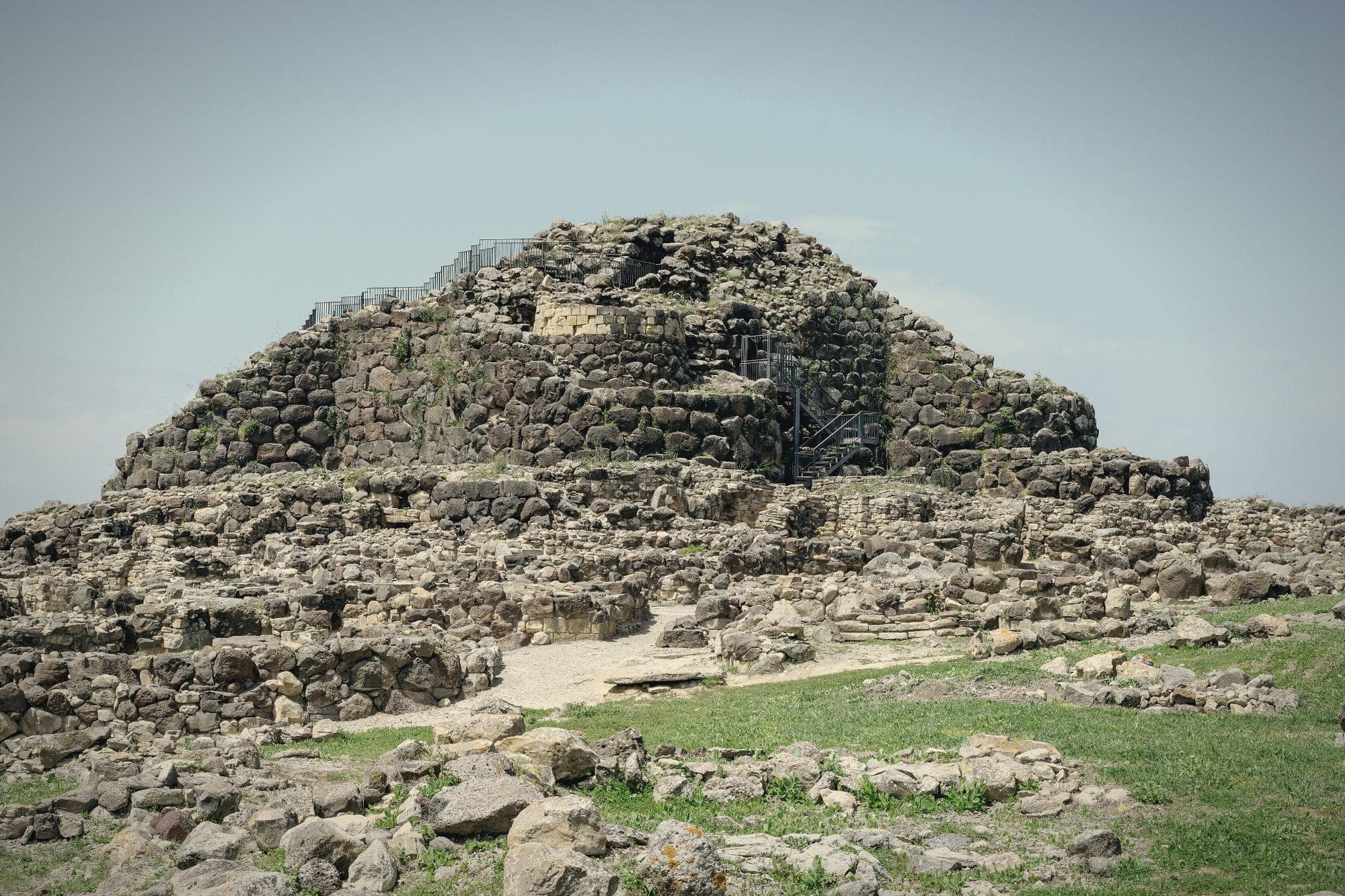
Cover photo: Maurizio Aresu, CC BY-SA 4.0, Wikimedia Commons