In May 2026, the publication of an interdisciplinary study in the peer-reviewed journal Open Archaeology captured the attention of the global archaeological community. Focused on the rolling hills of Trexenta—a fertile agricultural region in central-southern Sardinia—the study re-examined finds from the 2015 and 2016 excavation seasons at Nuraghe Barru, on the border between the municipalities of Guamaggiore and Guasila. Led by archaeologist Silvia Amicone of the University of Tübingen (Eberhard Karls Universität Tübingen), along with a multidisciplinary team including V. Tiezzi, M. Broisch-Höhner, K. P. Freund, L. Heinze, L. F. Morandi, and C. Pilo, the research applied cutting-edge archaeometric techniques to objects sealed away nearly three thousand years ago.
Initial media reports in early 2026 had circulated a sensational yet inaccurate story: headlines claimed that archaeologists had pulled a giant bronze sword directly out of an ancient well, where it supposedly served as a literal "plug." The reality revealed by chemical and petrographic analysis is far more nuanced, intriguing, and historically profound. The bronze sword did not seal the underground cistern at all; instead, it lay carefully placed along the steps of an internal spiral staircase inside the main stone tower. Meanwhile, the well itself had been hermetically sealed with heavy limestone slabs after being filled with intentionally shattered ceremonial pottery, human bone fragments, and sacrificial animal remains.
This discovery provides a crucial piece of evidence regarding the fate of prehistoric Sardinia. It demonstrates that the massive drystone fortresses built by the Nuragic civilization during the Bronze Age (c. 1700–1100 BC) were neither abandoned nor forgotten during the transition into the Early Iron Age (c. 1200–800 BC). Instead, these prehistoric monuments were repurposed into sacred sanctuaries, serving as venues for complex closing ceremonies, regional pilgrimages, and identity-affirming rituals within a vibrant trade network spanning the entire island.
Correcting the Myth: What Was Actually Found at Nuraghe Barru
In Sardinian archaeology, the line between popular folklore and scientific documentation can sometimes blur, especially when spectacular metal artifacts come to light. Following the first announcements of the excavation, news outlets spread the image of a sword jammed into a well-mouth like a prehistoric Excalibur. The publication of Amicone and colleagues' study (2026, DOI: 10.1515/opar-2025-0078) set the record straight, providing a rigorous stratigraphical timeline and establishing the exact location of every object recovered.
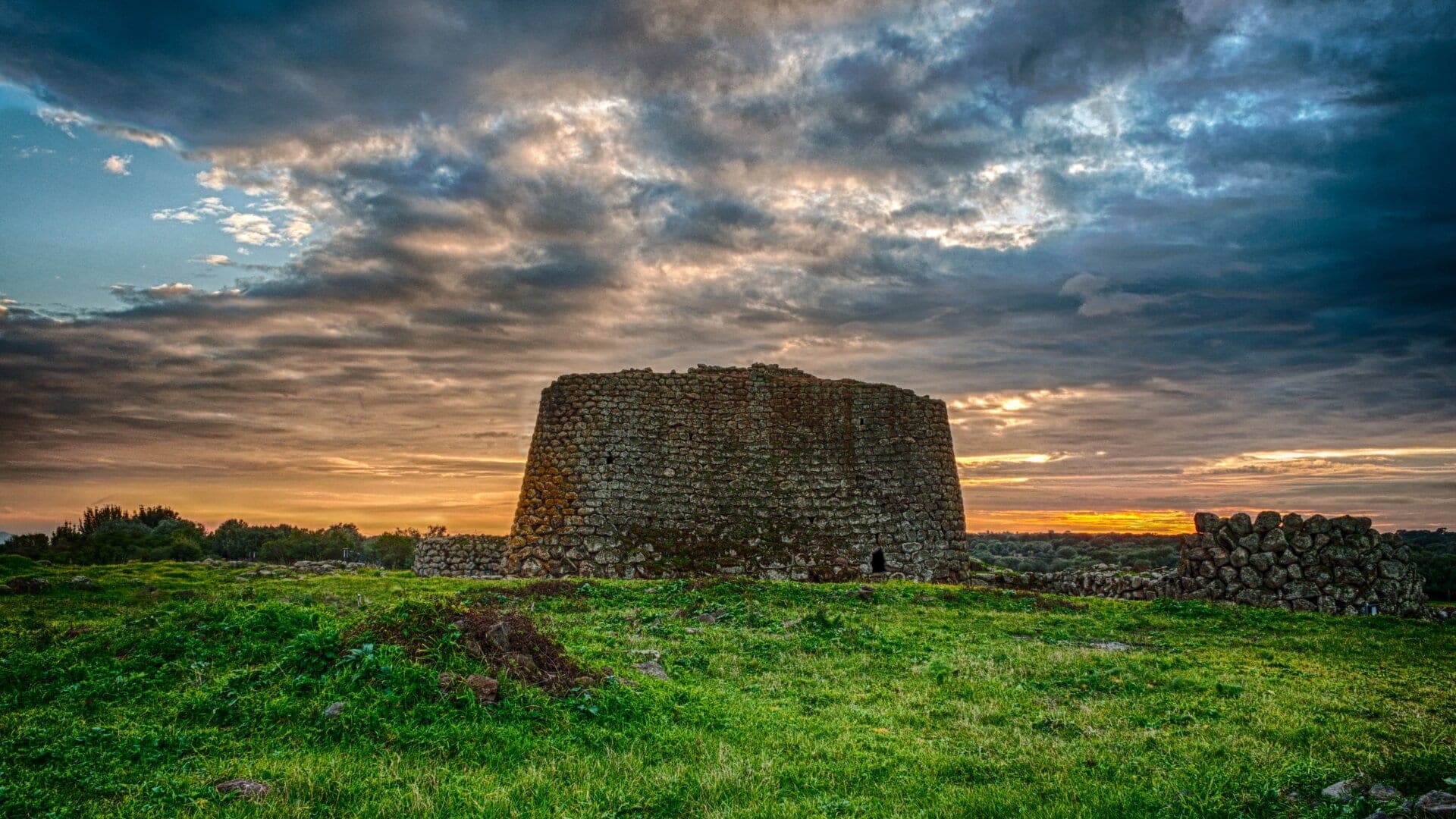
Nuraghe Barru is an impressive complex nuraghe—a central elliptical tower joined by curtain walls to two lateral towers with circular bases, built from squared blocks of limestone marlstone—surrounded by the remains of an extensive village of circular stone huts. During excavations led by archaeologists C. Pilo and A. Usai, research focused on the ground level of one of the towers. Here, two adjacent but distinct spaces were uncovered, both of which had been the site of solemn religious acts performed roughly 3,000 years ago.
The first space was a cistern-well at the base of the tower. The second was a staircase built within the thickness of the massive masonry walls, which originally led to the upper stories of the tower. The ancient inhabitants of Trexenta did not carelessly throw the sword into the water; rather, they orchestrated a carefully structured two-part ceremony, targeting first the water supply and subsequently the main pathway to the top of the fortress.
The Fundamental Distinction Between the Two Deposits
To understand the ritual logic behind these actions, archaeologists analyzed the two contexts separately:
- The Cistern-Well: This chamber at the base of the tower contained a votive deposit of intentionally smashed ceramic vessels, human skeletal fragments, and animal bones. Once the offerings were placed, the opening was permanently covered by fitting heavy, flat limestone slabs over the mouth.
- The Tower Staircase: Resting along the stone steps that ascended into the upper level, officiants laid an imposing votive bronze sword 94 centimetres long, alongside three razor-like bronze blades and a raw lump of unworked copper. Immediately after placing these items, the staircase was completely blocked with a heavy fill of stones and rubble, rendering the upper levels inaccessible.
The stratigraphic sequence proves that these deposits were not the result of a sudden structural collapse or an emergency hideout created during a military siege. Instead, they represent a deliberate, formal ritual of "retirement" and decommissioning of a monument that had ceased its original residential or defensive function.
Reopening the Cistern: The Underground Ritual Deposit
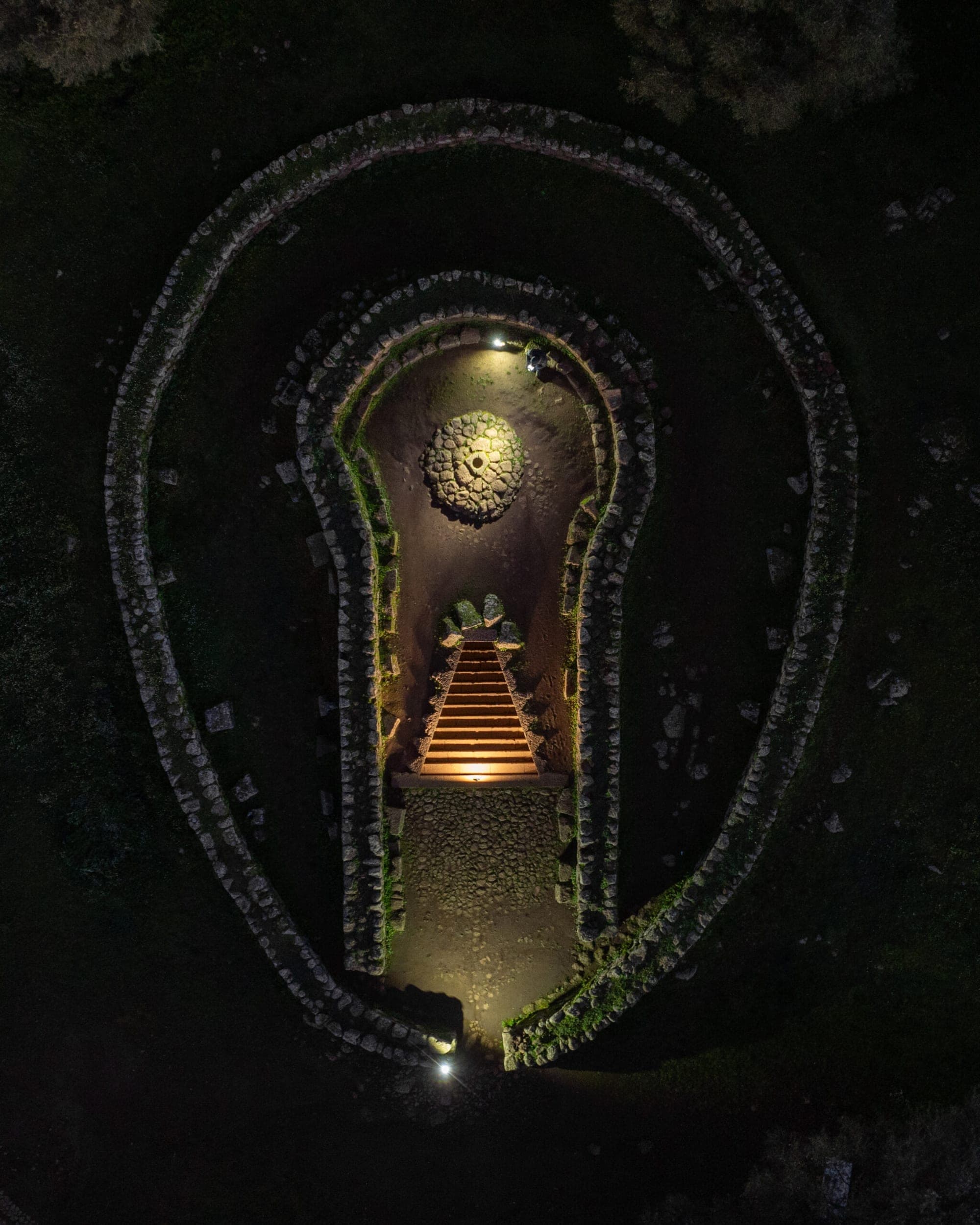
Water cults held a central place in Nuragic spiritual life, reaching their architectural peak in masterworks such as the sacred well of Santa Cristina. However, the discoveries at Nuraghe Barru reveal a distinct and previously underappreciated dimension of how prehistoric communities interacted with water sources inside residential fortresses.
When archaeologists lifted the limestone slabs that had sealed the cistern for three millennia, they discovered a pristine ritual context preserved from environmental degradation. The interior of the well did not contain layers of naturally accumulated silt, but rather a curated collection of objects and organic remains deposited during a single ceremonial event.
Among the ceramic items recovered were several askoid jugs, a delicate miniature amphora, and most notably, a rare four-handled ceremonial vessel. What made this pottery assemblage remarkable was that the vessels did not show signs of gradual wear or weathering; instead, they bore clear evidence of intentional breakage—the ritual killing of the object. This practice, widely documented across ancient Mediterranean religious contexts, rendered sacred objects unusable in the mundane world before dedicating them permanently to the realm of the divine or the ancestors.
Human Remains and Animal Sacrifices
Alongside the broken pottery, the team retrieved human osteological fragments and animal bones from the bottom of the cistern. The presence of selected human bones inside a sealed water source raises intriguing questions about Nuragic belief systems. This was not a standard burial site—such as the collective megalithic tombs known as giants' graves—but rather a selective placement of human remains, likely connected to ancestor worship or the consecration of sacred space.
The animal bones were placed in the same deliberate way, part of the offerings made before the well was closed. Once the offerings were deposited, the placement of heavy limestone slabs transformed the functional water reservoir into an inviolable sacred vault.
The Blocked Staircase and the 94-Centimetre Votive Sword
The second key focus of the 2026 study centers on the extraordinary metal assemblage found along the staircase. It was here that researchers uncovered the large bronze sword, an artifact whose exceptional size and state of preservation place it among the finest examples of late prehistoric Sardinian metallurgy.
Measuring 94 centimetres (37 inches), it is, according to coverage of the study, only the second intact votive sword ever recovered from inside a nuraghe. Its shape and its alloy—copper-rich and low in tin—show it was never meant for battle: this is a votive ceremonial sword, cast as a symbol of elite status, community authority, or religious devotion.
Results of pXRF Analyses on the Sword and Razors
To determine the precise chemical composition of the metal objects without causing damage, the research team employed non-destructive portable X-ray fluorescence (pXRF). The results revealed that the votive sword and the three accompanying razor blades were cast from a specific bronze alloy characterized by a very high copper content and low tin concentration.
The analysis of the three bronze razors yielded particularly significant historical insights. In terms of shape and decorative style, these razors closely mirror designs widespread across the Italian peninsula during the transition from the Final Bronze Age to the Early Iron Age. In traditional scholarship, such close stylistic parallels led historians to assume that these items were luxury imports brought to Sardinia by mainland traders.
The pXRF data collected by Amicone and her colleagues thoroughly overturned this assumption: the chemical signature of the copper in the Nuraghe Barru razors matches the elemental profile of Sardinian copper ores. This proves that Nuragic metalworkers were not merely importing finished goods from abroad; they were actively emulating and reinterpreting mainland Italian artistic styles while smelting local copper with exceptional technical mastery.
Beside the sword and razors lay a lump of raw copper, an unworked piece of primary metal. The inclusion of raw ore within a sacred votive deposit emphasizes the high value placed on unrefined metal as a primary resource, a token of wealth, and an ultimate offering to spiritual forces.
The Architectural Blockade of the Staircase
After placing the sword, razors, and copper ingot onto the stone steps, the community executed a final, dramatic action: they filled the stairwell with a dense packing of stone rubble and debris. This intentionally blocked the passageway, permanently cutting off access to the upper levels of the nuraghe.
The sealing of the staircase, combined with the capping of the cistern, marks the exact moment when the tower ceased to function as a dwelling or military outpost. The monument was not abandoned due to decay, warfare, or economic collapse. Instead, it was formally decommissioned and transformed into an open-air monument of collective memory for the inhabitants of Trexenta.
Petrographic Analysis: Pottery Travelling More Than 40 Kilometres
One of the most innovative contributions of the study published in Open Archaeology stems from the mineralogical and petrographic analyses performed on the ceramic vessels found inside the nuraghe. By examining thin sections of pottery under a polarizing microscope (ceramic petrography), researchers identified the specific mineral inclusions within the clay bodies, allowing them to trace the geographic origin of the raw materials.
The results yielded a major surprise: while some of the daily-use domestic pottery was crafted from local clays abundant around Guamaggiore, several high-status ceremonial vessels—including the four-handled ritual pot and key jugs from the cistern—were made from clay sources located more than 40 kilometres (25 miles) away.
This discovery significantly reshapes our understanding of Early Iron Age society in Sardinia. It proves that Nuraghe Barru was not an isolated rural site in the interior plains, but a regional sanctuary capable of attracting pilgrims, goods, and votive gifts from distant territories across the island.
A Network of Community Connections in the Early Iron Age
For decades, a conventional historical narrative posited that the end of the Bronze Age (around 1200–1100 BC) triggered a sudden collapse of Nuragic culture, leading to the abrupt abandonment of the great stone towers in favor of small, unfortified lowland villages.
The evidence from Nuraghe Barru directly contradicts this model of sudden collapse. The transition into the Early Iron Age did not mark the end of the nuraghi, but rather their profound symbolic transformation. Sardinian communities continued to visit and honor the ancient fortresses built by their ancestors, reconfiguring their interior spaces for communal gathering and ritual devotion.
The fact that ceremonial vessels crafted over 40 kilometres away were brought to Guamaggiore demonstrates the existence of organized networks of alliance, pilgrimage, and social exchange. Nuraghe Barru served as a meeting ground where groups from different valleys met to forge political pacts or celebrate shared religious beliefs through ritual feasts, ceremonial vessel breaking, and the deposition of precious bronze weaponry.
5 Key Facts Reshaping Sardinian Prehistory
To summarize the scientific breakthroughs established by the 2026 study of Nuraghe Barru, five key facts stand out:
- The sword did not plug the well: The 94-centimetre votive bronze sword was laid along the internal staircase, while the cistern was sealed separately using heavy limestone slabs.
- Nuraghi remained active in the Iron Age: Bronze Age stone fortresses were not instantly abandoned; many were converted into sacred sites and identity monuments used actively between 1200 and 800 BC.
- "Peninsular" razors were made locally: pXRF analysis proved that the Italian-style bronze razors were cast in Sardinia using local copper ores, demonstrating sophisticated local adoption of foreign artistic trends.
- Long-distance regional mobility: Petrographic analysis revealed that ceremonial pottery traveled over 40 kilometres to reach the site, pointing to wide-ranging regional pilgrimage networks.
- Deliberate ritual decommissioning: Sealing the water source and blocking the staircase were planned sacral actions designed to "retire" the monument from civil use and dedicate it to ancestral memory.
How Archaeometry Uncovers the Secrets of the Past
The investigation at Nuraghe Barru serves as a textbook example of how modern archaeological science—collectively known as archaeometry—can extract rich historical narratives from physical artifacts.
Without non-destructive portable X-ray fluorescence (pXRF), the three bronze razors might have been misidentified as simple imports from continental Italy, reinforcing an outdated image of prehistoric Sardinia as a passive recipient of foreign trade. Chemical analysis restored agency to Nuragic bronzesmiths, highlighting their ability to master complex alloys and adapt external fashions using local mineral resources.
Similarly, ceramic petrography transformed plain terracotta sherds into precise geographic indicators. Rather than relying solely on visual shape classifications, microscopic examination revealed the movement of clay, pots, and the people who carried them across the island's landscape.
These findings align with discoveries at other major prehistoric sites across Sardinia, such as the massive complex of Nuraghe Arrubiu in Orroli or the village of Su Nuraxi in Barumini. Together, they confirm that prehistoric Sardinia was a dynamic, interconnected hub fully participating in the broader cultural currents of the ancient Mediterranean world.
How to Visit Nuraghe Barru and Explore the Trexenta Region
Nuraghe Barru stands on a limestone hill between Guamaggiore and Guasila, in the heart of Trexenta. This historical region of central-southern Sardinia has been celebrated since antiquity for its rolling landscapes, fertile grain fields, and rich archaeological heritage.
The site is located approximately 4 kilometres from the village centre of Guamaggiore, occupying a hilltop position that offers sweeping views across the surrounding agricultural valleys. It is an open-air site with no ticket office or marked trails, but visitors can clearly make out the multi-towered layout of the stone fortress and, on the eastern slope, the outlines of the village huts.
Visiting Nuraghe Barru offers a chance to experience a place where two distinct eras meet: the Bronze Age architects who raised the massive stone towers, and the Early Iron Age communities who sealed their depths, entrusting a bronze sword and the vessels of a ceremony to memory and time.
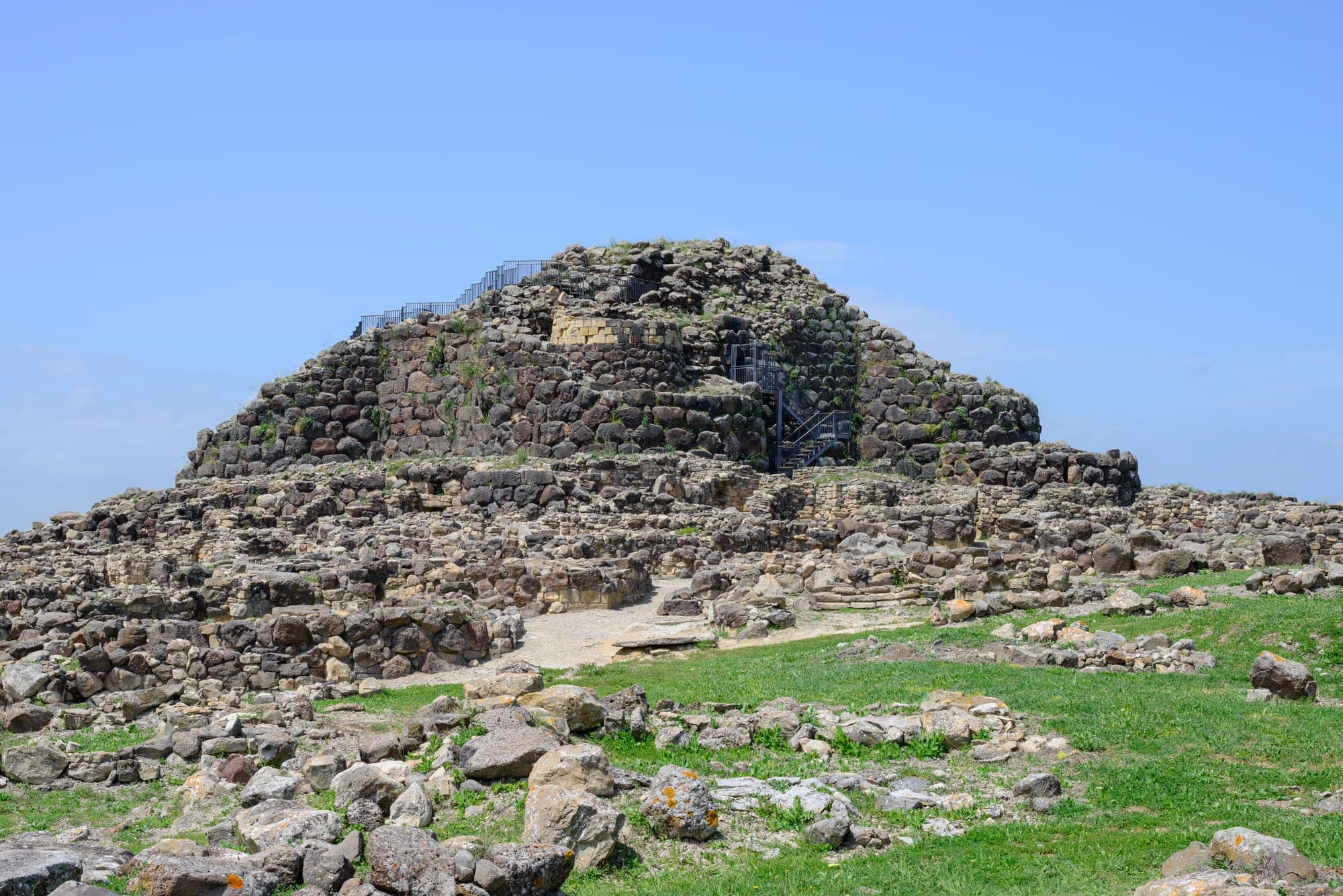
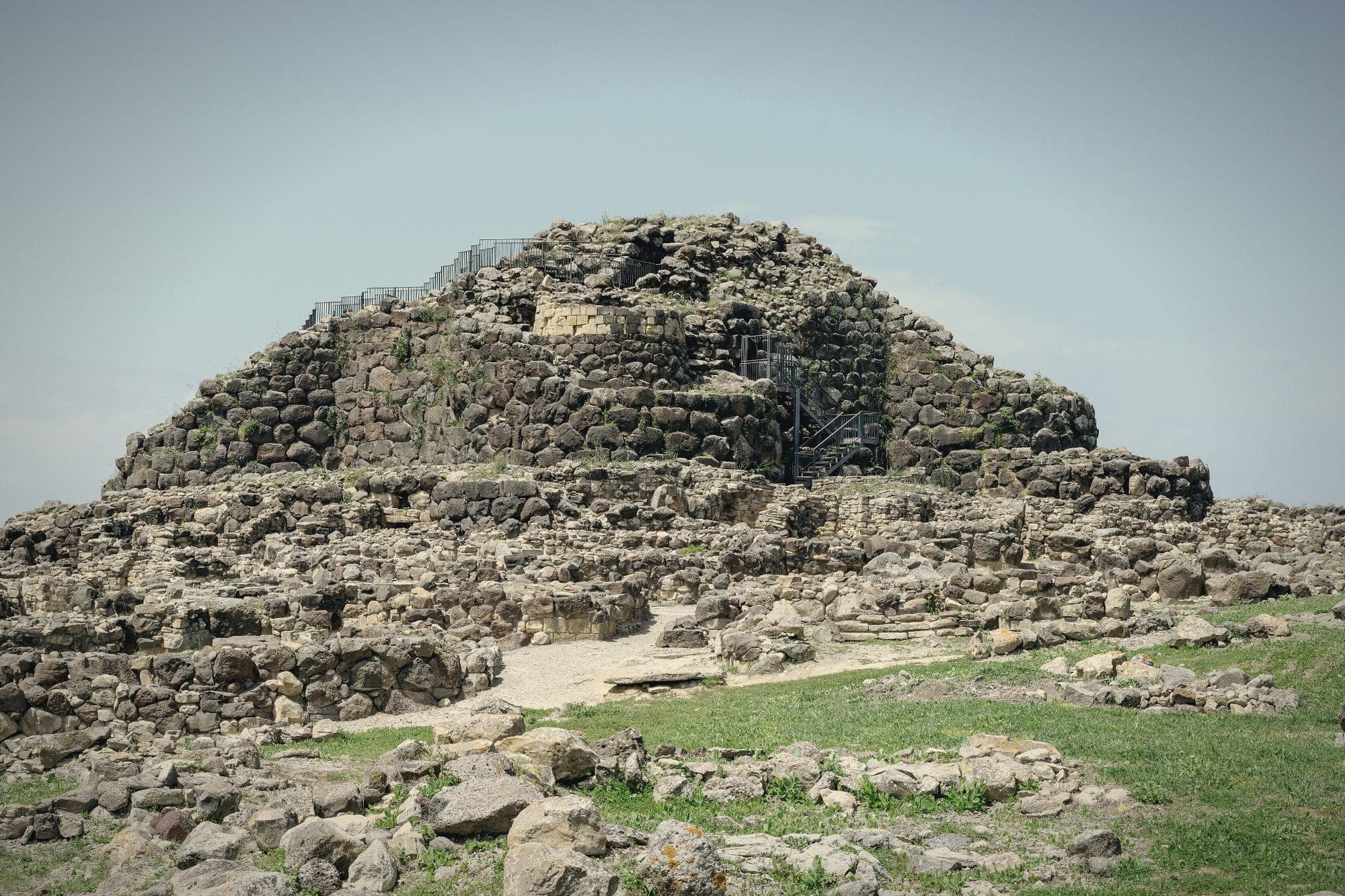
Cover photo: the nuraghe Su Nuraxi at Barumini, some 15 kilometres from Barru. Norbert Nagel, CC BY-SA 3.0, Wikimedia Commons