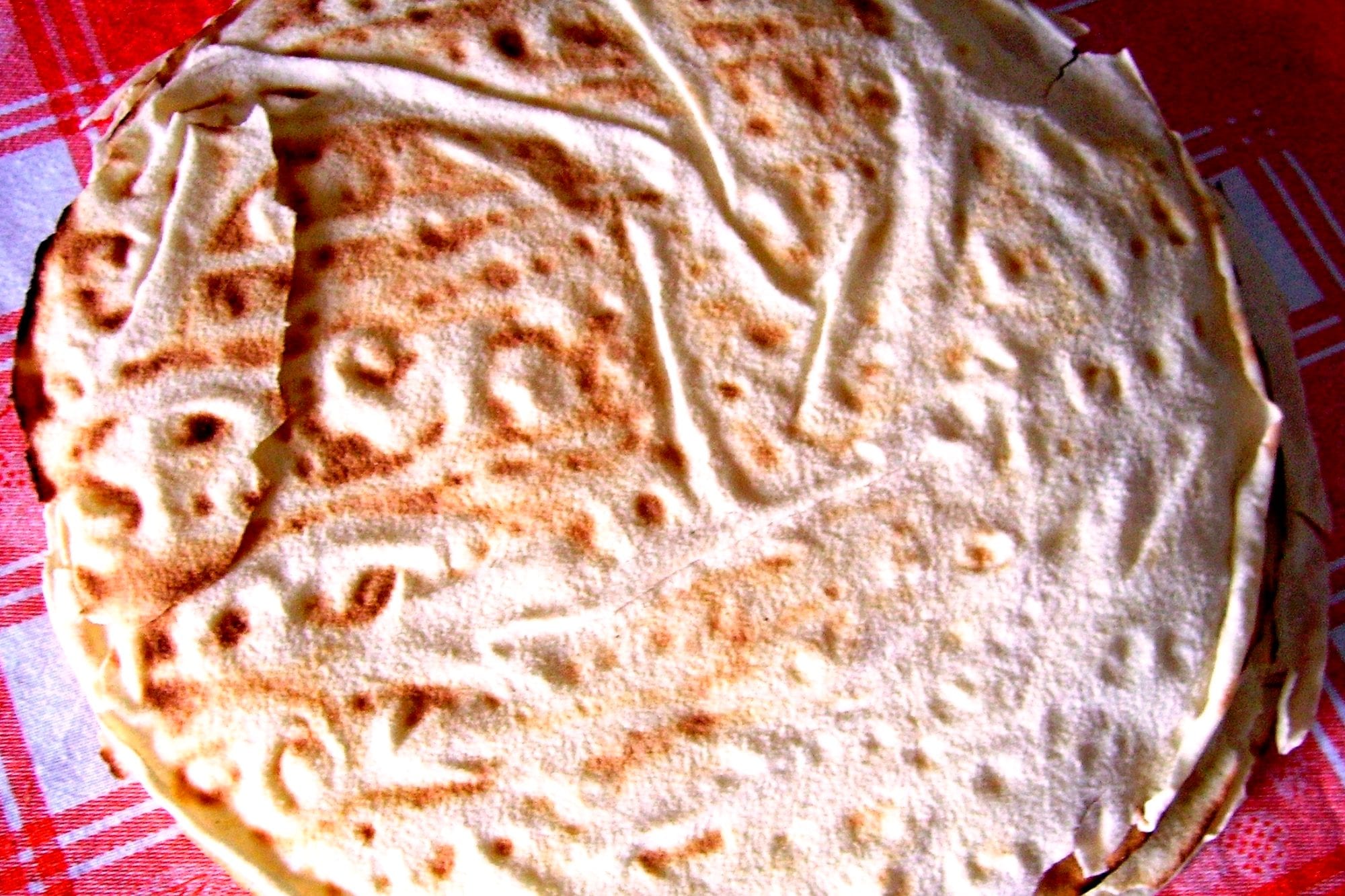
In a bakery in Fonni, a village high in Sardinia's central mountains, a disc of dough goes into an oven running at nearly 570°C. For a few seconds nothing happens. Then the surface tightens, steam pushes from the inside, and the disc inflates into a ball, like a balloon made of semolina. The baker pulls it out while it is still scorching, lays it down and opens it along the rim: the ball separates into two sheets, each as wide as the original disc and half as thick.
That is where the thinness of pane carasau comes from, and it is not a styling choice. Nobody rolls it paper-thin, nobody slices it: it splits on its own, because the violent heat forces it to. Everything the bread is — the crispness, the sound, the months of shelf life, even the name — follows from that moment.
And the story that surrounds it, the one about shepherds carrying it in a saddlebag through weeks of transhumance, deserves to be told accurately. It is true, but not quite in the way it is usually repeated.
The disc that inflates and splits
In 2023 a group of engineers from the University of Cagliari published a study in the journal Foods on carasau doughs, measured inside the working cycle of a bakery in Fonni. It is one of the very few scientific papers that describe the process with actual numbers, and it is worth following step by step.
The dough is spare: re-milled durum wheat semolina, water at 50% of the semolina's weight, salt and baker's yeast at 1.5% each. No fat, no sugar, nothing that holds moisture. It is mixed for twenty minutes, left to ferment for thirty, then sheeted into discs that proof for another forty minutes in a dedicated room. The traditional descriptions collected by the regional authorities allow a couple of hours of proofing, with the discs laid out on linen, cotton or hemp cloths.
Then the first bake, at around 570°C — the official product sheet for the regional traditional food gives a range of 450 to 550 — and the inflation. Steam forming inside the dough has no quick way out, so it separates the dough into two layers and the disc becomes a sphere. Opened while hot, it yields two sheets a few millimetres thick.
The second bake, the carasatura, is extremely short: about 400°C for roughly twenty seconds, just long enough for the sheets to take on a golden colour. As they come out they are stacked and pressed flat under a board, otherwise they curl and shatter during packing.
In the draft specification for the PGI mark (Protected Geographical Indication), this has become the non-negotiable rule: the sheet must separate in the oven, and cutting it mechanically is banned. Chemical leavening agents and soft-wheat flour are banned too. The number of passes through the oven can go up to three.
Twenty seconds against three months
Which leaves the real question: why does a sheet this thin keep for months, while a loaf of bread goes mouldy in five days?
The answer is water — specifically, the fraction of water that microorganisms can actually use. Food microbiology calls it water activity, written aw, on a scale from 0 to 1. The US Food and Drug Administration's technical guide on the subject notes that above 0.95 bacteria, yeasts and moulds all grow comfortably, and that below roughly 0.93 Clostridium botulinum can no longer start. Keep going down and you reach the threshold that matters here: below 0.60 nothing grows at all, not even xerophilic moulds, the dry-loving ones that hold on to about 0.65.
Fresh bread sits far above that line. A dry baked crispbread sits far below it: on an experimental product of that family, measured values came in around aw 0.15 with under 4% residual water. For carasau itself nobody has published a measurement — the oddest gap in this whole story, given that it is a bread sold on its keeping qualities — but that is the order of magnitude, and commercial packs generally declare up to six months.
The reason twenty seconds are enough to get there is geometric. When drying is governed by water diffusing towards the surface, the time required does not scale with thickness but with its square: halve the thickness and the sheet dries about four times faster. That is why the ballooning and the splitting are the heart of the method rather than a flourish — they halve the distance the water has to travel to escape.
The same trick cannot be applied to a loaf. At 400°C the crust would burn long before the middle lost its water, leaving bread charred outside and damp inside, which is to say still perishable. Carasau solves the problem by removing thickness instead of adding time.
The shepherds' bread, with one correction
That carasau was made to last is not in doubt. That it was the shepherds' bread needs a qualification.
The most reliable ethnographic survey of Sardinian bread-making is the volume In nome del pane ("In the name of bread"), published in 1991 by the Istituto Superiore Regionale Etnografico, the regional ethnographic institute, as the catalogue of an exhibition held in Nuoro between 13 April and 15 June of that year. In her essay on wheat and bread in daily life, Enrica Delitala distinguishes two kinds of carasau, and the difference is not shape but flour. The one made from fine semolina, pale and thin, was the bread of well-off families. Servants and shepherds — in the sheepfold, or on the long seasonal migration of flocks known as transhumance — got the versions made with cruschello, the coarser bran-rich flour, or with barley flour.
The technique, in other words, was shared; the raw material was not. Thin bread that keeps for months served people who stayed away from home for weeks, but the white sheet that now arrives at restaurant tables was, in Sardinian households a century ago, something you ate if you could afford good semolina.
The same survey places carasau in central Sardinia, in the Nuoro area and in the Barbagia highlands, and records the rectangular variant of the eastern Ogliastra region, pistoccu: a different bread built on the same logic, thicker at three or four millimetres against carasau's barely one, and meant to be moistened before eating, where carasau is eaten dry and crackles between the teeth. Pistoccu is now going through the PGI process alongside carasau.
Why the Nuragic people could not have made carasau
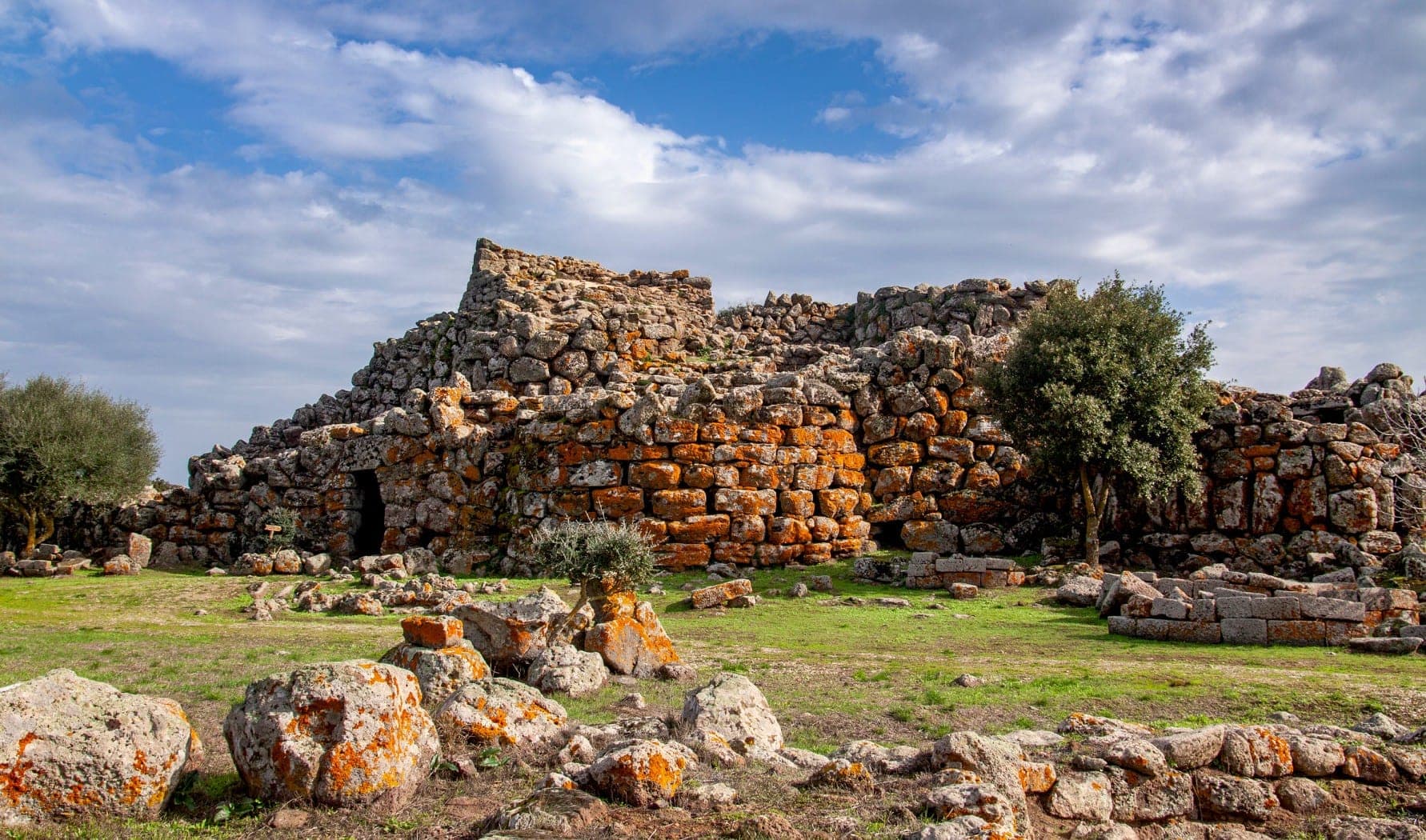
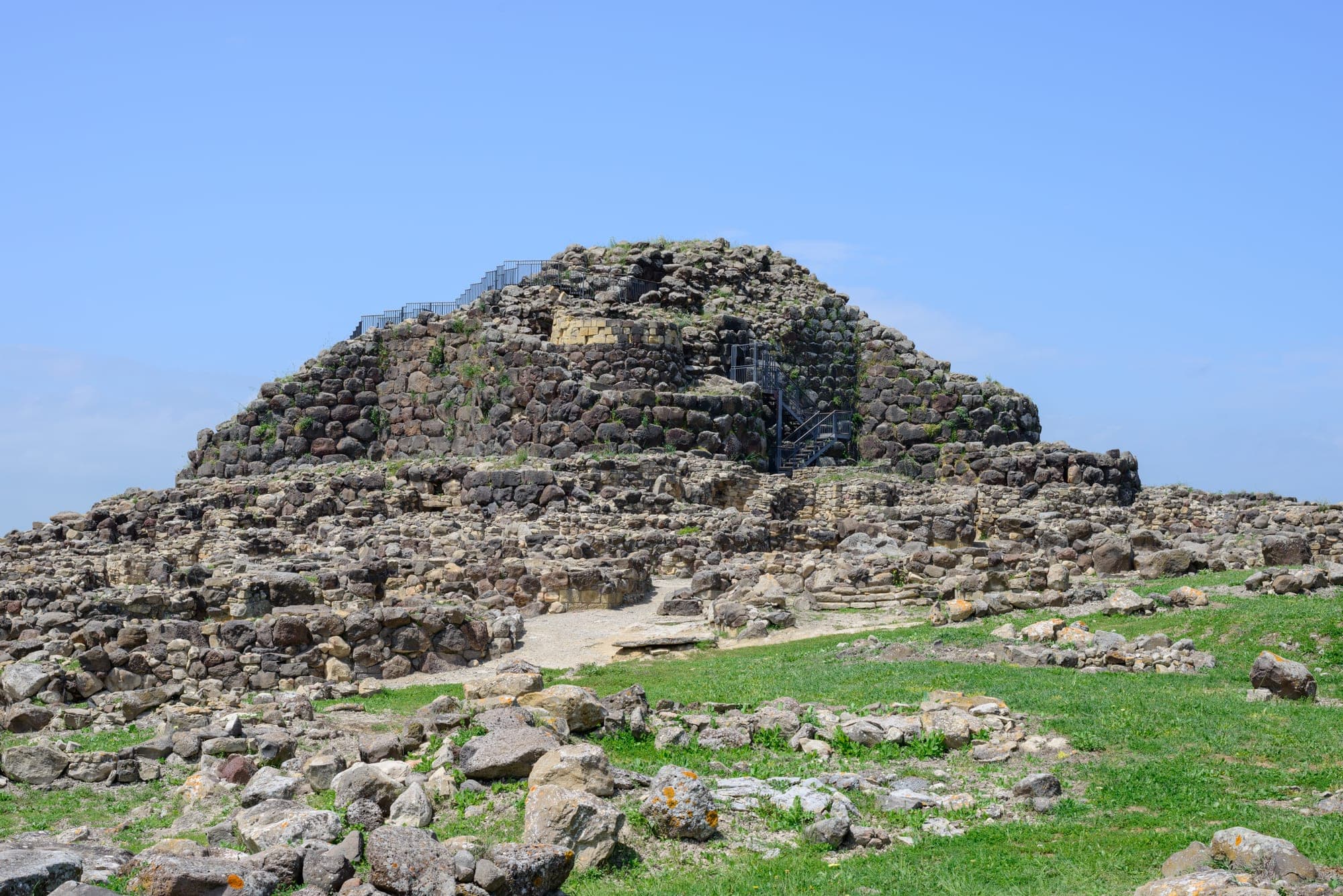
Almost every pack and a good many websites will tell you that carasau is the bread of the Nuragic people — the Bronze Age civilisation that built Sardinia's stone towers — and that it has been made for three thousand years. Sardinian archaeology says something different, and more interesting.
The oldest bread remains on the island come from two excavations. The first is the Nuraghe Arrubiu at Orroli: in a chamber of one of its secondary towers, archaeologists found the charred remains of a flatbread dated to 1300 BC, along with two red clay baking plates, dozens of grindstones, pestles and obsidian sickle blades. Read as a whole, the room was a bakery. Under the microscope the crumb shows small, regular air pockets and, crucially, no sign of leavening at all.
The second comes from a hut in the Nuragic village of Genna Maria, at Villanovaforru, and dates to the 9th–8th century BC: a piece of charred bread, unleavened or barely leavened, made with well-sifted flour. It is the oldest surviving evidence of bread-making in Sardinia.
Both are flatbreads. And an unleavened flatbread, however thin, cannot become carasau: without leavening there is no steam to balloon the disc, and without the ballooning there is no split into two sheets, which is the only way carasau comes into being. Durum wheat has been milled in Sardinia for millennia — the ovens and grindstones of the Nuragic villages show it clearly — but continuity of grain is not continuity of technique.
When the twice-baked sheet first appeared, frankly, we do not know. Home bread-making leaves almost no archaeological trace and is studied ethnographically, by watching how it was done while people still did it — and the major Sardinian survey remains the one from 1991. It is a hole in the history of carasau, and saying so is more honest than filling it with Bronze Age towers.
The name describes the cut, not the toasting
Carasau is the past participle of the Sardinian verb carasare. It is often glossed as "to toast", but its Latin ancestor, according to the linguist Massimo Arcangeli of the University of Cagliari, is charaxare, meaning to incise. The name does not describe the golden colour of the second bake: it describes the act of opening the ball in two.
The Ogliastra parallel holds here as well: pistoccu comes from Latin bis coctum, twice-cooked. Two breads from the same family, two names recording two different moments of the same process — one the cut, the other the double pass through the oven. The Sardinian language often preserves this kind of technical memory.
In Italian the bread is also called carta da musica, sheet music, a name registered as an official synonym in the regional list of traditional food products: it comes from the rustle of the sheet, which sounds like a score being turned. The anecdote about who coined the nickname circulates in ten versions and none of them has a document behind it.
In 2017, for its centenary edition, the Zanichelli dictionary admitted "pane carasau" among its Italian entries, with a definition that fits in one line: "a type of Sardinian bread in the form of a very thin, crisp disc, suitable for long storage".
The PGI that has not arrived yet
For all its fame, pane carasau holds no protected designation. The application for the "Pane Carasau di Sardegna" PGI only got moving seriously in recent years: as of March 2026 the paperwork sat with the Italian ministry, waiting for the regional government's opinion, which it has sixty days to deliver. According to Maria Antonietta Dessì, the consultant handling the dossier — the same one who steered culurgionis dumplings and sebadas pastries to PGI status — a smooth run still means a year, more realistically eighteen months.
Meanwhile the promoting committee has grown from thirteen producers to twenty-seven, together accounting for roughly 98% of output. The sorest point is the wheat: as far back as 2012 there were calls for a specification requiring Sardinian durum wheat only, but the current draft stops short of making it compulsory, because the island's own harvest would not cover demand. Producers who do use Sardinian grain say so and market it themselves.
There is also a third bake, which has become a product in its own right: guttiau is carasau put back in the oven with olive oil and salt, and its existence is the best proof that the dried sheet is a base rather than a finished object. Anything can go on top — broth, tomato, a poached egg, as in pane frattau, the dish that turns up again and again in accounts of traditional eating in the Blue Zone of the Nuoro province.
To see the part that industrial bakeries no longer show — the boards, the cloths, the moulds, the tools from the days when women baked in groups at home — the place to go is the Museo etnografico sardo in Nuoro, the institute that carried out and published that 1991 survey. And at Villanovaforru, in the small museum beside the site, there is the other end of the thread: the oldest bread on the island, a charred crumb that looks nothing like a sheet, and that comes from the same grain.
Cover photo: Shardan, CC BY-SA 3.0, Wikimedia Commons